
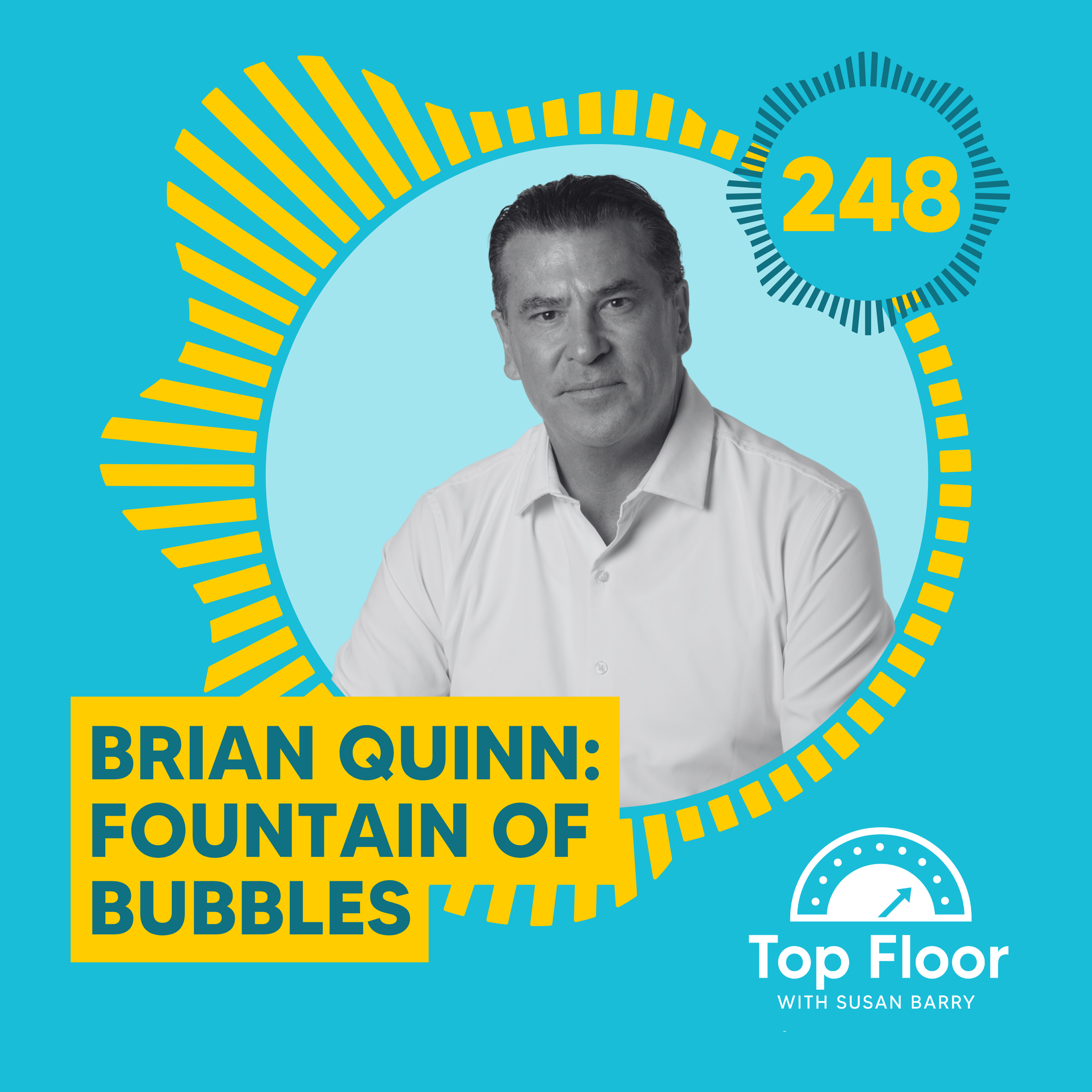
Transcript: Episode 248: Fountain of Bubbles
LISTEN TO THE EPISODE:
APPLE PODCASTS | SPOTIFY | TOPFLOOR.COM
[00:00:00] Susan Barry: This is Top Floor episode 248. You can find the show notes at topfloorpodcast.com/episode/248.
[00:00:14] Narrator: Welcome to Top Floor with Susan Barry. This weekly podcast ride up to the top floor features tangible tips and excellent stories from the experts and characters who elevate hospitality. And now your host and elevator operator, Susan Barry.
[00:00:32] Susan Barry: Welcome to the show. Brian Quinn started his career as a bellman on Long Island and worked his way through hotel operations before moving into corporate roles in development and franchising. At companies like IHG, Choice Hotels, and Synesta, he helped lead major acquisitions, oversaw nearly 800 development deals representing almost 50,000 rooms, championed hotel ownership opportunities for underrepresented groups, and played a key role in Synesta's multi-billion-dollar asset disposition strategy. That is a mouthful of a resume. Brian now serves as chief development officer for Rivet Group and My Place Hotels, where his job includes helping scale one of the fastest-growing extended stay brands in the industry. Today, we are going to talk about hotel development, but before we jump in, we need to answer the call button.
Call button rings…
The emergency call button is our hotline for hospitality professionals who have burning questions. If you would like to submit a question, you can call or text me at (850) 404-9630. Today's question was submitted by Elaine. Elaine asks, "Are you an early bird or a night owl? And do you think that has anything to do with your success?" I am so curious about this, and I have changed so dramatically in my adulthood. I just can't wait to hear what you have to say. Take it away, Brian.
[00:02:14] Brian Quinn: Yeah. I think I've lived in both worlds as well. My father was a captain in the Navy, so there was a pretty high bar about the expectation to be in places on time, be on station, and be ready to go. And in that first job, driving the hotel van and getting the flight crews to the airport, you did not wanna be the van driver/bellman that didn't get to work on time and cause the van to be late, and the plane to be late, and the crew to be late. So, for a long time, I would say that the early bird was built in by my parents. And then ultimately, that first job and the sense of responsibility I have over time, probably, like many people, as technology has changed, taken advantage of the fact that you can be watching the Knicks game and have your phone and laptop going at the same time. And people are like, "Are you really emailing during the Knicks game?" I'm like, "I'm sorry, I just thought of something." So, I have learned to use the ever-expanding group of tools to make myself productive at all times of the day. But I do need to get more sleep, though. I'll admit that. Either way.
[00:03:26] Susan Barry: Interesting. How many hours of sleep do you get?
[00:03:29] Brian Quinn: Well, I'm bad. Between four and five.
[00:03:31] Susan Barry: What? How is that possible? Actually, I think I'm probably the outlier. Okay. I was a night owl forever. Including when I worked on property in hotels, and I was always late to everything. I was a director of sales and marketing, and you just get caught up in stuff. And for whatever reason, a switch flipped for me when I started my company. I am such an early bird now, and I am pathologically punctual. I am never late. I am psychotically early, like the kind that you have to drive around the block a few times or else you look like an idiot going to the party, like 30 minutes early or whatever. But I get between eight and nine hours of sleep every single night.
[00:04:16] Brian Quinn: Oh, wow. I am jealous. I know I've gotta do better in that regard, but it's just sort of the way I'm wired. I'm working on it. I gotta get one of those Oura Rings, I think, and sort of hold myself as possible.
[00:04:27] Susan Barry: There you go. And start competing with yourself. Have a challenge. Well, early in your career, I know that you intentionally learned parts of the business that weren't in your job description. Can you talk a little bit about how you went about that, and maybe how it impacted you or shaped your career?
[00:04:47] Brian Quinn: Yeah, I think in the beginning, like all of us, it's a bit organic, right? People see something in us, and they may give us some roles and responsibilities that we weren't completely prepared for, but they have a sense that we could do it. And then you become a bit more deliberate after a few of those opportunities. So I would say, look for those opportunities. Stay aware. if you're in ops and you have gotten your experience in the rooms division in housekeeping or the front desk, and for some reason you're interacting with the sales department or food and beverage, and you make a connection with the director of sales or the food and beverage director, and they're willing to show you a little bit of how their business works, or you become sort of a champion in the other department, take it. Don't let that opportunity go by, to not lose it, to not have that experience. And so I tell people, "Look for the opportunities, and when they're there, take them." In that first bellman experience, one of my mentors, Neil Martin, was the food and beverage director. You know, classic, moved into the hotel. His family was coming a couple of months later, so he's in the hotel a lot. Back then, the bellman had a lot of downtime because we really were just driving the crews back and forth and checking in, checking out. And other than that, you were just sort of on station. So I had a lot of time around the hotel, but he just sort of grabbed me one day and said, "Hey, come down to the liquor room, come into the food storage, come into the kitchen." You know, not an area where the bellman usually hung out. And I learned about food cost and liquor cost and how those businesses worked. And then one other one I'll share on that is, working for Red Lion, you never know who you're gonna get sat next to at a dinner. I end up sitting next to the chairman of the board. That company was a public company at that point. And Mel Keating, just normal dinner chit-chat, and I was a direct report to the CEO, I guess then, but Mel and I had not had a lot of interaction. Almost 15 years later, he recruited me to be on the board of Rocky Mountain Chocolate Factory, where he is the chairman of the board. So my first public board appointment was because of that opportunity to sit next to Mel and have a meaningful conversation, and then take the responsibility to keep the relationship alive. I kept in touch with Mel, he kept in touch with me. And another incredible opportunity came in front of me.
[00:07:15] Susan Barry: While you have been involved in everything from the acquisition of InterContinental to Sonesta's asset repositioning strategy. Can you talk about navigating change at such a scale like that? What are some lessons from that? Is it different to navigate these big, huge deals versus smaller stuff?
[00:07:39] Brian Quinn: Yes. But I'll go to the first part of the question first. You do have to take the time. Where I've seen them not go well, or I've participated in some of them that have been challenges, you do have to take the time to build out your playbook. There's always gonna be unexpected things that happen when you're doing something big, right? You have to be ready for pivots. But I've rooted myself in a lot of these experiences in having a plan, double-checking that you have the right people on the team, a little Jim Collins, get on the bus type of piece. Do we have the processes in place? And ultimately perform and have people responsible for the integration steps that have to happen. Everyone gets very excited when there's a merger and acquisition or when working on a big project, and usually everyone leans in. The hotel business is sort of fraternal that way. But having that discipline of the playbook, wait a minute, was that in the plan? Did we budget for that? But we thought that person was gonna be a good resource in the integration office. Maybe not a great fit. Let's slot that person in over here and put somebody in who's used to more comfortably managing a critical path, that kind of thing. What are the processes? What's the delegation of authority look like? When are the decisions gonna be able to be made by a single executive or the subject matter experts? When is it gonna be brought to a larger group? When does it have to go to the executive committee? And then ultimately have check-ins along the way that you're performing against the plan. Now, sort of the broader part of the question. I think you have to be very transparent and constantly be building trust along the way. When you're doing something big, you're impacting large portions of the enterprise, right? If you're selling an asset, the people who are operating that hotel still have to operate the hotel during that entire experience. When you're buying a brand or launching a brand, there's a lot of work beyond the real estate and finance part that has to happen in the branding area, in the marketing area, in the tech area. And if you're not constantly reaffirming the plan, being transparent about where you are, that trust piece starts to erode. And when you're doing something big, you have to have that trust in place so you can move and meet the milestones. And then the other thing is something's always gonna happen, right? Whether it's something big like COVID, the real estate crash, or 9/11. I hope that doesn't happen. I was laughing with somebody. We used to have emergencies every 20 years in this industry, and then we have emergencies every 10 years, and now I'm like, "Is it gonna be sort of a stressor every five years?" Something unexpected is gonna happen when you're doing something big like that, and I think preparing the team for that potential step of happening, right? Like "Here's our plan, but just so you know, It may not go according to plan," and how everyone reacts when those pivots have to happen. Encouraging them, allowing them to make mistakes, being supportive is absolutely critical so they can work through those pivots and continue to work through the plan and work through that sort of unexpected, objection, or unexpected item that comes up.
[00:10:59] Susan Barry: It's interesting to hear you talk about these, like, crisis or sort of black swan events that are happening. I almost think about some of the deals that you've done as similar to that. Like, once in a lifetime deals, and you've done a big bag of them. So when you confidently say, like, "Well, you have to have your playbook," most people only encounter something like that once in a career, maybe twice in a career. How did you develop a playbook for acquiring a brand?
[00:11:31] Brian Quinn: Yeah. I think when I use the term playbook, I almost think about what the Knicks and the Spurs are going through right now, right? Those coaches started out the season with one playbook, and that playbook has evolved. And even just think, where we are with the finals. We thought it was going one way, and now we got a different result last night, so now it's gonna play out a little bit. I'm not making a prediction 'cause my prediction already got screwed up. The one thing that people sometimes miss with the playbook is that it has to be a living, breathing document. So in each of those situations, it changes. In each of those situations, sometimes you're gonna have all the talent you need on the team. Sometimes you're gonna have to acquire new talent in order to get it done. Sometimes you're educating the enterprise you're in on how to do it. Sometimes you're educating the enterprise or the one you're buying from. They haven't been through it. So being very aware and also being somewhat malleable and being willing to challenge the elements of the playbook as you're going through it is critical. But you just have to go through it, right? You can go research how other companies have done it, and what companies have done it well. And, there's a lot of content we have access to, more content than ever with AI. I encourage people to research other similar projects. But only your company's culture. Only what your talent dynamic is, how quickly you can go, and how deep the delegation of authority will be, and those kinds of things.
[00:13:15] Susan Barry: Interesting. My Place Hotels is an extended stay brand. Extended stay seems to be outperforming many other hotel segments right now. What is driving that demand? Is it temporary? Is it permanent? What do you think?
[00:13:33] Brian Quinn: I'm gonna say we're sort of in the third inning of a baseball game as it relates to extended stay. And the only reason why I say that is all the telltale signs. We had a little dip at the end of last year, but it sort of popped back up, and now the growth is pretty incredible. I think The Highland Group and CoStar came out with their April numbers, both showing a nice resurgence in a couple of interesting levers. So the supply of extended stay rooms is up. So what does that mean? In an environment where it's pretty tough to get new construction done, what deals are getting done? Extended stay deals are getting done. Well, why is that? That's because the consumer is demanding it, and developers know that this business provides a good return, so they're doing it even when there are some headwinds around interest rates and cost of inputs. Right now, I believe about one-third of all US hotels under construction are in the extended stay segment, when new construction is at a lower run-rate. So that tells you that there's incredible demand, and you only see that when those two groups are aligned, when the consumer is demanding it, and the developer is willing to do it. Why is that happening?
[00:14:49] Susan Barry: I'm glad to hear you say that because it feels to me like a recipe for oversupply. No?
[00:14:54] Brian Quinn: Our intel tells us that if there's any challenge in extended stay, it's getting more consumers to try it. When they try it, they like it. Size matters. Having the kitchen facilities matters. The extended stay service profile is hitting the consumer. Some of the best net promoter scores out there in the industry are extended stay hotel brands, right? Why is that? The guests can rest there. They have the extra space. You could have a colleague over to your room, and it's not awkward sitting at the edge of the bed. You can use your room as a place to have an interview, as an office, or as a storage component. I think a lot of this dynamic around extended stay has been building for some time. Because of the way people travel on their own, on the road, obviously, COVID accelerated it, the change in technology where work from anywhere. But there's a lot of cultural shifts too. People like to travel with their person now. People like to travel with their pet. You have new industries and new ways of thinking about old industries that have popped up. Traveling nurses, traveling doctors, traveling teachers, just sitting in the lobby of my place in Aberdeen, just sort of listening to the different stay occasions, why are people there? We have young guys and gals who are working on a data center that's being built. A woman who lost her husband was a teacher, sort of semi-retired, her kids are grown, and her spouse passed away. She decided to travel across the country teaching, right? So she needed to be able to have a hotel brand and a hotel room that could allow her to have a year's worth of all of her belongings on the road with her. Didn't wanna get completely crushed on the spend, so she could put some nickels away, and wanted to have an adventure, right? So that's something you didn't always see, a female business traveler having that aspiration. She had a life event that changed it, and technology and the types of hotels are empowering a really cool new adventure for her. In some of the secondary and tertiary cities, the need for medical professionals is incredible. So the traveling nurses, traveling doctors, and they get a premium, and they're getting an adventure. They get to sort of see the world or see the country, and they have a different set of needs in the guest room. Why do the developers like it? And, this is why I say I think we're at the third inning. If you think about the run that limited service had, maybe 20, 25 years where the brands elected to take some amenities out, make the hotels a little bit smaller, maybe trim down the F&B, limit some of the amenities, but still have the Good Housekeeping seal of approval on the asset, it made it more attractive for consumers because it was a little bit more economical. It made it more attractive for the developers because it wasn't as big a project. And they had an incredible run, right? 20, 30 years of success there. Upscale select serve, you saw the same thing. We actually added some amenities back, some F&B, a meeting space, a little sort of upscale fit and finish, and that was incredible for a long time. I think it is extended stay's time because there's a convergence of all these elements, and the operating model is the best in the business for driving margin to the bottom, right? The dollars that flow through the extended stay model because of the reduced number of touchpoints with the guest and the longer term guest around housekeeping and check-in/check-out, maintenance, and repair, make it a very attractive business for the developer/owner/operator.
[00:18:40] Susan Barry: I think I know that my place was built around a sort of specific vision of how to serve long-term travelers. And this is maybe too much inside baseball, continuing your metaphor. But for a lot of folks, extended stay is intended to be like a seven-night stay, but in the past, some of those hotels have dipped their toe into a one-night stay market when they weren't full, or whatever the case may be. So that's kinda what I'm getting at here. What makes My Place different from other extended stay options in the market? Is it just that, or is it something else?
[00:19:22] Brian Quinn: Well, My Place was given a gift, which also only happens a few times in our industry. When it was launched, they had it launched at a very specific segment, sort of mid-scale, economy plus, mid-scale. But the market ended up putting it up in upper mid-scale. And I've worked at a couple of other brands like that. There's a famous one at Starwood that was launched, which was gonna be sort of upper upscale and moved up. IHG had a boutique brand that happened in. That's great because you've sort of got wind underneath the wings unexpectedly, right? So, very quickly, they pivoted and understood, "Okay, here's where it's landing in the consumer's mind, so we've just gotta make sure we're rejiggered there to be in that upscale extended stay space."
[00:20:07] Susan Barry: When you say that, I just wanna translate this. What you mean is that people are willing to pay more than what the chain scale would typically warrant in the open market.
[00:20:18] Brian Quinn: Correct. And the type of traveler that started to patronize it was a little bit of a different psychographic and demographic guest. So that's great because in extended stay, the more you can charge per night, that rate flows through, 'cause the operating flow through is so strong in the business model. That's a lot of powerful fuel for the business. You do have to catch up on a few things around, having a recognition program as we do with stay rewards, and making sure maybe some different things in the gift shop than originally anticipated. They upgraded the bed offering to make sure that caliber of traveler was getting a good night's sleep. Little different fit and finish in the guest room, a little bit, take it up a notch. And then, as it relates to the length of stay, all of the extended stay brands are continuing to work on that algorithm, and each of them plays in a little different space. And I think one thing we have to recognize is that the United States is underhoused. So one other element that's sitting out there is that this is an alternate place for people if they have a fire in their home, if there's a family disruption, if there's a move to a new city, if there's economic pressure on the household. That does play a component in the broader industry. More in the economy space and lower mid-scale, but everywhere, it is part of the demand for this type of product. In our theory of the case, I would say that we're about 60% transient, and that doesn't mean single night, but sort of in that one to three night, one to five night component. And about 40%, we wanna see pure extended stay, so five nights, seven nights, 21, 30, the different ways people think about those gaps.
[00:22:17] Susan Barry: We like to make sure that our listeners come away from each episode of Top Floor with some really practical, specific tips to try either in their hotels, in their businesses, or in their personal lives. When you are evaluating a potential hotel deal, what are, like, the first three things that you look at? For everyone's personal lives.
[00:22:40] Brian Quinn: Yeah. I didn't know that I was gonna be imparting that kind of knowledge across the universe. But thank you for that opportunity. First is to pressure test the market. So, my initial sniff test is always supply and demand, right? There is this dynamic of what's already in the market. There's some proof of concept. What other types of hotels are there, where are they located, are there gaps in the market that aren't being served, or is it reinforcing? What are the demand generators, right? In extended stay, there are a few things that you need to look for specifically on the demand side as it relates to training centers, hospitals, universities, and reasons why people need to come to that market for a longer-term experience, right? Now, it's interesting. That can be in a lot of different places, like Aberdeen, right? We're loaded up right now at our corporate store, there in Aberdeen, with folks that are building this data center fifty or a hundred miles away. That was not in the playbook originally because that's a newer, demand reason right now.
[00:23:56] Susan Barry: And that's not permanent demand, right? Because they build them, and then they go away, or do they stay and work?
[00:24:01] Brian Quinn: Yeah. But when you manage a big system, even if the crews are moving from place to place, if we can get them inculcated into my place, we may have the opportunity to serve the same company around the country. So, supply and demand are first. Then, what is the diversity of that demand? Because you don't want it to be, to your point, if you use the data centers, you wouldn't want it to just be, "Oh, they're building five data centers within a hundred miles of this location." That will change. Now, servicing the data centers and what goes in there and how those businesses operate, there might be demand, but not that nice initial pop that comes from the construction piece. Think about the shale oil runs along the Canadian border up, down, and then, sort of moderated. So diversity in the demand generators is critical. So that you may have a data center, a hospital, a college, growing businesses, not shrinking businesses. Is there a government? Are there other reasons for long-term stays there? So, supply and demand, diversity in the demand, and then the strength of the demand generators. The reason why government, hospitals, and education are such powerful demand generators is that they pay their bills. They rarely go under, right? They have a public and a private component of how they make money in many cases. So we're always gonna need hospitals, right? So those are good demand generators that are very durable. And then the only other thing I would say about, like, pressure testing a project is if you can do it without fully loading every bit of debt you can onto it, I strongly encourage that. I think my lesson from some of these sorts of emergencies we've lived through, the real estate crash, COVID, and now the tariff thing. Not putting all your chips on red and assuming it's all gonna always work out. Look, I know there's a counterargument about the power of putting as much debt on it as you can because it does increase the return on equity. But having just a little bit more equity allows you to have a lower debt load, which just gives you some wiggle room if we get one of these sorts of unexpected emergencies, so you can weather through that better.
[00:26:25] Susan Barry: I understand the part about the unexpected emergencies. I wanna make sure I understand the debt load. Are you saying don't borrow as much as the bank will let you borrow, or are you saying set up your cap table so that you are finding equity for more than you are borrowing?
[00:26:48] Brian Quinn: I think I would work on both of those. Just like at home, you should have a safety fund or an emergency fund, or make sure that your prepaid cards and your exchange account and all those things are sort of set up in advance, so you're not playing it so close. Once you're in operations, have a cushion. So that should be part of your cap stack, your budget, and your projections. But I am saying if your model can allow you to borrow a bit less so that your obligation to that debt is a little bit less, that will help you weather some of these unexpected things that seem to be happening with a bit more frequency. It's just that if you take the maximum amount out and it works out, I concede that you will provide a greater return, but I like a little bit of insurance nowadays.
[00:27:52] Susan Barry: Yeah, I feel like that's really good advice, and it's helpful to make that connection between the sort of black swan event and why to do this, not just be conservative with money, but be conservative because crazy stuff keeps happening. What do you think your operational background gives you as an advantage as a development executive? Like, do you have specific skills, or is it just that you can speak the language? Tell me everything.
[00:28:24] Brian Quinn: You absolutely get credibility with prospective franchisees, developers, investors, the financial components of a hotel development when they recognize you understand how a hotel works, and that you've worked in a hotel or maybe you've built one, maybe you've renovated one, rebranded one. Because it puts you in their situation, right? It puts you in their shoes, and it just starts you on that sort of bonding and rapport with them that there's a common language, common shorthand, and a frank understanding of it. Some hotel experience and experience with sports are sort of like my two elements for sort of development executives when you're selling management contracts or franchises, just because teamwork is critical. You know, having a big goal, working together, and being a self-starter. But having a little bit of hotel chops helps, just because you accelerate through that sort of bonding and rapport piece. And then also, it just makes you a better hotel executive. Look, there are smart people in our industry who did not start out in ops, and that's fine. I think it is an accelerator for the folks who have that background. I tell people all the time, if you think that's what you're interested in while you're in high school, while you're in college, go get a part-time job there to understand the service industry and understand the nuts and bolts of the business, and it'll just help you so much as you move through a career in hospitality.
[00:30:02] Susan Barry: It's for sure a trust accelerator. The hotel business is an apprenticeship business. We do not trust outsiders. I mean, how many GMs have you heard talk about, like, "This asset manager worked at Goldman Sachs. She doesn't know anything about running a hotel"? You know what I mean? It makes a huge difference.
[00:30:20] Brian Quinn: And all of our acronyms, too. Like, how would you ever, ever get through it if you couldn't understand the acronyms?
[00:30:27] Susan Barry: Yeah. You just picture these finance guys, like, flipping flashcards, like rev par, rev par, rev par.
[00:30:32] Brian Quinn: Yeah, what does rev par mean? Oh my gosh.
[00:30:35] Susan Barry: Hospitality is a relationship business. I mean, it's so obvious. I feel embarrassed even saying that out loud. But I wonder if you have advice for building the kind of professional network that you need to create the career opportunities you've had over time.
[00:30:52] Brian Quinn: Yeah. I'm gonna quote one of my mentors, who unfortunately, recently passed away, Kirk Kinsel. He had two for us that reminded us a lot. One is to make deposits before you make withdrawals. And look, we're all on this journey. It's a high-touch journey, a human high-touch component with a lot of different parts. There are always ways you can help a colleague, help a competitor, help somebody in another part of your enterprise, or another enterprise. I think what's neat about our business, too, is that we do really genuinely want each other to succeed. We're fiercely competitive from 9:00 to 5:00, and then everyone's in the same lobby bar or coffee shop after talking about it. So I think we become curious about making deposits in others so that someday if you need to say, "Hey, I need a great person in the Northeast," you've built up an army of people that will give you referrals of somebody that may live in the Northeast, as an example. And then sort of working the T, recognizing that it's not just the vertical relationships that are important, who you are responsible for and the people that are responsible to you, but to work horizontally? So, in development, I've been very lucky to work with some incredible branders that you know, what are trying to get done? What's on their agenda? What are their key priorities for the year? What's the playbook they're working through, and how can I help them as the lead development executive or their partner on the ELT? Because there will be a time when I'm gonna need their assistance, and it shouldn't be a quid pro quo. It's just that, as a member of the executive committee, you're responsible for the entire enterprise, even though you may have your own vertical. But I think managing up and managing down is a critical success factor for every executive, but go horizontal as well. And then also reach out for maybe the person that doesn't have the hotel background or doesn't have all the deep relationships, right? Work for another incredible executive, Steve Porter, who would always find the quietest person in the room or the people who go to the bar all the way in the back during a wedding, not the bar that you see right when you come in. They go, "Go to the back bar. See who's back there. There are usually some interesting people back there that maybe don't know how to work the room as well, or don't know everybody in the room. Help them."
[00:33:26] Susan Barry: That reminds me of when I was a little girl, my job at my parents' parties was always to look for the person who didn't have someone to talk to and go talk to them. The best training for my career I could ever possibly have. It has made me relentlessly nosy, as you may have noticed, but that's cool.
[00:33:44] Brian Quinn: And it's interesting how your career has evolved into questioning people professionally too, so thanks, Mom and Dad.
[00:33:52] Susan Barry: Yes, exactly. We have reached the fortune-telling portion of our show, so you have to predict the future, and then we'll call you out if you get it wrong. Just kidding. What is a prediction that you have about the future of extended stay hospitality?
[00:34:05] Brian Quinn: I'm gonna go back to what I started with. I think we're just in the third inning. I think that there's an incredible runway here because you have the common element that creates these big runs in segmentation. When the consumer is demanding it and the developer can make great returns delivering it, what happens? You end up with happy employees and happy guests. And if you go back to Ron Rivet and Kemmons Wilson and Mr. Marriott. Those are the constituents we need to take care of, right? If you're taking care of your guests and you're taking care of your employees, everything else will take care of itself. The extended stay business model, because it has the twin demand of the developers and the consumers right now, I think, has a ton of runway. As something sort of unexpected or kind of an interesting wrinkle that could happen, I think somebody may figure out how to do upper upscale extended stay in the, I'm not gonna say short-term, but in the medium term. It comes with some nuances, but you've seen a sort of all-inclusive start to come on shore. You've seen all-inclusive go upscale. I think that at some point, one of my friendly competitors or somebody may work on something in the upper upscale segment around extended stay.
[00:35:29] Susan Barry: If you could wave a magic wand and change one thing about hotel development, what would it be?
[00:35:35] Brian Quinn: Oh, gosh. Stability around tariffs and lower interest rates. That would change my life tomorrow.
[00:35:41] Susan Barry: Got it. So just a handful of small changes to the economy and world. No big deal.
[00:35:48] Brian Quinn: Please, please pull those two levers. It would make everything much easier.
[00:35:53] Susan Barry: Easily done. All right, I have a bonus question for you. Okay. What do you think is one hospitality trend that everyone's talking about at all the conferences that you think is over-hyped?
[00:36:05] Brian Quinn: I think one thing we need to be careful of, I believe in the K economy. I think it is real. I think one leg of the K is holding up extended stay and providing all the demand for extended stay. And the lifestyle, luxury, and upper upscale experiential K is real as well. There are a lot more by the numbers of travelers on the lower portion of the K than there are on the upper portion of the K. And I'm just a little anxious. I've played in that segment in multiple roles in the upper upscale and lifestyle luxury space in the past. I'm anxious about whether there are enough travelers for all the offerings in that top tier. I understand the economics of the top tier, and I understand how much they're holding up the industry and the economy, and I believe that sort of 10 million and above households are critical. But how many fourth houses and fifth houses and sixth houses? What is the real capacity, because the numbers are not as big there? So I hope we don't over-build in that segment or get too far over our skis 'cause I don't want any of my friendly competitors or clients that we share to get hurt. So I'm just a little anxious at that top tier.
[00:37:24] Susan Barry: That's something that I've been thinking about, too. I think you articulated it much more clearly than I ever have, but I 100% agree with you. What about something that's under-hyped? Is there something that people are underestimating right now?
[00:37:37] Brian Quinn: I think the industry, and we're doing it, we're telling stories, you're letting me share my story. Some of your competitors are keen on telling stories. I think we've got to get back to talking to students, college students, high school students, people who are looking to make a career change, and have them fully understand how special this industry is. I still think it's incredible, my story, everyone's story in our industry, almost everyone, that you can really start out as a bellman and end up buying and building hotels, right? Or a night auditor, or a dishwasher, and all of that. There are just not too many industries left where that exists, right? We've still got a challenge around attracting people to the industry. Some of it was self-inflicted, prior to the most recent emergencies or two. But it is an incredible business where your competitors are trying to help you to a certain extent, great people, upward mobility, all kinds of opportunities. You get to see the world.
[00:38:44] Susan Barry: It's the American dream.
[00:38:46] Brian Quinn: I just think we've got to get out there and keep telling the stories. But getting people on that pathway into hospitality, because they're gonna have a blast, and really, their economics are really up to them. It's whatever ceiling they put on themselves because it's a lot of fun, it's incredibly rewarding, and the economics can be great, too, depending on which part of the business you get into.
[00:39:11] Susan Barry: That's true. There's another part of that career path thing that I think about all the time, I don't think I ever say it because we're like, "Yeah, of course you wanna be CEO when you start as a bellman." But something else that's beautiful about hospitality is that it can be a job that you do just for the money, so that you can go home and play guitar. Or paint, or whatever the thing is that is your passion, but you've got to pay the light bill. Great industry for that, too.
[00:39:41] Brian Quinn: And also, you asked whether I’m an early morning person or a night owl. It's one of the few industries that is an operating business 24/7. So if you've ever met a night auditor, they're a special breed. But there are people that that's the way their life is wired. What if your person is a policeman, or a policewoman, or an emergency room doctor, and you need the odd hours to manage the kids, or manage the house, or manage your parents, or something?
[00:40:07] Susan Barry: Okay, folks, before we tell Brian goodbye, we are going to head down to the loading dock where all of the best stories get told.
Elevator voice announces, “Going down.”
[00:40:20] Susan Barry: Brian, what is a story you would only tell me on the loading dock?
[00:40:24] Brian Quinn: I'm 16, 17, working as a bellman, and sometimes when you're learning how to sort of behave in a job with the public-facing and learning the rules of the road and when to stay inside the lines and when to color outside the lines. I was a little frustrated with the management's decision that they made with a few of my friends who would work at the front desk. Try to keep this story inside the lines, if you will. But my frustration came to life in maybe pouring some dish soap with a few other colleagues into a fountain in front of that hotel. And it worked a little better than we thought, and the bubbles caused the hotel to not be able to check people in and shut down the porte cochere, and maybe even made it into the lobby. So, I was asked to leave for 24-48 hours, and then I was asked to come back if I promised never to do that again.
[00:41:29] Susan Barry: Oh my gosh, I can't believe they let you come back. You must've been a really good bellman.
[00:41:34] Brian Quinn: Many, many lessons. It was a wonderful family that I worked for that I'm still friendly with, and they really helped set me off on my career. And so thankful that they allowed me to have my sort of childhood silliness and make a mistake and continue on. But I often think today, if I were the general manager or an RVP or something, how I would react to that. And the last thing was that the gentleman I worked for, David Cowan, was such a prince. He said he thought it was one of the funniest things he'd ever seen. I'm glad he saw the humor in it.
[00:42:10] Susan Barry: Brian Quinn, thank you so much for being here. I loved our conversation. And I really appreciate you riding with me to the top floor.
[00:42:17] Brian Quinn: All right. It was great, and I appreciate the dialogue and the questions. And everybody, have a great summer and travel safe.
[00:42:25] Susan Barry: Thank you for listening. You can find the show notes at topfloorpodcast.com/episode/248. Jonathan Albano is our editor, producer, and all-around genius. He even wrote and performed our theme song with vocals by Cameron Albano. You can subscribe to Top Floor on Apple Podcasts, Spotify, or wherever you like to listen, and your rating or review will go a long way in helping us give you more of what you like.
[00:43:01] Narrator: Thanks for listening to the Top Floor podcast at www.topfloorpodcast.com. Have a hospitality marketing question? Reach us at 850-404-9630 to be featured in a future episode.