
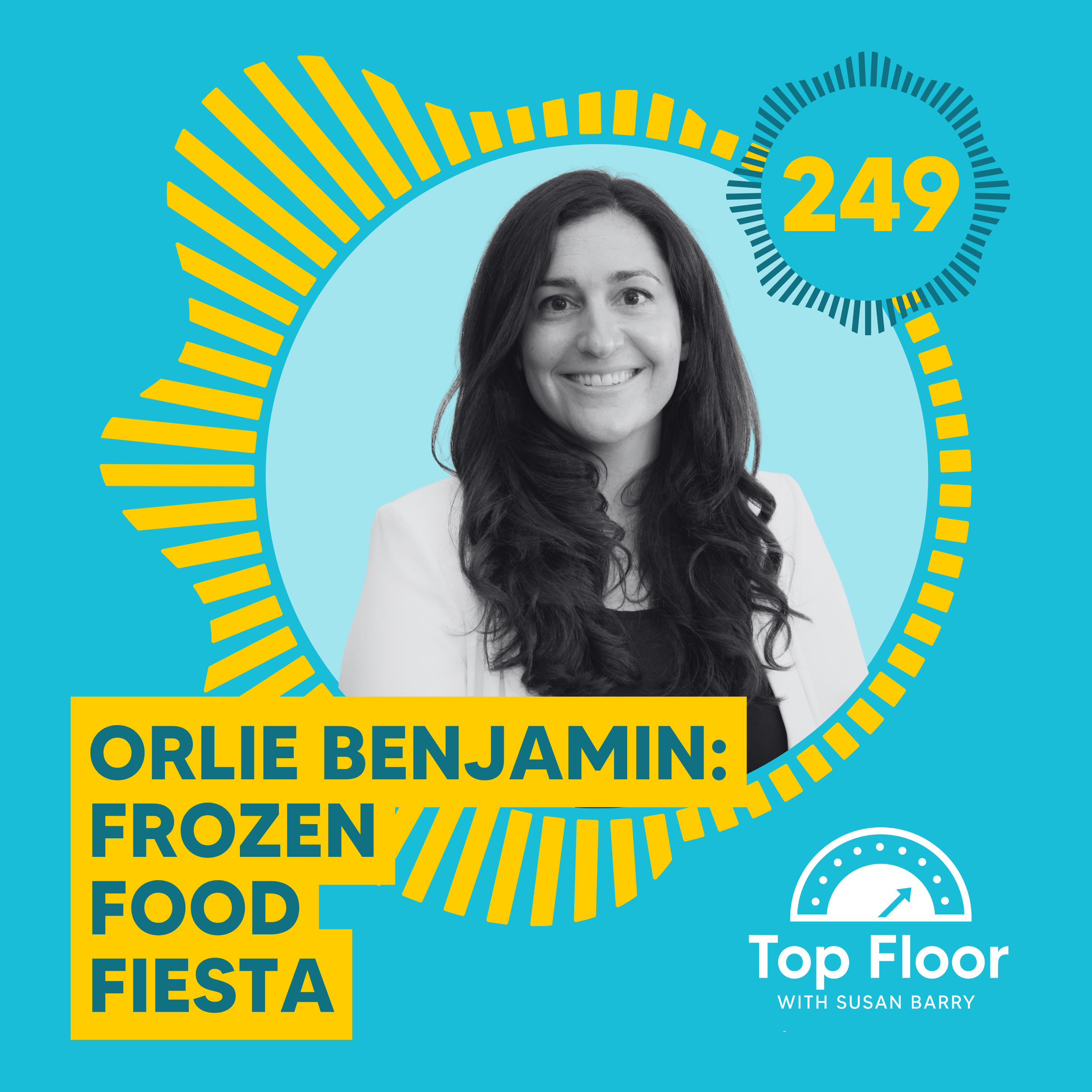
Transcript: Episode 249: Frozen Food Fiesta
LISTEN TO THE EPISODE:
APPLE PODCASTS | SPOTIFY | TOPFLOOR.COM
[00:00:00] Narrator: This is Top Floor episode 249. You can find the show notes at topfloorpodcast.com/episode/249.
[00:00:14] Narrator: Welcome to Top Floor with Susan Barry. This weekly podcast ride up to the top floor features tangible tips and excellent stories from the experts and characters who elevate hospitality. And now, your host and elevator operator, Susan Barry.
[00:00:32] Susan Barry: Welcome to the show. Orlie Benjamin is the founder and CEO of Lasoh, a hospitality technology startup that helps vacation rental and boutique lodging operators market to their guests. Before becoming an entrepreneur, she built her career in marketing, pricing strategy, and guest experience with brands like American Airlines, NetJets, Disney, and Victoria's Secret. Drawing from her experience in Fortune 500 companies, startups, and vacation rental ownership, Orlie is rethinking how hospitality businesses manage guest relationships by combining guest experience, marketing automation, and AI-powered tools into a single platform. Today, we are going to talk about the convergence of hotels and vacation rentals and the future of hospitality technology. But before we jump in, we need to answer the call button.
Call button rings…
The emergency call button is our hotline for hospitality professionals who have burning questions. If you would like to submit a question, you can call or text me at (850) 404-9630. Today's question was submitted by Ralph. This is such an interesting question. Ralph asks, "Is it still possible to make a profit with one or two short-term rental units, or has that ship sailed?" I think people are starting to get the sense that ever since private equity and the sort of professionalization of property management, that maybe the onesies and twosies aren't worth it anymore. What do you think?
[00:02:20] Orlie Benjamin: Well, as an owner/operator of only one unit, I absolutely think it's possible to make a profit, but I don't think all units are equal, and I don't think all business models are equal. So possible? Absolutely. I also know that I designed and built mine, and it was very intentional. And so I think your business model is as good as your business strategy and your product and your experience. And so I think there are a lot of variables to consider. But absolutely, it's possible, but I'm sure it's harder. It's not even just harder because of private equity rolling things up. The pricing model has shifted around distribution channels, and there are a lot of changes that are happening right now to the overall environment.
[00:03:04] Orlie Benjamin: Those are really squeezing the profit margin. So it's definitely not as easy as it used to be, but it's still a business model, for sure.
[00:03:11] Susan Barry: So you said that you've got a single unit. What made that happen? What inspired you to leave the corporate world and try to build a vacation rental business from the ground up?
[00:03:23] Orlie Benjamin: So I followed the path my parents told me to follow for the most part, which was to go to law school or be a doctor or lawyer. And I did all these things I was supposed to do, and then I started listening to myself. And when I started listening to myself and learning about myself, I recognized that being in corporate environments where I didn't have the freedom to operate based on the dreams that I had wasn't really fulfilling me. And so because of that, I decided to create an exit plan, and that exit plan was buying land and building a vacation rental business. When I did that, I was very excited. I loved the whole process. I loved the dreaming process. I loved the design of the property process, and then I also loved operationalizing the business process. And that's how I got into dreaming up Lasoh because I looked around the industry and thought to myself, "Wow, there's a lot of opportunity based on the early stage of the tech environment and the fact that there's things missing relative to how I've seen it work in Fortune 500 companies. I actually have a real business opportunity here." And I think the combination of being willing to take a bet on myself because I had worked long enough and had enough confidence in myself to build that. But also, I spent some time working in corporate venture capital for Scott's Miracle-Gro, and was also the head of marketing for a Silicon Valley-based startup. Those two things actually exposed me to the idea that I could actually be a part of building something. Because you only spend your whole life working in an environment where you're part of a machine, you don't really realize that you could actually build your own machine. So, I think the combination of being exposed to building a machine and then really learning to listen to myself. Those two things are really how it all started.
[00:05:11] Susan Barry: It's interesting because a year before I started my company, I was having lunch with this woman, and she just very offhandedly said, "Oh, you'll probably start a business one day." And I swear to you, I had never thought of that before that very moment. It was almost like she gave me permission and unlocked the door, and I was like, "Oh, I guess I can."
And here we are, 17, 18 years later, and I actually did it. How far along were you with your vacation rental business when you realized that the technology that was available to you was not cutting it? Was it before you started, or had you kind of gotten down the road and thought, "Oh, there should be a better tool for this"?
[00:05:56] Orlie Benjamin: It was really early. I mean, while the house was being built, I was already doing deep research on all of the technology, and I was setting up the infrastructure so that by the time the house was ready to go. I was already pre-selling. I was pre-selling stays before the house even opened, right? Because you can set up your technology, and you can future sell. Future selling involves marketing. And so it was actually one of the first things I started to do. Even before the place was ready to be slept in, I was already starting my marketing journey, and that's when I realized that there was a gap. But before I really ever committed to doing anything about it, I actually attended several conferences, because just 'cause I didn't find something on the internet didn't mean it didn't exist. And I went into some deep dive research. I probably messaged over 800 people on Facebook groups.
[00:06:52] Susan Barry: Good lord.
[00:06:52] Orlie Benjamin: Literally. Yeah, did like thorough market research. Not saying, "Is this a good idea?" But, like, asking a variety of questions around where you have pain points, what do you wish could be different? Really, like, customer research and discovery. And I spent about a year and a half building towards being ready to start the software business, 'cause first I was operationalizing the vacation rental business. Second, I was employed, and I had to be kind of at a point where I was like, "Okay, I'm leaving a W-2 environment to go take a bet on myself, and also I need to go learn some things about being a startup founder before I leave a reliable employment opportunity and have another side hustle," you know? So I needed to really prepare myself for that.
[00:07:41] Susan Barry: Gotcha. Do you think that what you're doing now has been more influenced by your vacation rental business or by your corporate career?
[00:07:52] Orlie Benjamin: Ooh, that's a really good question. I'd say they're kind of 50/50. I'll say 60% corporate, 40% vacation rental, mostly because I'm coming from this history of working in these publicly traded companies. But also, I've immersed myself for the last three years in this industry, going to conferences, eating, breathing, and thinking only this. And I can tell you I'm working like 80 hours a week. So, I think that those three years are probably, like, six years in normal working time. So, I think it's close to 50/50.
[00:08:31] Susan Barry: Tell me about the difference between managing property, managing an asset, and managing guests. I think I know that you make a distinction here, and I'm curious about what that is and why it matters.
[00:08:46] Orlie Benjamin: So, how I think about this is actually very much related to my time at NetJets. We had a team in the company called Asset Management, and their job was to manage NetJets owns the private jets. For anyone who doesn't know, NetJets is a private jet fractional ownership model. So, it's owned by Berkshire Hathaway. It's kinda like Uber if the Uber driver and the car were owned by Uber, and you had to have $5 million to get in.
[00:09:16] Susan Barry: So, NetJets is what I think taught everyone the word fractional.
[00:09:19] Orlie Benjamin: Yeah, it was the original fractional ownership model before timeshares. It's over 60 years old as a business. So what I learned there is that there was a group called Asset Management, and I was part of a group called Guest Experience. And by the way, there was another group called Marketing, and Guest Experience was actually the bridge between Asset Management and Marketing. Because on the marketing side, you have a sales component of, like, how do you really know how to sell the product? But once you sell the product, because the product is an experience, the experience is almost like retention marketing. How do you keep someone who spent $5 million on a jet share so happy that they stay? And so, there's an acquisition side, and there's a retention side, and then the asset management side was really only focused on the aircraft. What do the seats look like? What is the product strategy of the plane? How many big ones? How many small ones? What are the amenities? Which is really, really similar to property management, which is the asset of the property. But the property is an asset within an experience, and the product actually is the experience. And so, the combination of guest experience and asset management is what people were buying into. So, that's what made me completely frame the thinking for this industry because I think it's the same.
[00:10:40] Susan Barry: Your software combines guest experience tools with marketing automation. Why have those traditionally been separated or lived in separate systems? And what do you think is missed when they are separated?
[00:10:56] Orlie Benjamin: I think every company I've worked in usually has a marketing team and an operations team that's some sort of customer touchpoint, and usually that customer experience or that guest experience team is responding and reacting to the customer as part of their engagement with the brand, whereas the marketing team is usually driving behavior and doing sort of from a distance communication. I think that great experiences make marketing easy. And so if the guest experience, which by the way, the product is the experience, not just the asset, if the experience is incredible, marketing has the easiest job because if somebody falls in love with something, it's so easy to resell it. And it's so easy to sell it again to someone new because of the social proof and the loyalty that you build. And so I think a disconnect that exists in a lot of business models is not having that touchpoint between the people in charge of ensuring that the customer is happy throughout their journey with the brand, and then creating that into brand loyalty. And so for me, that's part of why the software is designed this way, and it's again, something I learned at NetJets, right? NetJets has a 85% customer retention rate. That's pretty crazy. So, the CEO was always used to say, 'cause it was not publicly traded, he always used to say, "If we had a stock ticker, it would be our net promoter score." Because the satisfaction of the customer is absolutely indicative of how the company will perform, because guess what? There are only so many billionaires out there and many digit millionaires. And so you have to work really hard to acquire one of those customers, and you have to keep them because it's a recurring revenue stream.
[00:12:50] Susan Barry: Well, there's not, like, an infinite pool that you can fish in. And say, "Oh, well, we'll just replace." There's a finite number of those folks. I think that we have talked about this before, but the period between when a guest is booking and when they arrive has significance. Can you talk about that and how your software plays into that period of time?
[00:13:15] Orlie Benjamin: We'll have to find the link after this call, but I read somewhere that 50% of the joy of a vacation comes in anticipating it. And so when you think about a great experience making for great marketing, if you cut 50% of the joy coming from the point of booking to before arrival, that is a serious untapped opportunity. Because if you can get people excited and create goodwill before they ever even show up, you're getting half of the experience already figured out before they even get a door code. So for me, that's part of why it's a very underserved part of the journey, because most operators think really, really in depth about the point of arrival to the point of departure, but that's only half the journey. And so if the other half can be combined, it's a pretty unstoppable combination.
[00:14:08] Susan Barry: What are some things that you communicate to guests between booking and arrival?
[00:14:14] Orlie Benjamin: I think it's about communicating the right thing and also communicating it to them at the right time. I think great hospitality anticipates needs. So some of the things that we do are we communicate some items that are built by the operator in our guest portal, such as local recommendations of things to do. We have a whole recommendations section that is called Our Favorites, and that recommendation section is built like an e-commerce page, which means you can filter, you can sort, and you can engage. It's not just like a wall of text. It's literally looks like a whole bunch of Google pages, and then under each one of those, like a whole bunch of little, almost like a product page. Like, if you were shopping for clothing on a website, it looks like a whole bunch of recommendations, but it's sortable like a website. And in each one of those recommendations, we actually have a note from the operator or the host, and that gives some level of stay like a local because we have found that in some of the research we've done that guests really, really value local recommendations. Anyone can go to Google, anyone can go to Yelp, and also, people don't wanna feel like they're bothering the operator and asking for this whole curated itinerary. But if it's serviced to them and given to them without being asked, and they're able to really plan before they arrive, they're able to make the most out of their time because vacation is really about buying time to make memories. And if you can use your time before you get there so that you're really maximizing your vacation time without having to deal with any of the inconveniences, you get more, you get more outputs from that trip. So that one is probably the most important one that we've noticed. We also have a concierge-generated trip itinerary, and it actually uses all those recommendations, but it's highly personalized to the person based on the inputs that they provide. And the reason why that's exciting is that you can only provide as good a stay as the context you have about the guest. And the more you know about why they're coming, the more you know about who they are, and you can take action on it. Also, another way to level up. In fact, I think one of the ways that a lot of operators fall down is if they have information about the guest and they do nothing with it, it's almost worse than if they knew nothing. 'Cause if at least they knew nothing, it's kind of permissible. But now, like, if someone knows that they're coming for an anniversary or for some sort of special occasion, it doesn't mean you have to physically bring them a cake, but acknowledging it and addressing it, and so much of this is emotional, kind of just seeing them, it goes a really, really long way.
[00:17:02] Susan Barry: We like to make sure that our listeners come away from every single episode of Top Floor with some practical, tangible tips to try either in their businesses or in their day-to-day lives. You talked about underutilized data. What guest data besides, like, I don't know, date of birth and phone number, do you think that operators already have that they aren't taking advantage of?
[00:17:32] Orlie Benjamin: I think ZIP code is a really good one. Knowing if someone is a drive to versus a fly to can really change the way you communicate with them, especially if you have last-minute getaway opportunities. Because if somebody is within driving distance, and/or you think enough about them that they might be willing to get on a plane, you wanna send a message to someone that is meaningful to them. And so I think thinking about their proximity to the location is an important one. Let's think about it. I also think there's probably some behavioral information that can be extrapolated from the scenario, whether they come during weekdays or weekends. Okay, well, you could re-market to them around workcations versus weekend getaways versus multi-generational family get-togethers if you have a little bit of context. I think there are so many layers to this because it's like, how much context do they have, and what can they unlock. I think a lot of operators are sitting on a lot of data that they can action, but it's really hard to action because unlocking value from data is a whole thing. And then a lot of operators are probably not even gathering data in a way that it can be unlocked because you need somewhere to put it, and you need like a whole strategy around how to pipe it in. So I think there are so many use cases that I don't want to take up the whole podcast. But I think there are a couple of really easy ones around. What kind of stay have they had, and how do you create a whole bunch of campaigns around it.
[00:19:08] Susan Barry: I always think about the sort of anonymized credit card data matching that you can pay for. And if you were a property or any kind of business, but we'll just say a property, that you create trip personas and draw lines between that credit card data and that persona. So, for example, if the credit card data says this person spends a lot of time at outlet malls, and there's an outlet mall down the street from your property, they fit the shopper trip persona, and you give that type of messaging. I just don't know if individual short-term rental owners have the wherewithal to execute a strategy like that, and I feel like hotels do, but they won't do it.
[00:19:59] Orlie Benjamin: Well, I can tell you we're working on that. I can also tell you I've done that in prior lives. So you can go to Experian, and they have 10,000 data points, and let's just talk about a really simple use case. I see it happen with me on my social media all the time. I'm someone who likes to ski. Okay, well, it's a pretty clear cohort of who likes to ski. Vail Resorts is already sending me all their messages through the email communications that they have with me, but I'm also getting ads on social media because somehow I've been coerced into a variety of channels, whether it's pay-per-click or it's meta as a skier. That is such a clear use case because skiing is expensive, and it involves staying somewhere, and it's probably more than two nights. Knowing if someone has a ski propensity, you can go prospect into a whole bunch of customers if you're a ski destination. I'm sure hotels are doing this really well because they have the infrastructure. Maybe they're choosing not to because of concerns around privacy, but I'm telling you, retail does it really well.
[00:21:07] Susan Barry: I was just thinking, if you think about a ski vacation versus your sort of garden variety, like I'm in town for a family reunion, it's a very different spend, so the cost of acquisition for that lead can be higher, right? You can retarget all day long. I think where there's an issue, the three-legged stool of hotels, the brand, the ownership group, and the management company, those are usually three different entities, and nobody wants to pay for anything, right? So it's this constant, like the Scarecrow in The Wizard of Oz, pointing in two different directions or whatever. I think that's probably why those strategies don't get executed as well, whereas Avail Resorts is vertically integrated. They own, manage, operate, and brand their stuff. Anyway, I think that's the issue. They have the data, they just are like, "Who should pay for it?" You know what I mean?
[00:22:02] Orlie Benjamin: Well, I think in the vacation rental space, you have the owner asset, but then you have the management group, but the management group is also managing the brand, and so at least you get two out of three.
[00:22:13] Susan Barry: Yeah. What role do you think AI will realistically play in hospitality over the next five years? Like, where do you think it's really making an impact, and where do you think it's being overhyped?
[00:22:24] Orlie Benjamin: That's a tough one. I had a really interesting trip in May. I went to California, and I went to the executive summit for VRMA, which is the Vacation Rental Managers Association. That was in LA, and then I directly went to San Francisco right afterward to go to the world's largest aggregation of software companies called SaaStr. And what was being talked about at VRMA compared to what was being talked about in Silicon Valley was so split-screen that I felt like I actually traveled into the future by many, many years. So I don't know where the adoption is going to happen because I think tech can exist even if there's no adoption. But I think where the overall world is going is anything that's repeatable is going to an agent, and building agents is gonna become very, very common, even at a high school level. And then the next level of sophistication comes from, okay, I've built a variety of agents, now they all need to be orchestrated and talk to each other in a way that's meaningful. And then the next level after that is the ecosystem where these agents live, which also needs to be able to talk to the ecosystem of this other software where these agents live. And so I actually would liken it to how you build a team of people. First, you hire someone, and you train them, and then you hire some more people, and you train them, and then they start working outside of your business with other people, and before you know it, there's a whole network of intelligence. I think that people are going to start heavily leaning on Agentic intelligence to do things that are rote, and the skill of the future is gonna be about teaching and training. So, anyone who's out there that's a teacher, in my opinion, you have a superpower right now. Right? And I think the question is, for this industry, when is it guest-facing and when is it not? I think there's gonna be a much bigger adoption on the backend for anything operational because there's no risk to the business. There's only upside. And I think that it'll allow operators to do more with less and keep their operating costs smaller because you can grow your business with fewer people in a way that you had to add more people. And so I think that's gonna be a tailwind for the overall industry, just like it will be for other industries. What I'm not certain of is what the adoption will be to enable AI to engage directly with guests and what the competence will be there. I don't think that the chat interfaces, I'm personally not comfortable with that. I think it still needs to be incredibly hand-supervised. Even the way we've built everything, we don't have a chat feature. We have a lot of agentic capabilities, but they're designed to help operators do their work, to do more with less, not as much on the guest side. I still think there's a long way to go, and you have to start somewhere. And so I think right now it's a very early adopter stage if the brand cares about the guest experience. But I think it'll get there eventually, and I think as guests, we're all gonna get really used to talking to AI agents all the time like they're people. And I think it's gonna happen in the next four or five years. I think it's gonna be fast.
[00:25:51] Susan Barry: The thing that I keep hearing is not so much that we will get used to talking to agents, but that our agents will be talking to agents.
[00:26:01] Orlie Benjamin: Websites are already being designed to be JSON first. We don't read code, right? But if you're searching for something in Claude and it's going out to a website and it can quickly read it, it doesn't care about imagery, 'cause it's actually hard for it to digest imagery. It cares about the code it can quickly grab. So 100%, Susan, and I think that's that whole world of, like, agents talking to agents, which is that later stage. I don't know. It all feels a little Black Mirror, but I think it's happening fast.
[00:26:32] Susan Barry: Well, how can hospitality operators in the meantime reduce their dependence on third-party distribution channels like the OTAs, Airbnb, Vrbo of the world?
[00:26:45] Orlie Benjamin: I think being a brand in the most basic way. Forget technology for a second. I think, create a great experience, be memorable, don't let Airbnb and other distribution channels be your brand. I mean, if we think about the way that guests talk about where they're going, they're going to an Airbnb. They're not going to a Monarch Collective property unless Monarch Collective ensures that throughout the experience, it is evident that they are staying at a place that actually has a point of view and is known. That can happen at all the physical touchpoints during the stay. It can also happen before the stay, and it can certainly happen after the stay. So I think being known in both the physical and in the digital world is a really, really simple way to get started, and I think also just trying to gather whatever you can in terms of guest contact information, and doing something with it to take action, even if it's the simplest thing like, "Hey, how'd you hear about us?" Or "How was your stay?" I mean, those are two really easy things. You don't need anything special for that, but just starting to get to know your guest and letting them know you. I mean, at the end of the day, it's called customer relationship marketing because there's a relationship, right? So if they know who you are and you know who they are, like, maybe you'll have an advantage.
[00:28:00] Susan Barry: Well, we have reached the fortune-telling portion of our show, so you have to predict the future, and we will see if you've gotten it right. You already predicted some of the future. Here's my next one for you. As the lines between hotels, vacation rentals, and residential communities start to blur, what is a prediction that you have about the future of lodging as a whole?
[00:28:26] Orlie Benjamin: I think the future of lodging will go to the experiential places, and that can be boutique hotels, and that can be vacation rental managers, but the business model of a giant hotel space that isn't divestible unless it's used for a hotel is like a bigger thing to underwrite. Whereas a boutique hotel that could maybe become an apartment complex or a vacation rental that could maybe later become a home, there's less risk in that. So I think there's a financial component to that. I also think from a guest perspective, we are all immersed in technology in a way that's desensitizing us all the time, and I think we're craving real experiences and real-life things. And people, even surveys I've read, Gen Z and sort of the elder millennial class, like they care about spending money on experiences more than things. And we're craving human connection because technology is making life a lot more lonely. And so I think being experiential as a business strategy is a really great way to go. And I think for the first time, like the smaller player that has something special and unique has a lower barrier to entry because underwriting isn't so hard, and they can differentiate themselves in a way that is really hard to do at scale. So kind of the way we started this conversation, I think that the smaller operators actually have a ton of opportunity to come in and do something amazing. It's hard to scale, and so scaling is really where things get hard, and that's where true operational professionalism will other businesses shine, but that first couple of steps. I think people are looking for experience.
[00:30:19] Susan Barry: I almost wonder if there's not a degree of luxury in friction, sort of the inability to scale an experience makes it more luxurious. And the landscape of lodging brands right now is so undifferentiated that you have to hope, and by me, I have to hope that somebody somewhere is going to draw a line in the sand and have a position or a point of view about what they are and what they aren't. At some point, please. Those people are the ones who will win.
[00:30:58] Orlie Benjamin: I think there's a place for both. I mean, listen, Starbucks is crushing it because it's consistent, and it's reliable, and it's known. But so is any solid boutique coffee shop that roasts its own beans and has something interesting. And so there's space for all of it, and I think there's different use cases for different scenarios. Starbucks might be, when you're on the road, the place you know you can stop and get a predictable $7 sandwich and $3 cup of coffee, and the bathroom's gonna be clean. And you don't wanna take a chance on the mom-and-pop situation, 'cause you're on the road. But if it's the local coffee shop, and you want, like, a really specialty experience, that might be where you go instead of Starbucks. So I think it's use case specific, and I think hotels are the same way. Sometimes people want something really elevated and special, and sometimes people want something that's reliable and trustworthy. And so it's the same customer, different use cases.
[00:31:52] Susan Barry: If you could wave a magic wand and change one thing about how hospitality companies think about guests and marketing, what would that be?
[00:32:02] Orlie Benjamin: I would want them to think about the guest as an asset, just like they think about the property as an asset. I believe that the asset of the property and the guest, when balanced, is an incredible combination, and it's a superpower. It's a one plus one that equals three, and I think those who do that well will have a moat around their business.
[00:32:23] Susan Barry: Okay, folks. Before we tell Orlie goodbye, we are going to head down to the loading dock, where all of the best stories get told.
Elevator voice announces, “Going down.”
[00:32:35] Susan Barry: Orlie, what is a story you would only tell me on the loading dock?
[00:32:39] Orlie Benjamin: One of my first booked stays at the property was a last-minute booking, and I was like, probably booking 10. It was a rainy evening, and they booked the property for the two-night minimum on a weekday. I'm like, "Oh my gosh, this is so great." The cleaners came after the stay, and they said, "None of the beds were slept in." I'm like, "That's interesting." And then they continued, and I probably should be mindful of what I say on this show, but there definitely was an OnlyFans event that happened at the house. But it took me a while to figure it out, so I had to start with who this person was, going down a rabbit hole of who she is and her Instagram, and then I saw there were these buttons that had, like, a paywall. And the description of what was left in the house was a whole lot of really random frozen food. A whole lot of, like, Doritos and Gatorade were left throughout the house. I mean, it was almost like a very collegiate-level stay at a pretty nice place. So the whole thing was entertaining because I was new to the whole experience. And the whole, like, detective-like approach of trying to figure out what happened until we unveiled it. It was an experience.
[00:33:57] Susan Barry: That's awesome. Has she been back?
[00:33:59] Orlie Benjamin: She has not been back, and I have not nurtured her to come back.
[00:34:02] Susan Barry: Well, that's too bad. Orlie Benjamin, thank you so much for being here. I know our listeners are intrigued and excited, and I really appreciate you riding with us to the top floor.
[00:34:14] Orlie Benjamin: Thank you, Susan, for having me. This has been a blast.
[00:34:18] Susan Barry: Thank you for listening. You can find the show notes at topfloorpodcast.com/episode/249. Jonathan Albano is our editor, producer, and all-around genius. He even wrote and performed our theme song with vocals by Cameron Albano. You can subscribe to Top Floor on Apple Podcasts, Spotify, or wherever you like to listen, and your rating or review will go a long way in helping us give you more of what you like.
[00:34:53] Narrator: Thanks for listening to the Top Floor podcast at www.topfloorpodcast.com. Have a hospitality marketing question? Reach us at 850-404-9630 to be featured in a future episode.