
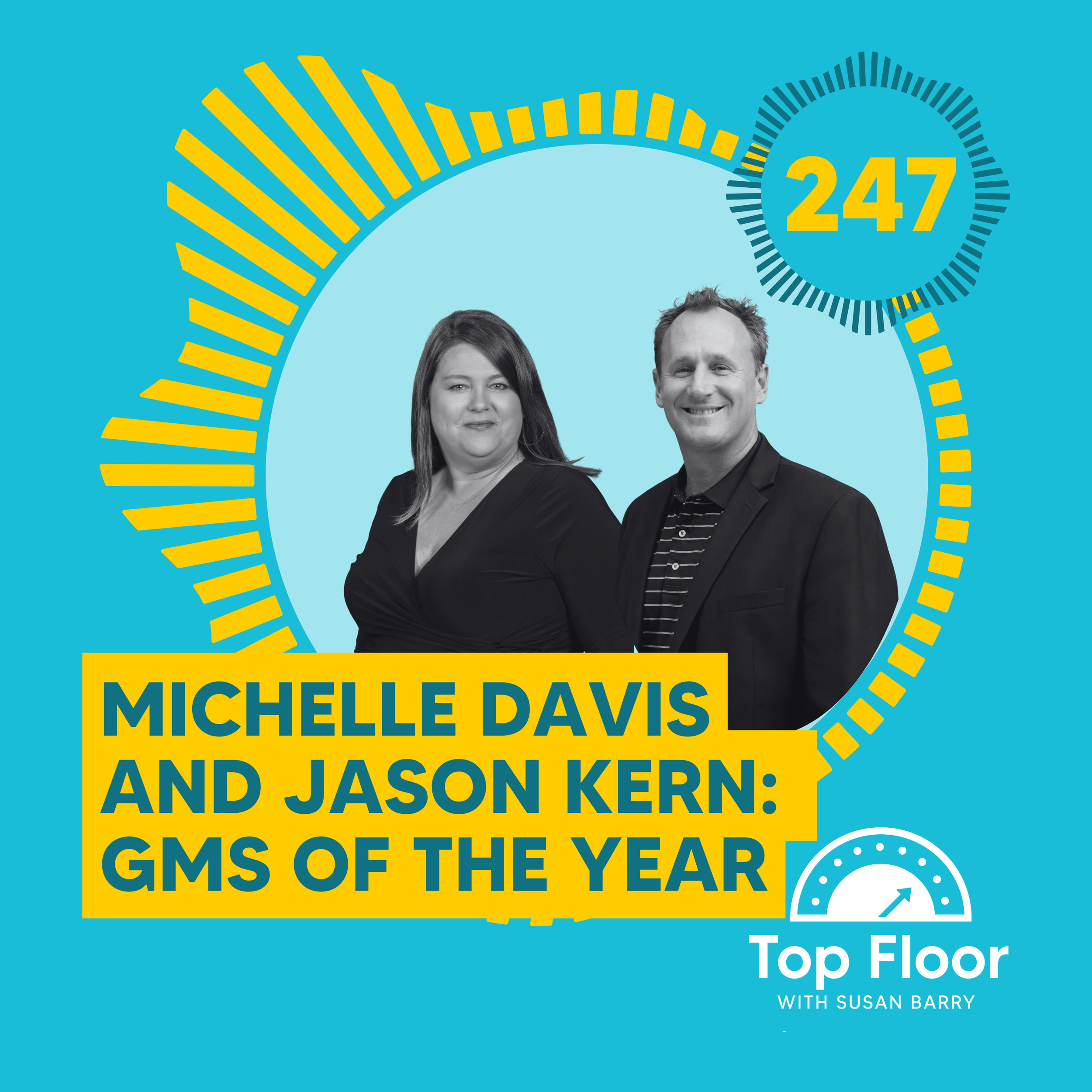
LISTEN TO THE EPISODE:
APPLE PODCASTS | SPOTIFY | TOPFLOOR.COM
[00:00:00] Susan Barry: This is Top Floor with Susan Barry, episode 247. You can find the show notes at topfloorpodcast.com/episode/247.
[00:00:13] Narrator: Welcome to Top Floor with Susan Barry. This weekly podcast ride up to the top floor features tangible tips and excellent stories from the experts and characters who elevate hospitality. And now your host and elevator operator, Susan Barry.
[00:00:32] Susan Barry: Welcome to the show. This is such a special episode of Top Floor because I got the chance to interview two truly outstanding hotel general managers. Michelle Davis and Jason Kern were both HVMG's General Managers of the Year for 2025, and this conversation really gives you an inside look at how truly excellent GMs run their hotels. I have a long-term professional relationship with HVMG, so I know that their standards are incredibly high. You can take the lessons and advice that Michelle and Jason share to the bank. Please enjoy my conversation with Michelle Davis and Jason Kern.
I'm here with HVMG's 2025 General Managers of the Year, Michelle Davis and Jason Kern. I'm so excited to ask you a bunch of nosy questions, but before I do, will you tell the names of your hotel and, like, how many rooms, kinda what style of property that you have? Michelle, you'll go first.
[00:01:49] Michelle Davis: All right. Well, I am the GM of the SpringHill Suites Orange Beach at The Wharf, and we have 132 sleeping rooms. We have in-house about 3,000 square feet of meeting space, yet we have an event center right beside us that adds another 10,000. So I can house groups that are bigger than what I should be able to. And we're part of The Wharf entertainment district here in Orange Beach, Alabama. So we sit on the Intracoastal Waterway, so while there's a marina outside my door, bars, restaurants. We're building a Margaritaville resort right across the marina now. So for our guests, we may not be on the beach, but everything you wanna do outside the beach is right here. So we like to say, we're steps from the beach, but miles from the stress.
[00:02:48] Susan Barry: Well, I haven't been to your hotel, but I've seen photos, and it's absolutely beautiful. Jason, what about you?
[00:02:55] Jason Kern: Well, good afternoon. I'm Jason Kern. I'm the general manager here at the Embassy Suites St. Augustine Beach Oceanfront Resort. Yes, a very long name. But we're directly on the beach here in St. Augustine. Just south of the historic district, so about three miles from the historic district. So our guests get to enjoy the beach and the stress-free of the beach lifestyle, but three miles from all the historic attractions and events going on downtown. So you get kind of the best of both worlds here. We've got 217 suites, and our hotel is pretty diverse. We do a lot of seasonal activities through spring break and summer with families, and then we really do a great job in the meetings market and the weddings market. And we've got three outside event lawns, all with ocean views, giving probably the best oceanfront views, I would say, in Florida from an events perspective, and also an oceanfront ballroom. So our guests do get to enjoy even when the weather's poor or there's other stuff going on, they get an ocean view from everywhere they're at. We're on a little island here. You think you're in the Caribbean someplace, 'cause there's nothing really around us right where we're at, so it's really pristine still, which is fantastic.
[00:04:10] Susan Barry: Well, it's funny to me because I am originally from Panama City, Florida, and that's about halfway between both of your hotels. So, depending on how this conversation goes, we may need to have a meeting in the middle and see what transpires. You were both named GM of the year for HVMG's 2025 season. What is an assumption that people make about being a hotel general manager that is completely wrong? Jason, why don't you go first?
[00:04:49] Jason Kern: Okay. That's a great question. I think the one thing that I've always thought about is, so I came up through sales and marketing, and when I was growing up in my career, GMs always came up through operations, and I never thought GM was even the track that I was gonna be on. And through a mentor of mine, as I was building my career and getting more involved in, like, the leadership aspects of it, he really started to push me towards understanding that leadership is what GMs do. It's not necessarily about understanding all the operational nuances, especially at first. You can learn that along the way, but really bring the leadership style to the hotel that you're at.
[00:05:28] Susan Barry: Well, I see you nodding your head, Michelle. Did Jason answer for both of you, or do you have something else that people get wrong?
[00:05:34] Michelle Davis: There is an assumption people have to come through operations to get to this position, but more and more, we're seeing other positions. I think from outside the industry, the assumption is that we don't have to work, right? It's basically bankers' hours, if we're lucky. No weekends, no nights, and they forget this is a 24/7 business that we're responsible for. So we're on call 24/7, and it can be a lot. People are like, "Why is the hotel gone?" I'm like, "Well, they need me." So, but that's one of the assumptions outside the hotel is that, "Oh, you don't have to work." Yeah, we do.
[00:06:18] Susan Barry: Jason talked about leadership. Michelle, what is a leadership habit you have developed that you didn't have five years ago?
[00:06:27] Michelle Davis: I would say one is more delegation. I felt like, as the general manager, anything that was maybe I would see as difficult for my management team or outside of their area, I had to take it on. And one of the things, especially this year, is trying to move our operations managers to become more strategic managers instead of managing just today. I used to let them manage the day, and I managed all the future. I would strategize and figure out what the next five years gonna look like. If I want to not be on call 24/7, they need to be able to do that as well.
[00:07:15] Susan Barry: Did something specific happen to precipitate that, or was it just a natural progression that you're like, "It's time for me to start working less than 80 hours a week"?
[00:07:26] Michelle Davis: Well, I would say that part of it, I have a stable management team, and they are 100% the key to the success. And now that it was the chief engineer position that kept turning over every year or so.
[00:07:44] Susan Barry: Were you running back to fix the elevator? What were you doing? Painting?
[00:07:50] Michelle Davis: So now that I feel like I have a stable team, they're ready. We've kinda dialed in the operations, and so they're ready, and right now we're going through a big transition of PMS systems with all of Marriott hotels. And so I'm delegating a lot of those tasks. They're doing things they've never done before, and they're like, "It's hard, but we love it," right? So they're learning more, so I think it adds value to their self-worth, not self-worth, but to their self of being able to know more information and be able to answer these questions now.
[00:08:27] Susan Barry: That makes a lot of sense. Jason, do you agree with that, or are you a control freak and your experience is totally different?
[00:08:34] Jason Kern: It's funny you said that, Michelle, 'cause I think all of us, especially as a new GM, you wanna hold on to everything, and you realize as you grow, you've gotta put trust in your team. And I would say to my team, like, "What would Jason do?" Like, if I wasn't here, they already know what the answer is, so you don't need to call me because you know what I'm gonna say at this point, right? So they kind of adapt to that, and they know what the expectations are. The other thing I've really worked hard at, especially the last five years, post-COVID, if you would, again, things were really rough in the hospitality industry, is to not take things personally. It doesn't mean that you don't care, and it's not to say I don't care if there's a guest comment or a reaction, it's a team member or whatnot, but just don't take it personally. Listen to the issue at hand. See if you can resolve it. But you can't take it with you, and dwell on it too much, and take things too personally. Don't make changes to one reaction to something, make changes on the trend. And, that's taken me a while in my career to kind of figure out and let things roll a little bit more, and it's part of the beach lifestyle anyway. So I should have adapted it a long time ago, but it's a good practice to keep in mind anywhere you are in your career.
[00:09:48] Susan Barry: Well, now that you are both delegating and not taking things personally, it's a perfect time for me to drop you into each other's hotels for 30 days. What, Jason, is the first thing you would change at Michelle's hotel, or not touch at all?
[00:10:07] Jason Kern: Well, it sounds like she's got a pretty smooth operation there, so maybe I could work at the pool or something like that and just be the towel guy. That would be great. Do the recreation activities or something like that. I've known Michelle for years and respect everything she's done. And we joke a little bit that we have a little competition on awards, but it's fun to see her win things. Her operation is interesting. I'd love to just step into someone else's shoes just to see what it's like to be in the different hotels and meet her team members, and understand what they're all about. So I don't think I'd change much, but I would like the opportunity just to switch roles. We should bring that up with Richard one day. Michelle, can we like pop into other people's hotels and just run it for a week and see what it feels like?
[00:10:54] Susan Barry: It's like a student exchange program.
[00:10:57] Michelle Davis: Exactly. Right. I think all full-service GMs should test a select service hotel.
[00:11:04] Susan Barry: Ooh, that's a good idea. That's a good point. What do you think you would do differently at Jason's hotel?
[00:11:11] Michelle Davis: How many outlets do you have, Jason?
[00:11:14] Jason Kern: A three, yes.
[00:11:15] Michelle Davis: Exactly. So I have that right there. I'd be like, "Oh my gosh. All right. What's our food cost today? What do we do?" Last time I was at his hotel, I was wearing a hard hat because we were looking at a prototype room. I know when I get to his hotel, that I'll be converting his surf shack, where he hides his wetsuit and boards, into my personal meditation space.
[00:11:42] Susan Barry: Okay, fantastic. Well, I'm glad you have a proactive plan.
[00:11:47] Jason Kern: Don't give up my secrets. Don't give up my secrets.
[00:11:53] Susan Barry: Put yourself in the position, a guest has had a terrible experience at your hotel, but they are being completely unreasonable. How do you handle it? Anybody wanna go first?
[00:12:08] Michelle Davis: Otherwise, I think the answer is hard to practice, which is unreasonable hospitality, right? They're being unreasonable, then you be unreasonable back to them. "Okay, I'll comp your stay. What can I do for you?" I've gone so much that, "I will book you another hotel. I'll refund your money, and I'll pay for you to stay somewhere else. I want you to have a happy vacation." And they just look at you like, "You're gonna move me?" And I'm like, "Yes, if that's what it takes to ensure you have a happy vacation." And, I can think of a guest I did this with, and they came back because I was so willing to make sure that they had a great stay. Guess what? I saw them next year, so.
[00:12:59] Susan Barry: Wow. That's interesting. I love that, the way that you phrased that. If a guest is being unreasonable, come back with unreasonable hospitality, which is a brilliant book, by the way. Jason, what do you think?
[00:13:13] Jason Kern: I love that. I think empathy is always the key. We're a beach resort. People have traveled in for a lot of times, they've driven four, five, six hours, maybe they've flown overnight, they've gotten here at 11:00 a.m., and want their room and check-in at 4:00, and we're sold out. And unless you wanna make a new friend and go share a room with the person who's still in it. Sometimes, unrealistic requests, like "Your room is actually occupied right now," like "I can't physically get you in there." But I always try to show empathy, and I understand where you're coming from. And I've got kids, too. I remember that time 'cause usually that's what it is. They're usually stressed out more about what got them there than what's happening right there in front of you. I even empower my team this way, too. I'm like, "If you don't handle it right now," and they say, "I want to speak to the general manager," and it's 8:00 at night, and then I'm not there till the next morning, they've dwelled on that all night. Just try to fix it tonight so that the next morning they don't have to repeat themselves again. And then of course, you, as a goal as a hotel general manager, is you don't want it to go above your property level because inevitably, if it goes above you, the compensation's gonna probably double. So if you can handle it on-site, make sure the guest is happy. If it goes above you, the brand's gonna do something more. Your management company's gonna do something more. So why not just fix it and take care of them so they can, like Michelle's point, maybe you turn around their stay and they leave thanking you for coming back. If it goes above your head, they're probably not coming back. That's what my experience has been.
[00:14:43] Susan Barry: And then you have to spend the next 26 days writing emails about it, too.
[00:14:50] Jason Kern: That's true. You can either deal with it for 10 minutes or deal with it for 10 days.
[00:14:54] Susan Barry: Yes. Can you think, Jason, of a small operational tweak that made a disproportionately big impact in your hotel?
[00:15:10] Jason Kern: I mean, there are a lot of things you're always kind of tinkering with in the hotel. I think one of the rules I kind of live by is to try to do the right thing even when no one else is around, 'cause you never know who's looking, whether it's a guest. I've had guests coming up to me and say, "Well, I didn't know who you were. I thought you were just a maintenance guy, and you were out walking around picking things up. And then you come in the lobby, and you realize that you're the general manager of the hotel." And so, that goes a long way with guests. Especially when it's really busy, and you're running a high-volume hotel, if they never see management, they think you're nonexistent. But if they see you out there helping out, leading the charge, I think it goes a long way for the guest experience, and also for your team members, too. So, if I'm picking up cigarette butts or straightening chairs or adjusting umbrellas for guests, my team will naturally do that too. And just like the guest who says something to you, your team members, they see and understand that. And so that little tweak, it goes a long way, doesn't cost anything, right? You're walking your property anyway, but making sure they see that you're doing it even when you're not with your boss.
[00:16:11] Susan Barry: So Michelle, speaking of team, what is something you do with your team that costs nothing but pays off constantly?
[00:16:21] Michelle Davis: I mean, it's twofold. So with the management team, the cost of a book. So we read, every new manager that joins the team, we read Five Dysfunctions of a Team. And we talk about that as a team, so we learn how each other thinks, and we do the Myers-Briggs together, and then we also establish our communication norms. So for like, for me, I'm a loud talker, and when I get passionate, I get louder, and so we talk. Is yelling at one another okay? And so for some people it is, some people it's not. I may curse a little. But if you don't respond well to that, then I'll make sure that that. So we talk about our communication, norms, and we talk about it first us. We're the team, the management team. We do that every year. So every year we review the book, and then we set what are our goals for this year. And once we decide what our goals are as a management team, then we build the associates' annual performance goals off of it. And I think that's key to success because now it's everybody, like, the pyramid, everybody working to one common goal. So we build that, what is that common goal for all of us every year?
[00:17:56] Susan Barry: Jason, have you ever read that book?
[00:17:58] Jason Kern: I have not, but I will have to get that into the arsenal here from now on.
[00:18:02] Susan Barry: Yeah, you gotta put it on your to-be-read pile. That's right. What about you? Is there something that you do with your team that is free or inexpensive but really pays off?
[00:18:14] Jason Kern: It sounds really simple, but I think it gets away from a lot of hotels, just meeting daily with your team. Your morning huddles, your afternoon, whether it's operational, like in the food and beverage outlets, they do a separate one, housekeeping does one in the morning. If I can pop into those are great, and then the manager huddle every morning. People will text and email, and sometimes it's hard to be mad when you're face-to-face. You can actually get things resolved if you're looking someone in the eyes. But it creates a medium in which you have to talk to each other. And I don't know how you guys feel about text. After one or two texts, I'm like, "Pick up the phone or go see them in person," because things get misread and misunderstood. It becomes an ugly situation, so it's a lot easier just to talk in person. So, doing those little huddles every day and meetings, they cost absolutely nothing
[00:19:06] Susan Barry: Can you think of a time when your team absolutely nailed it without you, like, without you having to get involved, or maybe you were on a vacation to your surf shack or something like that?
[00:19:21] Jason Kern: This is a true story. I was out in the ocean, after work, of course, it was after 5:00. I look back, and we always joke 'cause, there's a fire station right down the road here, and when you hear sirens go off, we always say, "Keep going. Keep going." 'Cause you don't want to stop and go, "Oh, generally that's gonna be something you don't want to have to deal with." And that day, we had a fire alarm go off, and I was actually out in the ocean. And it was one of those embarrassing things 'cause you, you're like, "Oh my gosh, can't believe this is happening," and run up. But my team had already handled everything. It was an alarm that go off, someone was cooking in the microwave something? So another big deal. But I came up, and I'm wearing shorts and a T-shirt, but everything was handled fine, and everything was smooth, and my AGM was here, and he's like, "I got you. Don't worry about it." I'm like, "Well, I'm not in a position to really talk to guests right now in my shorts." That's kind of the funniest one. My team does it every day. There's always something going on, but that's one that kind of stands out.
[00:20:15] Susan Barry: What about you, Michelle? Do you have an example?
[00:20:17] Michelle Davis: Last weekend, it was a sellout weekend, and we are already oversold by four or five rooms. The event's happening here. And used to, those were one of those days that I would sit here till late to make sure everything had a plan put together. What are we gonna do? We're oversold, we're gonna take this, do this? But I worked with the team and started teaching them the tricks I use, and nobody walked, sold out, great ADR. I actually made it over the bridge before and had no phone call. It's the team, I feel comfortable leaving this property now.
[00:21:09] Susan Barry: That's a big accomplishment. Do you have any guest interactions that you still think about years later, maybe besides the one that you told to hit the bricks, and then they came back the next year? I'm just kidding.
[00:21:25] Michelle Davis: During COVID time, which was crazy, and I think Jason and I both, that was just a crazy year. The beaches were closed. Alabama beaches opened before Florida, so we got all the Florida guests. It was just insane. And I had a guest call, and his daughter was getting married. They were getting married here at the beach, but because of COVID, they couldn't come, and wanted to cancel, and I said, "That's not a problem." "Cancel the reservation, no charge." Eh, they kept holding off and holding off. And then, he's like, "But we're gonna come, and we're gonna try for the fall." I said, "No, I'll move your reservation." I don't even remember. Fast-forward to the fall, the guy's at the front desk, and he's talking to me, and I don't remember talking to him six months ago. And he just said, "Thank you for making this happen. My only daughter's getting married, and I was diagnosed with brain cancer. And it was very important that we get the wedding done, so I could see her. And I was like, you're quite welcome. I had no words to say, right? And I was just like, "Well, I'm so happy this happened for you." The next week, I come into my office, and I have this huge bouquet of flowers from this gentleman. And I'm just like, how inspiring for him. I'm like, "You're the one who's got life issues happening." And if I could take from that and live through an attitude of gratitude, right? And just be great, just for those small things. And I love it. But this is why I love the business, 'cause you never know how you're gonna impact people's lives, right? So, all right. Sorry.
[00:23:26] Susan Barry: Well, we have to take a break now so that all of us can blow our noses. Jason, what about you? Do you have a guest interaction that you still think about?
[00:23:38] Jason Kern: I'm sure every GM has this experience, but the front desk calls and there's a guest here who wants to speak to the general manager. Do you know what it's about? No. They're insistent, and you're automatically thinking like, "Oh, something's horrible," right? And so you're kind of preparing yourself to go out there and deal with something. Like, at least give me a heads-up on what's going on so I can prepare? And it's nice to get the surprise where they just come out and say, her name is Janet, my public space commercial attendant in the lobby, how she treats the resort like it's her own house, and she welcomes you, and she's tidying up like it's her own house, and speaks to the guests. And this person just wanted me to know how fantastic one of our team members is. And I thought, "Wow," I was all built up with anxiety going out there. And I go out there, and it was just, I'm like, I gotta remember that. Like 99% of our guests are really happy, and why should I expect that the person wants to speak to me about something negative when all this great stuff is going on here? And it's just a good reminder for me that we make really cool memories for people, and our team members do. And I think that's the interaction that keeps people in hospitality, because that's the parts of one of the things I get to tell Janet, "Wow, Mr. Fowler came down and couldn't stop bragging about the..." Of course, they were here for the next three days, and every day I see him talking and interacting, and then they're starting to know each other, and then that just creates the connection that helps people want to come back year after year. So those kinds of interactions, I think, are priceless.
[00:25:10] Susan Barry: Do either of you have a mistake that you've made as a general manager that changed the way that you lead?
[00:25:20] Jason Kern: I was trying to manage people instead of leading them, and I think that's a big difference. So you can like manage processes and schedules and payroll and all these sorts of things, but really people don't like to be managed, they like to be led. And so it's just kind of changing the mindset like, "Hey, I'm here to let's do this together." I think that was a big thing I learned and that helped me, like, not micromanaging, trusting my team, and really like getting to the higher level in my career, and bringing the hotel to the next level is just not managing every second of someone's life. Let them kind of give them the broad strokes and the end game, involve them in the story you're trying to tell, and then they'll get there themselves.
[00:26:03] Susan Barry: What about you, Michelle? That's a hard one to follow.
[00:26:06] Michelle Davis: I know. For me, one of the things was, like, I would manage everybody the same, hold them all to the same standard. And one of the things that, 'cause I was taught you gotta hold everybody the same. You gotta be consistent and this. But then I realized that someone's high-level bar may be someone else's mid-level bar. So I hold everybody to doing their best, but their best may not be the same across the board, if that makes sense for what I'm saying. And so be demanding but fair with everybody, but do not treat everyone exactly the same. That you've gotta perform. "Why are you tough on me?" "'Cause I know you can do it." And that's one of the things that I've adjusted throughout my management.
[00:27:11] Susan Barry: All right. I've had enough of this inspirational leadership lesson stuff, so it is time for a fun question. What is the most only in hotels situation you have ever dealt with, Michelle?
[00:27:26] Michelle Davis: I have to say I'm not going into any details, but as a general manager, and only in hotels, I've had a lot of poop situations. Like, ungodly. I'm like, "What?" Different things. I'm just like, "These are adults staying here. I don't understand." But I think it's 'cause it's only in hotels, you know? Only in hotels. It's the only place you're gonna have these kinds of situations.
[00:27:59] Susan Barry: It's very true, and I appreciate the lack of detail in your response. Your turn, Jason.
[00:28:08] Jason Kern: Oh, that's funny. It's interesting, I do a lot of events here, and there's a lot of different folks coming and going. I think the one that stands out the most to me is probably that we do a lot of weddings here. I got a call in the middle of the night that the groom was sleepwalking, naked in the lobby. And so the night auditor called me because he made his way to the desk naked. They were able to wake him up in a way that he realized where he was. They gave him a towel. Of course, we switched rooms 'cause they didn't share a room the night before the wedding, so now you're staying with his bride. His name was not on the reservation, so we're not supposed to let you into the room, right? And so they had to call me to verify, and this is not a lie, he was actually a hotel guy, not in our company. But, so I knew who he was, and he was mortified, but we had to give permission. And the security went and knocked on the door, and his now wife came to the door, and there he is. But only in hotels, right? So, not for nothing, the next couple of days, 'cause they were staying in the hotel for a few days before they left, it was hard to look at him the same way.
[00:29:29] Susan Barry: Okay, I want each one of you to ask the other a question that you've always been curious about when it comes to how another general manager operates. Ladies first, Michelle.
[00:29:49] Michelle Davis: How do you divide your time? How do you get out from behind your desk? I wanna know that. With more and more stuff coming on us as general managers from ownership reporting to accounting and finance stuff wanting, and this report and that report, how do you get from behind your desk these days?
[00:30:11] Jason Kern: It's an effort for sure. My watch tells me to get up every hour and walk around, so that helps. So I try to remind myself that's the fun part of the job, and you can get caught up in your office a lot nowadays. Most financials are a big part of the position, more than I would've known 10 years ago or 15 years ago. And it's just something that you have to do, and you're in your office doing those types of things. But the best part about my job as a resort general manager is getting out and seeing my team in action, and walking the property and being out there. So I force myself every hour I get up, no matter what, and at least go walk a floor, walk out by the beach, check on the pool. So it definitely breaks up your day, which is great. But you have to be conscious of it, 'cause otherwise, forecasting and budgets and all this other stuff, you're gonna be in your office all day, and that's not why I wanted to be in this career.
[00:31:08] Susan Barry: That was such a good question, Michelle. Jason, do you have one for her?
[00:31:12] Jason Kern: It sounds simple, but like, what motivates you, Michelle?
[00:31:16] Michelle Davis: What motivates me is when I see people that I've invested in succeed. There are a lot of people in this company I've hired or interviewed, or been part of, and I love seeing them grow and learn new things. I always like to say, "Oh, I want to be your kindergarten teacher and give you the basics," but then for people to become smarter than me or more successful, it's such a good feeling. I'm so proud of Melissa Arata, right? I hired Melissa. Now look, she's the VP of our revenue management, and she does an excellent job. And I now learn from her, and that's amazing to me.
[00:32:10] Susan Barry: I thought you were gonna say you were motivated by beating Jason for the awards that the two of you seem to both win. Let's go through the lineup real quick. So you were both General Manager of the Year for 2025. Michelle was the Margie Vito Leadership Excellence Award last year. Anybody get anything in 2023?
[00:32:44] Jason Kern: Tough year.
[00:32:45] Michelle Davis: AHLA GM of the Year for me.
[00:32:49] Susan Barry: Okay. Oh, okay. In 2022, Jason was General Manager of the Year. Yes. Michelle was in 2021, and Jason had Hotel of the Year. Is that right? Yes. So basically, we have been operating neck and neck for a good minute here. I think Michelle may have one up on you, Jason. So, next year needs to be your year. Based on what you've heard today and the mission to level the playing field in terms of awards, Jason, what is one thing you might steal from Michelle after today's conversation?
[00:33:28] Jason Kern: Well, I gotta get that book, obviously. That would be important to do every year. Sounds like a good plan. No, I like the story that you told about how to handle a guest situation where, if they're being unreasonable, then you'd be unreasonable, too, but in a good way. I think that's a great approach, and I think it’s something I would probably implement this weekend.
[00:33:54] Susan Barry: Excellent. Michelle, what about you? What are you stealing from Jason? Besides his Surf Shack.
[00:34:02] Michelle Davis: I know, besides his Surf Shack. I think that it was a good reminder to hear about not taking it personally? And I wanna learn more about doing that. I love this business, I love the associates. And it's hard when you feel like you invest so much of yourself into someone and then they let you down. So just don't take it personally, right?
[00:34:36] Susan Barry: What about, we were joking around about being GM of the year and how you guys basically trade each year. What does it mean to you to be given that award, Michelle?
[00:34:46] Michelle Davis: Funny story is, like, someone had told me that when I decided to change careers, and I wanted to go back into operations and be a GM, someone told me I wouldn't like it. And that you wouldn't like it. “That's not your thing." And for me to have won it and now be successful at it was such, like, personal gratification and, like, I can do this, and I truly do like it, and I love it. But then also on the other side, like, I think, "What is wrong with me that I'm so aggressive and such an overachiever sometimes?" But my dad just told me, "Michelle, you've been like that since you were little," so I'm like, "I know." I'm like, "I know. Like, can you just relax a little?" But it makes it feel like I'm doing the right thing. I am where I belong, right? I have a thing that says, "Do what you love, love what you do," and that's exactly what I'm living.
[00:35:53] Susan Barry: Awesome. Jason, what about you? What does it mean to you?
[00:35:56] Jason Kern: It's a great honor, of course, and I was really surprised 'cause honestly, you think you win awards twice 'cause you know, "Oh, they just rotate that around." I was like, "Aha. I mean, we had a great year, and I got up there, and I thought about it afterwards, I got to bring this back to my team. And the hotel of the year and GM of the year, sometimes for me, are almost the same because Michelle mentioned this already, the only reason we're successful is if you really build a strong team that allows you, it frees you up to do more things, and it gets you out ahead of things a little bit. I think you'd find that pretty consistent with most successful GMs is that they've got a really strong team that they've hired everyone and built it, and it's taken time, but that's where you start to reap the benefits, is having that longevity and having people that you can trust and really carry out the vision while you're not there.
[00:36:45] Susan Barry: If a brand-new GM is listening, what is one piece of advice you would give that is not necessarily written in a handbook?
[00:36:53] Jason Kern: I said this earlier, but you gotta make sure you stay out of your office as much as you can. You've gotta keep your finger on the pulse of everything going on. This is the type of job where you lead by presence sometimes, and popping out, take a different route, park your car and go through the back, park your car, and go around the front in the morning. Don't let anyone know your route, 'cause then they'll figure out how to do things.
[00:37:19] Susan Barry: That's good in and of itself. Be tricky.
[00:37:22] Jason Kern: Keep coming in at 8:30, come in at 7:00. Like, change your routine up so you can see the different parts of the operation and make sure that they think you're always there?
[00:37:33] Susan Barry: Michelle, what about for you?
[00:37:34] Michelle Davis: I would tell a new GM, first and foremost, build your management team 'cause they're the ones that can implement the visions you have. Yeah, they're the ones that will support you and help achieve the goal. So you wanna make sure that you invest in them and you have the right people in, as your management team.
[00:38:02] Susan Barry: Okay. We're gonna move into a little rapid fire. You have to answer as quickly as you possibly can, and just to keep it pushing, we're gonna go Michelle, Jason, Michelle, Jason, Michelle, Jason, okay?
[00:38:18] Michelle Davis: All right.
[00:38:19] Susan Barry: Early bird or night owl, general manager?
[00:38:24] Michelle Davis: Night owl GM.
[00:38:25] Jason Kern: Early bird.
[00:38:26] Susan Barry: Favorite department to spend time in?
[00:38:30] Michelle Davis: Front desk, 'cause I get to meet all the people.
[00:38:30] Jason Kern: Banquets, 'cause that's where all the fun happens.
[00:38:36] Susan Barry: One thing you wish owners understood better.
[00:38:40] Michelle Davis: That they understood hospitality. I'm sorry, I know it's rapid fire, but that a lot of times our owners are investors, and the hotel's an investment, but the true thing about hospitality sometimes, it's not always about the bottom line, but it is about the bottom line. But if you take care of the hospitality, then the bottom line comes into place.
[00:39:06] Susan Barry: Totally makes sense. Jason, what's one thing you wish owners understood better?
[00:39:12] Jason Kern: There is a balance between profit and service, so making sure that I'll do either. There's a balance there.
[00:39:23] Susan Barry: One word your team would use to describe you.
[00:39:26] Michelle Davis: Smart.
[00:39:27] Jason Kern: Approachable
[00:39:30] Susan Barry: Coffee order
[00:39:31] Michelle Davis: Latte. Just no syrup, no sugar, just a latte.
[00:39:39] Jason Kern: I'm an iced vanilla latte with oat milk kinda guy.
[00:39:43] Susan Barry: I feel like we may have heard the most opposite answers that I've ever heard from two people being asked the same question. So to me, it sounds like we could put the two of you together and make a 24-hour-a-day, plain coffee, highly seasoned coffee general manager. I don't know. Well, thank you both so much for enduring my nosy questions, and congratulations on being named General Manager of the Year.
[00:40:16] Michelle Davis: Thank you.
[00:40:20] Susan Barry: Thank you for listening. You can find the show notes at topfloorpodcast.com/episode/247. Jonathan Albano is our editor, producer, and all-around genius. He even wrote and performed our theme song with vocals by Cameron Albano. You can subscribe to Top Floor on Apple Podcasts, Spotify, or wherever you like to listen, and your rating or review will go a long way in helping us give you more of what you like.
[00:40:55] Narrator: Thanks for listening to the Top Floor podcast at www.topfloorpodcast.com. Have a hospitality marketing question? Reach us at 850-404-9630 to be featured in a future episode.