
Transcript: Episode 236: Godfather of Las Vegas
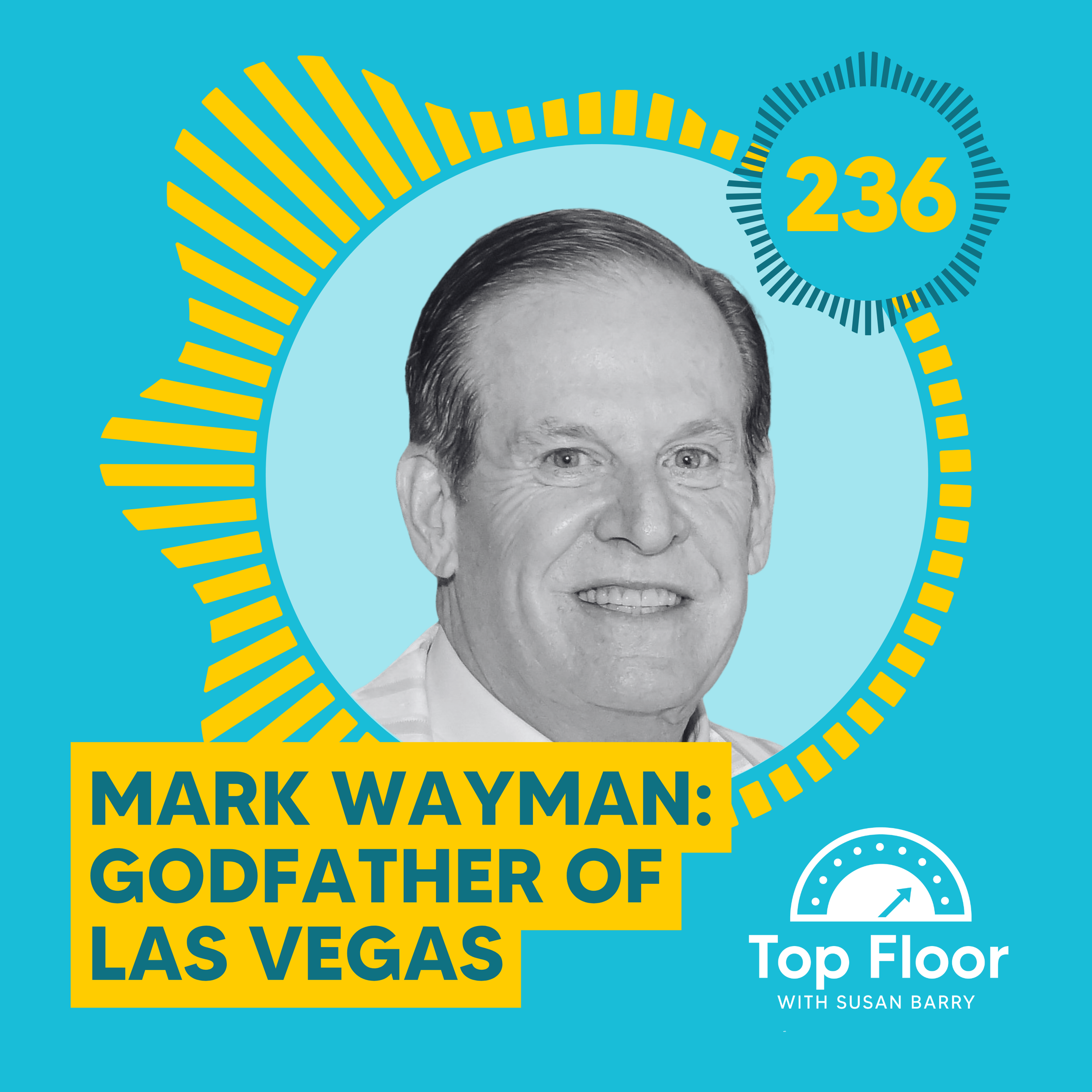
LISTEN TO THE EPISODE:
APPLE PODCASTS | SPOTIFY | TOPFLOOR.COM
[00:00:00] Susan Barry: This is Top Floor with Susan Barry, episode 236. You can find the show notes at topfloorpodcast.com/episode/236.
[00:00:15] Narrator: Welcome to Top Floor with Susan Barry. This weekly podcast ride up to the top floor features tangible tips and excellent stories from the experts and characters who elevate hospitality. And now your host and elevator operator, Susan Barry.
[00:00:32] Susan Barry: Welcome to the show. Mark Wayman has built a career by constantly reinventing himself and bringing lessons from one industry into another. He began with a degree in computer information systems and started out in the software world, working in Silicon Valley during the early startup era. After earning his MBA, he moved from the technical side of software into product management and marketing for specialized platforms. Mark's career path ultimately led him into the gaming industry, which is why we're talking today. And he now owns an executive recruiting firm that specializes in casinos and hospitality. So today we are going to, for the very first time in top floor history, talk about the gaming industry. Something that I find endlessly fascinating, but before we jump in, we need to answer the call button.
The emergency call button is our hotline for hospitality professionals who have burning questions. If you would like to submit a question, you can call or text me at (850) 404-9630. The emergency call button is brought to you by Cayuga Hospitality Consultants. Cayuga is a highly concentrated organization of the industry's best-connected consultants across multiple disciplines. Members are former senior executives who now work independently on projects worldwide. Learn more at cayugahospitality.com. That is c-a-y-u-g-a hospitality.com.
Okay, Mark, today's question was submitted by Lana. Here's what she says. I am searching for my next executive role, and I have been self-employed for the last three years. How do employers look at that? I love this question so much because I have been self-employed for almost 20 years, and I still hear people say, consultants are just people who can't find a job, which is definitely not true for me. So what are your thoughts?
[00:02:49] Mark Wayman: That's an excellent question. By the way, thank you so much for having me. Greetings from Las Vegas, Entertainment Capital of the World. I get that question often, and what I find is that it's more of an issue for the candidate than it is for the employer. If you've been an entrepreneur like you or I have for 20-something years, it's hard to go back into the cubicle. It's hard to go back to the corporate world. So, I think it's harder that way. The way people get jobs, 85% is through their professional network, 10% through an executive recruiter, and everything else is a lottery. So, what I always tell people is, let your professional network know, Hey, I'd like to reenter the corporate side of the world and see if you can't get some referrals that way because almost all jobs come either through a recruiter or through their professional network.
[00:03:46] Susan Barry: That is so interesting that it's that much of the professional network, and you really don't think hiring managers are like, oh, you've been working for yourself for three years. You're damaged goods.
[00:03:58] Mark Wayman: That's a great question and I'll tell you, it's changed since the pandemic and pre-pandemic. Back when I started in 2004, you might've heard that. But since the pandemic, a lot of people have taken sabbaticals. Some people tried to start their own Dairy Queen, so a lot of people got out and tried different things. I don't think it's as big an issue as it was pre 2020.
[00:04:23] Susan Barry: Interesting. Well, I'm glad to hear that. Although I will never be testing it because I will never, ever, ever, ever work for someone else again. Now listen, I just jinxed myself, Mark. What if I did? And now you're like, I'm knocking on your door a couple of years from now. Like, please help me. Well, you have had a super interesting career path that spans software, Silicon Valley startups, financial services, and now gaming. What do you think were the sort of pivotal moments that nudged you from one industry to the next? Or was it just random sort of lottery stuff?
[00:04:59] Mark Wayman: I grew up in Orange County, and I was a technology executive, and I was recruited to go to Texas by a large pharmaceutical company. And I said I would relocate to Texas if you paid for my MBA at Texas A&M because no one in my family had ever had a four-year college degree. And I think it was my dad's finest moment when I got my four-year degree from Cal State Fullerton. So they paid for me to go to Texas A&M. They were headquartered in Frankfurt, Germany. And so then they asked me to go to Frankfurt. I said, no matter how old I get, I will never be German. So I was recruited to come out to Las Vegas, Nevada. And of course, we're about 80% hospitality and gaming, and so that kind of moved me into the gaming circles.
[00:05:44] Susan Barry: Interesting. Well, early in your career, you were working in the tech world during this sort of startup era, at least the first startup era. What do you think that environment taught you about innovation, specifically, and maybe about the dangers of being in a bubble? I think we're in another bubble right now.
[00:06:07] Mark Wayman: I would have to agree with you. There are a lot of macroeconomic issues right now, especially as related to Las Vegas, because we're typically ground zero for the downturns. I'll tell you a quick story. I worked for LA Gear, it was the only place I ever got fired. And because I carpooled, I had to put my stuff in a cardboard box and sit on the curb and wait for my ride. And I said to myself, I will never work at a company where I dislike my job, not one day. And so I sorted myself, I put 6 to 12 months of living expenses into an emergency account. So if I ever lost my job again, which I never did, but if I did, then I'd have money and I wouldn't be fretting about making the mortgage payments.
[00:06:53] Susan Barry: And have to take something that you hated.
[00:06:56] Mark Wayman: Exactly. Take what we call it a bridge job, right? Until something better comes along. But that was what it taught me, was to be prepared and to always have that emergency fund so that you can take your time and find the right opportunity.
[00:07:09] Susan Barry: And do you have any tips for someone who hears, you say, 6 to 12 months emergency fund and they're like, maybe I can barely pay my bills now. How am I gonna save that money up?
[00:07:21] Mark Wayman: That's a very good question. And the answer is quit going to Starbucks every morning, paying $15 for a latte. Quit eating at McDonald's for lunch every day. Quit going out to expensive dinners. Quit flying to Europe. My dad taught me the best financial advice that anyone can ever give, and that is if you can't pay cash, you can't have one. It's that simple. No debt. Most people have to have mortgage debt or maybe a car loan. But since the pandemic, everyone spent the 7 trillion that the government handouts that they received. Then they ran up their credit cards, then they started doing emergency fund. Unfortunately, you have to have some self-discipline. You can't have it all.
[00:08:10] Susan Barry: Yeah. But so many people lost their jobs. I mean, what were they supposed to do to pay for their life?
[00:08:14] Mark Wayman: Well, a lot of people left the workforce. They didn't lose their jobs. They quit. I've never seen so many people work so hard and not ever having to work and so it was great. Maybe their spouse could carry their health insurance. That's the big one, right? But I stayed at home and played [], and that’s fine. And I realize that there is a percentage of Americans that are not making enough to get by. We have the high prices, the inflation, we have a lot of issues. But on the other hand, I see people spending money they just don't have. You need self-discipline.
[00:08:54] Susan Barry: It's interesting. I wonder, the sort of economic conditions that folks who are starting out now face are so different from when you and I did, like self-discipline and giving up a latte still won't get you a mortgage payment, much less. Years and years and years of investments. Well, I'm wondering, looking back, are there any skills from your early tech and finance roles that have sort of unexpectedly turned out to be valuable in when you're looking at the gaming industry?
[00:09:31] Mark Wayman: I think the one thing that I learned was that relationships trump transactions and relationships trump talent. How else can you explain? I see people making a million dollars a year that are completely unqualified for their job. I worked on a 400,000 job for a cruise line that will go unnamed, and I worked on it for four months. The two best people on the planet. They hired someone for 200,000 that was completely unqualified. So relationships are key. People come to me and say, Mark, I'd really like a board seat. Well, go to all the buddies of the chairman of the board. It's just how it works.
[00:10:14] Susan Barry: That's interesting. Well, I think this is a good segue into my next question, which is, you are absolutely known as the godfather of Las Vegas. Which clearly, the relationships have a lot to do with it. How did that happen? How do you know so many people in this city and how does it help your business?
[00:10:34] Mark Wayman: So, two things I did. The first one was when my contact list reached a thousand people. I started a newsletter. Well, it's mostly who got hired, who got fired, because the casino world's pretty small. Everybody knows everybody, and people just love that news up. The second thing that I did was I went to all these networking events, right? And all I saw was financial consultants and attorneys and CPAs and people looking for business. So I said, I must start my own event. I invited six of my clients and I said, look, I'll bring the Cuban cigars. I'll pay your bar bill. And we have one purpose. The purpose is for the six of you to get to know each other. And that turned into next month, I'll have about 150 people. These are all clients. We don't have vendors and service. It's all the people I do business with. And it's just kind of a perk for them. They know they can come out, they can relax. We have live entertainment. They get to meet really cool people and nobody's gonna solicit them.
[00:11:38] Susan Barry: That's interesting. Do you have sort of like a no-selling policy or is it an unwritten rule?
[00:11:43] Mark Wayman: No sales, marketing, soliciting, or promoting. None. And once in a while, we get a sniper. But they just don't get invited back.
[00:11:52] Susan Barry: And so would do people tell on them? Like she's running around handing out business cards?
[00:11:58] Mark Wayman: Oh, I watch the room. Very high-profile people. I don't call 'em out. They just don't ever get invited back.
[00:12:08] Susan Barry: Interesting. I love both of those ideas. I have another question about your newsletter. So you said, it's about who's getting hired and fired. Do you really say, like, you just come out and say, Susan Barry got fired, here's what happened or is it a little bit more like a wink and a nod?
[00:12:26] Mark Wayman: Usually, I would say Susan Barry has left the building. As a nod to Elvis. Everything I do is very confidential. So I'm like an attorney or a doctor, so even if I tell a client we're gonna pass on a particular candidate, I never disclose the reasons.
[00:12:48] Susan Barry: Got it. That makes sense. Well, what about some big operational or guest experience challenges that you think are unique to gaming environments compared to traditional hotels? Like, I could tell you what the issues are on the hotel side, but I'm wondering when you add a casino to the mix, how that changes.
[00:13:11] Mark Wayman: So in the casino, it's all about customer yield. What's the value? How much do they spend? And to put it simply, they get an Excel spreadsheet and they list everyone, and they put how much each person lost or spent. They draw an imaginary line somewhere. Below that line, they don't care if they come back. And I know I'm gonna get hate mail, but they don't. They just don't care. Everybody above that line starts getting free stuff. And when you get to the top, it's RFB, free room food, beverage, free play 'cause they're more valuable customers. So that's how a casino does.
[00:13:49] Susan Barry: From your vantage point, how do you think that technology reshaped gaming and hospitality over the last decade or a couple of decades?
[00:14:01] Mark Wayman: And so here comes more hate mail. Casinos care about slot machines and marketing. That's what they care about. They don't care that much about technology. I was coming here 40 years ago, standing in line at the desk for an hour at the hotel registration desk, for an hour thinking I'd really like to be gambling in the casino right now. Now, we're 40 years later, we have the same problem.
[00:14:25] Susan Barry: It's no faster. Is that what you mean?
[00:14:27] Mark Wayman: Yeah. Well, Hilton and some of the other place staff kiosk. Some of have remote checking, so you don't even have a front desk. And Las Vegas just never really caught up with all the technology that some of the bigger hospitality companies have.
[00:14:42] Susan Barry: I wonder why that is. Are there unique risk factors there? Is it more dangerous for a casino to get hacked than it is for a hotel? I'm grasping at straws here, but I'm just curious why?
[00:14:58] Mark Wayman: Because their focus is slot machines and marketing, right? The object is to get as many feet in the casino as you can that the more feet, the more money. And they were able to raise the prices during the pandemic due to the government handout. Everybody came. I thought we were gonna be in real trouble. The government gave away 7 trillion, and people use that for Pampers and milk. No, they didn't. They used it to come to Vegas and gamble and drink. So, the casinos and this ended up being a very bad thing. They kept raising the money, 'cause it's supply and demand. Like Dubai right now, rates are off 90% because there are missiles going over that. So they raised the rates so high. The problem was that when we hit the downturn, people didn't have money and they stopped coming. It's too expensive to come here.
[00:15:54] Susan Barry: Interesting. We like to make sure that our listeners come away from every single episode of Top Floor with a couple of really specific, practical tips to try either in their businesses or their personal lives. So if someone wants to build a career on the gaming side of hospitality, what skills or experiences would you recommend that they focus on developing?
[00:16:24] Mark Wayman: Well, to start out, everybody starts on the front desk. It's not so much a skillset, but a character attributes. I would say integrity is number one. My dad used to stay without integrity, nothing else really matters. I would say loyalty is number two because this is Mayberry, RFD, meaning Las Vegas has 2.2 million residents. 200 people run this city. It's not like LA, or Chicago, or New York. You can't just move on and bury yourself somewhere else. You can't do that here. If you burned your bridges in Vegas, you have to leave. And then I would say again, the third character attribute is the relationships. You need to build those professional relationships because it's like a fishbowl and everybody in Las Vegas kind of moves slowly in a circle.
[00:17:16] Susan Barry: Interesting. So, I heard what you said about Las Vegas is like a small town in a big city or a small group of people. Does the small town of at all extend to other gaming destinations like Macau, Atlantic City? Like, do those people all know each other, too? Or is it insular geographically?
[00:17:41] Mark Wayman: That's a really good question. I would say Las Vegas, and then I would say Asia as a whole, meaning Manila and Macau. All the Asian folks tend to know each other. The balance of America, no. I mean, it's pretty spread out and it's another issue that Las Vegas faces. There's a casino on every corner in America now. 50% of our customers drive up from California. But now you've got the Sycuen and the Pechanga and you've got these beautiful casinos, Southern Valley in Sacramento. There really isn't a great value proposition for driving up here, especially when the prices are this high.
[00:18:23] Susan Barry: Interesting. What would you do, like if you were, oh, I don't know, Mark, the Godfather of Las Vegas, what advice would you give the city of Las Vegas?
[00:18:34] Mark Wayman: I think we need to go back to the days when the money was generated on the casino floor. So when I started coming here, going to the Landmark, it was $9 for the rent, and they gave me all, you could keep down Buffet Ticket and the Melinda First Lady of Magic Show for free. Why? Why? Because they knew I was gonna go gamble. When Las Vegas started getting corporate and run by bankers, they started trying to make money on everything, the food, the hotel, the retail, and it just got to a point where the average American. It's kind of the Disneyland effect. I'm fairly wealthy. I can't afford to go to Disneyland. It just got too expensive. Now they've started running some specials and doing some things. But again, it's supply and demand back in the pandemic, the demand was so high. No matter how high you raise the prices, people just keep them.
[00:19:31] Susan Barry: While we've reached the fortune telling portion of our show, so now you have to predict the future, and then we're gonna see if you got it right. What's just a big picture prediction you have about the future of gaming?
[00:19:45] Mark Wayman: Well, I'm hearing that summer's gonna be tough. I don't think you can predict it, and I'll tell you why. There are too many macroeconomic issues in play. We'll start with World War III in the Middle East. We don't know how that's gonna turn out. Right now, it's turning into Trump's Vietnam, right? And I'm not being political. I don't like Trump or hate Trump because it's bad for business. But when you have things like that, a record consumer debt, record credit card debt, record government debt, $6-$7 gas price. You have all of these macroeconomic issues. It's going to make it hard for the average American and one of the first places that they cut their discretionary spending is gonna be on vacations. People are always gonna gamble and drink. Vegas is not dead. The numbers may be down. Vegas is not that. So anybody tries to tell you, that's great. The numbers are off by 5 to 10%, but Las Vegas will survive.
[00:20:47] Susan Barry: If you could wave a magic wand and change one thing about the way executives approach looking for a job, what would it be?
[00:20:56] Mark Wayman: I just wish I'd be honest. Honesty is the best policy. We didn't have all these issues before the pandemic. People are putting down colleges when they don't have a four-year degree. You don't put that down unless you graduated. I don't care if you're one semester away, seven credits away. They're not honest about their title. Well, I'm the interim CFO. No, you're not. The VP of finance, you are not the CFO. They lie about their compensation. They try to spin it in any way they can. The days of 40% salary increases and working from your bedroom and your slippers watching Netflix are over. That's over. Companies are laying off right now, and this has been going on. I call it the white-collar job recession. This started in May 2023, finding a job. Now, keep in mind I work at 200,000 plus. So it's the higher-end companies that are laying off right now. They're not hiring. And these casino executives are some of the most efficient, brilliant people on the planet. The casinos are a machine. They can smell a downturn in the air, they were laying off before things started to go south.
[00:22:12] Susan Barry: Okay, folks, before we tell Mark goodbye, we are going to head down to the loading dock where all of the best stories get told.
Elevator voice announces, “Going down.”
[00:22:25] Susan Barry: Mark, what is a story you would only tell me on the loading dock?
[00:22:30] Mark Wayman: Oh, everybody asks this question over and over. How did you become the Godfather? So, I worked for a software company that did counterterrorism for the government. We were funded by the CIA, and you can't make this stuff up. True story. So one night I'm up in the Found House of Blues Foundation Room. It's a private club on the roof bay, and I told you I have these events, and there's probably 60 people there. And the VP of sales for EMC showed up. She walked into the room and took a look around. There were a lot of FBI and CIA guys there. So, what are you, the effing godfather of Vegas? The place went crazy. And the next day I woke up and I had eight voice messages. Godfather, I need a favor. And it stuck. So, I've done a lot of people favors over the years. We're very involved in the community with the charity for 20-something years. Every time I make a placement, we donate money to charity.
[00:23:33] Susan Barry: That's really cool. What are some of your favorite charities?
[00:23:37] Mark Wayman: Saturday will be the Nevada SPCA, the animal shelter. They're doing a big event. We're a sponsor. Catholic Charities, which is for the homeless here in Las Vegas and then Make-A-Wish. We've done 20 or 30 wishes over the years.
[00:23:53] Susan Barry: Wow. Is there one that stands out to you that you remember?
[00:23:56] Mark Wayman: The first one I ever did, I owned race horses and so National Make-A-Wish said there was a girl that I wanted to see Jockey Mike Smith win the Kentucky Derby, and I said, well, the Derby part's a God thing. But I said, I know Mike Smith. And so we set up a day for her. She was 14 years old. She has cystic fibrosis. She's still alive. She's in her thirties now. Anyway, we set up a day with her and Mike at Santa Anita, and that one still makes me cry.
[00:24:25] Susan Barry: Wow. That gives me chills. Mark. Mark Wayman, thank you so much for being here. I know our listeners got some great insight into the gaming industry and I really appreciate you riding with us to the top floor.
[00:24:39] Mark Wayman: Thank you for having me.
[00:24:41] Susan Barry: Thank you for listening. You can find the show notes at topfloorpodcast.com/episode/236. Jonathan Albano is our editor, producer, and all-around genius. He even wrote and performed our theme song with vocals by Cameron Albano. You can subscribe to Top Floor on Apple Podcasts, Spotify, or wherever you like to listen, and your rating or review will go a long way in helping us give you more of what you like.
[00:25:16] Narrator: Thanks for listening to the Top Floor podcast at www.topfloorpodcast.com. Have a hospitality marketing question? Reach us at 850-404-9630 to be featured in a future episode.