
Transcript: Episode 235: Lucky Breakdown
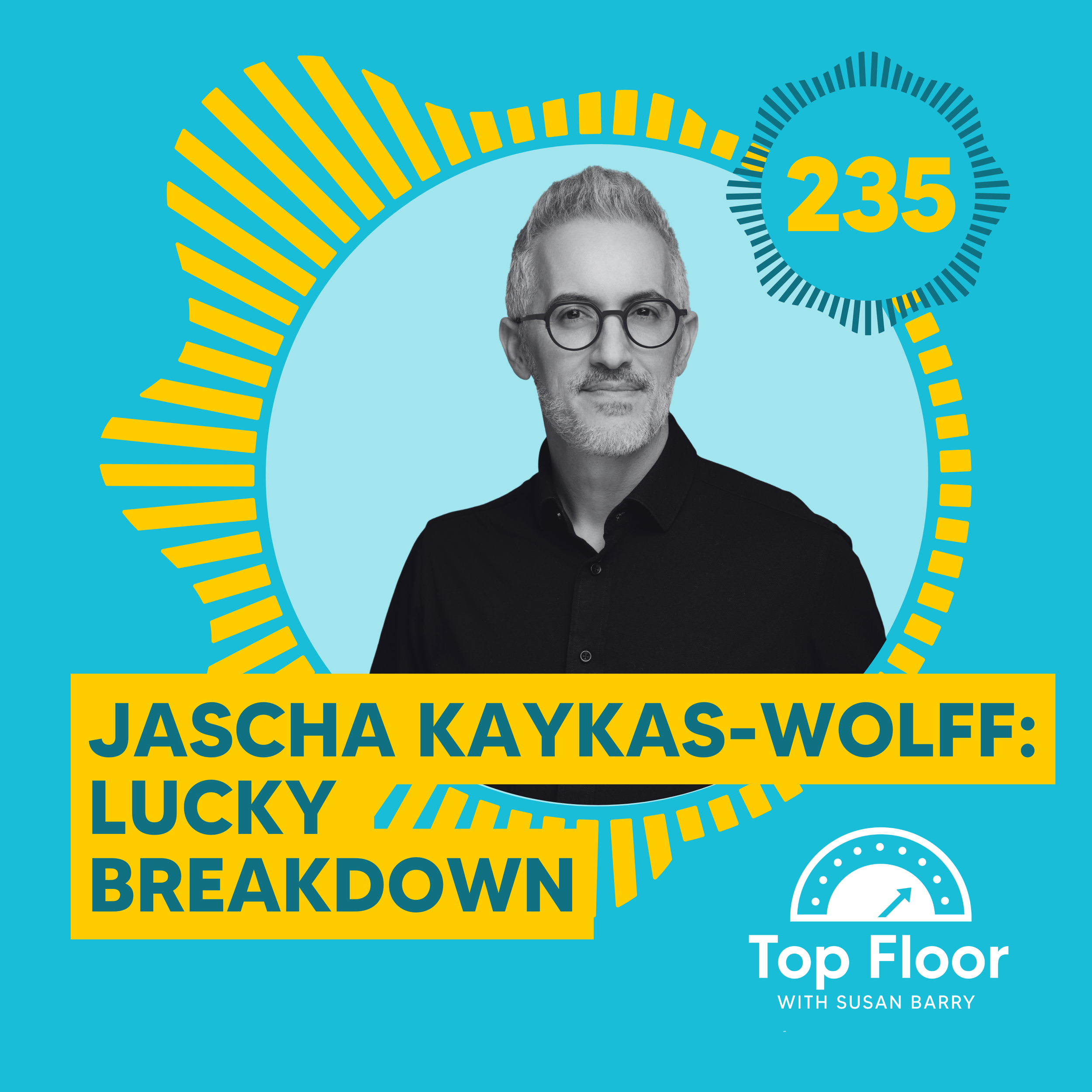
LISTEN TO THE EPISODE:
APPLE PODCASTS | SPOTIFY | TOPFLOOR.COM
[00:00:00] Susan Barry: This is Top Floor with Susan Barry, episode 235. You can find the show notes at topfloorpodcast.com/episode/235.
[00:00:14] Narrator: Welcome to Top Floor with Susan Barry. This weekly podcast ride up to the top floor features tangible tips and excellent stories from the experts and characters who elevate hospitality. And now your host and elevator operator, Susan Barry.
[00:00:32] Susan Barry: Welcome to the show. Jascha Kaykas-Wolff grew up in a socialist collective outside Eugene, Oregon, raised by a pioneering female rock concert promoter who brought artists like Sade and the B-52's into his orbit. From a childhood that oscillated between cultural richness and financial insecurity, Jascha was driven to understand systems and build things that matter. He started his career on early MTV reality shows that I was watching from home, like the real world and road rules, before pivoting into tech during the early days of the commercial internet at places like Yahoo, Microsoft, Torrent and Mozilla. Jascha became known for hiring unconventionally, building systems and helping to create what became known as agile marketing. He is now CEO of Visiting Media, a hospitality first technology company. Today we are going to talk about AI's transformational moment leadership across industries and the future of hospitality. But before we jump in, we need to answer the call button.
Call button rings…
The emergency call button is our hotline for hospitality professionals who have burning questions. If you would like to submit a question, you can call or text me at (850) 404-9630. The emergency call button is brought to you by Cayuga Hospitality Consultants. Cayuga is a highly concentrated organization of the industry's best-connected consultants across multiple disciplines. Members are former senior executives who now work independently on projects worldwide. Learn more at cayugahospitality.com. That is c-a-y-u-g-a hospitality.com.
Okay, Jascha, today's question was submitted by Rafi. I love this question. I think it's a really hard one to answer. So you're in the hot seat. I have a SaaS product that I think would be perfect for hotels. How do I get started selling into the hotel industry? Are there any specific dos and don'ts I should be aware of? Man, this question, we could probably do an entire episode just answering this one, but what do you think off the top of your head?
[00:03:03] Jascha Kaykas-Wolff: Sure. Well, first of all, Susan, thanks for having me. I appreciate it. I'm a fan of the show and I appreciate the question. Look, I think that I wanna be very upfront and say that I'm still new to the hospitality industry. I'm about two years new to it, and this is my learning.
[00:03:18] Susan Barry: That's why I thought this would be a good one for you.
[00:03:19] Jascha Kaykas-Wolff: Let's ask the new person. But look, here's how I would answer that question very directly. What I've learned in the last two years is that this industry, I think, everybody that's in it understands this is people first always. And with that, there is a kind of empathy for those that are trying to get into the industry that I haven't seen in most of the industry that I've worked in over my career. So my initial recommendation is like, go to a property, talk to the people that are at the property, find that front desk person. Have that front desk person introduce you to the director of sales and marketing. Have the director of sales and marketing introduce you into the GM. That will happen because that's what people do in this industry. There's also some bravery that has to go into that, having the conversation physically show up. That's what this industry is all about. That's what I think is so exciting about it, and that's how I would start if I were starting fresh.
[00:04:06] Susan Barry: It's funny, your answer reminds me of something. A friend of mine, Jackie Brown, said to me, she was like, you know, when you're selling in hospitality versus any other vertical, you will get someone furious. That is so nice to you, while they are so furious that you have no idea. People are just hospitable. That's sort of the nature of the game, right? How did growing up in a collective outside of Eugene, Oregon, shape the way that you think about business and leadership? Were you on a commune thinking, this is how I'm gonna set up my org chart when I grow up?
[00:04:41] Jascha Kaykas-Wolff: It is exactly where we grew up on a farm. I grew up on a farm for the first five, six years of my life with my mom and my younger brother and a collective and a commune. This is an oversimplification, but the basic idea that a collective has no central figure who's in charge. It's really a socialist experiment and a commune has a person who's in charge. And that's the distinction. So my kind of reflection back on that time was that one, it didn't really impact me outta the gate, thinking about kind of the way that I work today. In fact, as a young person, it made me almost rebel against the environment that my family, my mom in particular, gave to me. It made me think about being incredibly studious, focusing on just the things that were factual and directly in front of me. Kind of presenting an opportunity for me in a rebellious phase of my life to become a character. And I think I might be a little bit older than you, but maybe we watch the same kind of TV. Alex P. Keaton, family ties, right? Like that's kind of where my rebellion to my family was. Shirt buttoned all the way up to the top, all that kind of good stuff. I think my rebellion put me in a position where I just didn't understand why you didn't have to figure out every single detail yourself and get it done. Because if you didn't do that as a young person, like I wouldn't get the opportunities that I ultimately got, which is getting into college, doing all those kinds of things. As I've gotten older, I have a reflection now that I think fits more in line with kinda directionally the things that were taught to me as a very young person, which is, hey, you have to recognize the importance of each person in a team. That collective is effectively that. There's not defined roles, but if you don't go out and milk the cows, you don't have dairy. If you don't go to the market and sell whatever it is that you're growing on the farm. Then you don't have the ability to come back and provide economic support for that group of people. So this idea of independent ownership, kind of not micromanagement to me, has become a really central theme in the way that I think about my leadership, kind of at least the principles of my leadership. I firmly, firmly believe that when you bring together a group of people, when you invite them in, like it is your obligation and responsibility as a leader to empower them to be autonomous.
[00:07:00] Susan Barry: When did you realize that maybe the entertainment world, at least at MTV, wasn't the path that you wanted long term? I mean, it's very interesting to me because I'm not a big reality TV person now, but real world, New York City and that maybe the first four seasons and the first road rules were like my religion. So I think it's interesting that you were there and then what made you go like, whoa, whoa. Wait a minute.
[00:07:32] Jascha Kaykas-Wolff: Yeah. Well, I guess I can start first by saying I romanticized and I think I still do. Many different things, but the film industry and the television industry in particular, as a young person, it was an escape for me. I was excited about it. That's where I would spend my free time watching movies, going to the theater, doing those kinds of things. When I moved to Los Angeles and went to school there, I was singularly focused on I'm gonna find a way into this industry. And I did, and I got fortunate. When I was there, when I was working for MTV in the Bunum and Murray group, which started all these reality TV shows, singled out road rules, Real World, for me, I had a tremendous amount of pride that I was capable. I would show up to work. I started as an intern, unpaid, and got a PA job. And when I would show up as a PA, like I would do everything that was asked of me, and then I would figure out everything else that wasn't asked of me and how I could get it done also. And I took a tremendous amount of pride in that. I believe that that kind of pridefulness, that ego and the activity, right? The conclusion of getting a bunch of stuff done that wasn't asked of me was that it would put me in a position to be able to get promoted, to get the next job, to get whatever. The environment that I was in there, this is my kind of recollection, the way that I've retuned this memory over the years was that I would work hard. I think I'm a moderately smart person. I could string together a couple of sentences pretty well and be articulate, and it didn't matter how smart I was and didn't matter how hard I worked. It didn't matter the things that I was saying inside of the organization. People would get shoulder tapped. A producer's cousin or nephew would show up and get the production canary role or something else, which was the roles that I was up for. And that became really frustrating to me. I don't think I really understood what meritocratic environments were professionally at the time, but that was really the seed for me that kind of grew discontent of like, Hey, it actually isn't about how high quality your ideas are, it isn't about how high quality your work is, it's about who you know. And that was something that I really wrestled with ideologically and that ultimately left me to leaving that industry. So I think about that today as well. It's like, do the best ideas win? No. Do the most capable people, are they always the most successful? No. But finding an environment where you feel confident that you can be safe emotionally and practically, I think, is the key driver for success. And in that environment, if I look back, my ego was telling me one thing, but the reality was I was in an environment where the organization's leadership didn't really create emotional safety. I didn't understand how to articulate that then, and that drove me to being unhappy and ultimately trying to find a different path. So that's a lesson for me, but really a kind of something that took me a long time to figure out. It wasn't about the work, it wasn't necessarily about the industry. It was about acknowledging that the environment that was created by the management team of that organization didn't fit well with me. And I think about that a lot now, today.
[00:10:19] Susan Barry: So that lack of sort of psychological safety, I mean, it is the same thing as not having meritocracy, though, right? What would the difference be?
[00:10:32] Jascha Kaykas-Wolff: Yeah, like I think saying that there is the potential for a meritocracy just as an organization is a bit of a farce. It's kinda this false promise of the best idea always wins. But I think that the kind of key driver that I'd say is that if that is the concept, the best idea wins. In order for you to feel confident that you can bring an idea forward, you have to have emotional safety. You have to be able to say, Hey Susan, I have a really interesting idea, or, I think it's interesting. Let me present it to you. Let me pitch it to you, and we can have a real conversation about it. And you can say, okay, great, here's the merits of that idea, or this is why I don't think it's gonna work and go back to the drawing board. In an environment like the environment that I was in and it had a relationship to some of the things that I experienced at Microsoft as well, which we can talk about it at a later point if you're interested. But that environment didn't create safety. It wasn't an environment where you could bring ideas in and have them not get shut down. And that for me was really the key learning that I didn't know how to articulate that I bring back today. Marriage ideas, cratic environments. Maybe I don't think that they really exist. However, if you are a good leader, you can create a space where anybody that works with you can come to you with an idea and they're gonna feel safe doing it, even if it doesn't show up in whatever the end product is of the services that you produce.
[00:11:46] Susan Barry: I mean, there is such a thing as good and bad ideas. Some ideas are just better than others. And so I think a lot of times when people perceive a lack of meritocracy, it's because their ideas aren't as good.
[00:11:58] Jascha Kaykas-Wolff: Or they don't know how to pitch 'em, or they don't know how to flesh them out. And again, I think that feeds back into this idea of if you create a safe environment for your team. If that is a primary focus for you as a leader and your leadership team, the potential for ideas to come to you, the ideas to be shared across the organization and have them get better because of participation. Like that's the big win here. And most organizations aren't set up in a way where that can happen.
[00:12:22] Susan Barry: Interesting. Well, you sort of hinted about Microsoft, so let's ask, what did you do at Microsoft? And I know you ultimately had to pitch Bill Gates and Steve Ballmer on Microsoft Store, so I wanna hear about that too.
[00:12:38] Jascha Kaykas-Wolff: Yeah. Well, I think from a professional perspective, doing well, I was at a company called Yahoo back when Yahoo started in the late 90’s. I worked in the commerce group, which meant online shopping, kind of back in the early days of online shopping. And Microsoft was interested in kinda the experience that I had. So they recruited me and brought me there. And I didn't really understand what Microsoft was other than they built. You know, Microsoft Word and the operating system Windows at the time. And it was a behemoth organization, an absolute behemoth organization. The organization was not one that was known for emotional safety. In my early 20s, right in the early aughts, when I was working there, it was the kind of environment where I would show up for a meeting in the business team that I was a part of, and other executives who were in their 50s. I wasn't an executive at the time. I was a young person, a director, and other executives who were in their 50s would scream and yell at me and others in meetings, like literally just dress you down, scream and yelling. And I didn't know any better. I was like, this is just the way that it's going to be. That environment really hardened me to think about when I show up in a meeting, like I have to be prepared for somebody to attack me first.
[00:13:47] Susan Barry: Wear some armor.
[00:13:48] Jascha Kaykas-Wolff: Right? Which is a horrible situation to be in. I like an absolutely horrible situation to be in. So, you know, when I was there, I started to think a lot about kind of what's the empirical information that's available to me that can make a case incredibly strong. And that made me confident going into meetings where I'd say, look, you can say whatever you want about me or about the team that I'm in. That can be your ego that drives it, but I have the facts. And I'm gonna use those facts as a kind of a point of reference. And that's gonna create kind of truth and get us to the right answer. At least that was always my intent. When I was there, a few of my colleagues and I was working in the commerce group. It was in MSN, called MSN Shopping, and a couple of my colleagues and I had all this data that told us what we thought was interesting, that kind of was predicting what would be happening in the future, and that was people were showing up @microsoft.com, the websites, and they were searching to purchase Microsoft products. That sounds very simple, but at the time, nobody had really connected the dots. But in particular, they were searching for the software that we were selling, like a Microsoft Office in Windows, and they were saying to us in the comment fields, we'd actually like to purchase this product directly from you. We don't want to go to a Best Buy or Circuit City. These stores that are around kind of back in that time. So we had all this interesting data and we started to see kind of some trends that were happening that, again, it's very dated, but the trend that was happening that was really interesting to us is that more people were getting access to broadband internet. So we put these kind of pieces together. People are searching for products, people are searching for people to purchase products directly from us, and broadband internet was coming and becoming more and more popular or available. So we thought, “Hey, wouldn't it be interesting if Microsoft created a place for people to purchase their software directly from them and made it available to get it directly as a download?” And that doesn't sound controversial today. It doesn't even sound interesting today,
[00:15:30] Susan Barry: But I remember when this was breaking news.
[00:15:34] Jascha Kaykas-Wolff: Right? It was like that didn't happen. And so we put together a pitch and we kind of took the pitch through different parts of the organization. The pitch was very simple. It was three things like one. People are searching for Microsoft products, they wanna buy it. Two people wanna get it from us directly and they want it now. They don't want to go to a store, they wanna get it shipped to them. Three, broadband internet is real. That's coming. So we can take big products that are downloads and we can make it available for people. And it was like running through the gauntlet, presenting to other executives, kind of working our way through. And we were getting solid feedback. But generally speaking, most of the teams were saying, Hey, we're never gonna do this as a direct business. There's no way.
[00:16:09] Susan Barry: Can you imagine? Oh, that's so funny.
[00:16:11] Jascha Kaykas-Wolff: Yeah. Right. You're like, I guess so. But at the time, the conviction that I had and we had as a team was we have the data, the data tells us the truth, and we ultimately were put in a position where we had the opportunity to pitch the idea to bill. And Steve, not that we were friends, not that we all just refer to 'em by first name. We had this opportunity to go in front of them, and I was petrified. I mean, I had this kind of view in my head of, these are two people that if you mess up, if you say the wrong thing, you're gonna get destroyed and maybe I'll get fired. And I was incredibly, incredibly worried about going to this meeting. And I'd say the most interesting part of the meeting for me, and maybe the big takeaway here, is I sat down in this meeting, I was prepared, we were prepared, we had all the data, we'd had many conversations. We tested the theories. So we presented this pitch to the two of them. And in the middle of this pitch, I'm kind of staring across the table and we're at this big long conference table and the two of them are sitting on one side, and the three of us are sitting on the other side. And I'm kind of looking at Bill Gates and I'm looking at his chest because he was wearing a kind of ratty t-shirt with a little bit of tearing around the neck. And his t-shirt had a mustard stain on it, like he'd been eating a hotdog and it had kind of fallen his shirt. And I share that not to make fun of him, but because in that moment it kind of created a humanity and a connection that I wasn't really expecting, that I try and bring into every meeting that I have today, which is, hey, it doesn't matter who this person is and what role that they're in. Treat them with respect. Bring them information that's going to help them make good decisions, if that's what the value exchange is, but also acknowledge that everybody's a human. This person, multimillionaire, billionaire at the time, had created this company that was wildly powerful. It was incredibly influential in the technology space. And he had a mustard stain on his shirt.
[00:17:55] Susan Barry: I cannot help myself. But to wanna go back a little bit to the part where you said that you would get yelled and screamed at in meetings? Because I don't know that that has ever happened to me, but I hear about it often from my contemporaries. What do you think made that stop? Like, when did people all of a sudden go, wait a minute, we better quit yelling at everyone.
[00:18:23] Jascha Kaykas-Wolff: Yeah, well, I'm gonna juxtapose it to what I think is the geopolitical environment today and some of the kind of cultural elements that we struggle with, or we are struggling with nationally. I am not a fan of the current administration. I'll just be very clear about that. And there are a multitude of different reasons for that. But I'd say one of the things for me that I find most difficult to live in every day is that there's so much comfort in attacking people, and that's becoming a cultural norm again. And I find that to be incredibly disappointing, sad, right? And it weighs on me personally every day. I think that at the time in the late 90s, like in the early aughts, culturally, we were still in a position kind of where it felt okay to be demonstrably kind of mean and attacking to others because that had some business success historically, like the capitalist system kind of thing, that that is an okay behavior. We started to recognize in the early aughts that creating kind of safety for teams, treating people well is actually a better driver for outcome than attacking or micromanaging or controlling. And Microsoft was kind of in the middle of all of these kinds of cultural changes that took place.
[00:19:44] Susan Barry: I hear you on cultural changes, but I have to wonder if it wasn't cultural changes driven by litigation?
[00:19:52] Jascha Kaykas-Wolff: Oh, absolutely. You have to have a change agent. Like this is a resistance movement that kind of showed up in the professional environments and the aughts. The idea of diversity, equity, and inclusion became something that was understood that isn't about just gender representation and ethnographic representation, but it's about understanding how you treat people to create equanimity so that you get the best results and that is an incredibly important, I'll call it a movement. Maybe that's not fair, but it's an incredibly important idea to hold onto it. It threads back to some of the earlier discussion that we've been having. Like it is our responsibility from a professional perspective to create an environment where everybody has the chance to be their full self, to be successful in support of the organization, but that's ultimately gonna be going to be because they feel good and comfortable about the things that they're doing, how it's contributing to them. You have to have resistance to get change. And we saw resistance, and resistance showed up as litigation and that kinda spurred a movement. And now the inverse of that is happening. And I think we have to find another resistance movement, be a part of another resistance movement, and it can show up in small conversations like the ones that you and I are having and maybe the audience, if it resonates with you. And ultimately we're going to have another movement again, of resistance. I'd like to participate in that. I hope we all wanna participate in that. But we have to drive that resistance. We have to drive that movement ourselves.
[00:21:12] Susan Barry: That's true. And I think it is important to always talk about the way that change gets made in using the active voice. So rather than women were given the right to vote, no, no, no, no, no. Nobody sat back and was like, oh gosh, it's time. Let's move society forward. There was a hundred year long fight that took place before that anyway. We could probably talk politics for a hundred hours.
[00:21:42] Jascha Kaykas-Wolff: So I think about this a lot. My mom is a feminist and an activist, and I love her and I respect her as a business person and as a person and as my mother. She's an absolute inspiration for me. When she started her business as a concert promoter in the 70s, she couldn't get a credit card. Because it wasn't legal. It wasn't like legal or not, the policy was that it wouldn't happen. And she was a part of that movement, right? Like she's a part of that movement and we have to be active in making the change that we expect. And that is our responsibility every single day. And if we have a position of privilege, which I do. I am a white, middle-aged man in California. I am in a position of privilege. I am a CEO for a company. It is my obligation, my responsibility to make change happen, to create equanimity inside of the organization in the environments that I'm in. And I think we all have a similar position, if we have a position of privilege.
[00:22:43] Susan Barry: Well, speaking of the company of which you are, CEO, I would love for you to briefly describe what Visiting Media does, because I have some probing questions about the company that I wanna ask next.
[00:22:57] Jascha Kaykas-Wolff: Sure. Well, at a very high level, here is what we do. We care about helping event spaces, hotels, and stadiums sell their property more effectively, and that means giving the seller at that property all of the best tools to be able to showcase exactly what's great about what their physical space is. So we were one of the pioneers in what's called immersive asset creation and capture, that is the 3D walkthrough. Sometimes it shows up like a Matterport dollhouse of a property. We do that at such an enormous scale. We've developed a network of several hundred different technicians all over the world that can basically get to any single property anywhere in the world within a couple of weeks. So we do that. We do that with incredibly high quality, and we do that at a very large scale, and that's particularly important in our value proposition. We match that with the enablement capabilities that are so important for a sales team. We create software. That software is called the Edia platform. The Visiting Media platform takes those assets that we create on behalf of our customers. It brings together the other assets that, when combined, can create the best proposals that help that seller differentiate their property from a property down the street or something else that somebody may be taking a look at. We do that in the hospitality industry, we've done that across thousands and thousands of customers, and we've done that across, I think it's over 25,000 different users of our product over time as well. So we have this very rich community of sellers and hospitality who connect with each other, who do skills training as well. That's really what we're known for. That's what we do, that's what we take pride in, and we continue to try and evolve the best ways that we can. Sales teams at properties.
[00:24:36] Susan Barry: Is this AI? Are you prompting video creation via AI or are you sending a photographer to the hotel? How does it work in practice?
[00:24:47] Jascha Kaykas-Wolff: Yeah. In practice, we send a technician to a property and they capture things live. That is photography that is drone fly-throughs, that is CGI work. That could be done on premise or elsewhere. So we do that work to create those assets that creates a corpus of data. All that's the term of art that I would use. We've got a bunch of assets that we've created on behalf of customers. At the point that data is available, that corpus of data, then AI plays a very significant role in the way that it manifests value for our customers. So I'll give you an example of that. AI sits in our part of our infrastructure that takes those assets that are created, looks at them, uses a kind of vision, APIs and the like, identifies all of the attributes that are associated with a specific space in a property and creates an incredibly rich description with metadata. And end in end that's available inside of our platform so that a seller, when they're talking to you, if you're interested in creating an event at their property, is able to say, I need to find all of the things that are gonna help Susan understand why this is the right property for her to choose for this corporate event, or for this wedding, or for this, you name it. And then it brings together all of his assets. Discovery is another area where AI play can play a role as well. That's just a really simple way to think about how we work and how AI plays the role for us. We capture, we create the data. That data is really the richest point for engagement with AI. AI can do everything from trying to understand the metadata around the image and the assets and enriching those that kinda metadata and the descriptions. And it can do things like, Hey, here's a property shot that shows a panographic info of what's going on at the beach in the day and how the property is laid out. And I can ask that software to use AI to change that into a night photo with a full moon. So we can do a lot of manipulation that's more temporal. That's interesting. But really fundamentally, AI is about enriching the data. And the data are the assets that we capture, and we physically capture those assets.
[00:26:44] Susan Barry: This question's gonna be hard for me to articulate, so I'm gonna maybe talk in a circle for a second. How often do you bump up against objections or feedback that it is unfair to have, for example, a daytime photograph turn tonight. What I'm trying to get at here is, I think there’s a valid but emerging concern that because some things we see aren't real or are enhanced, nothing we see is real. So I'm curious about your company's POV on that and sort of how you're tackling it.
[00:27:28] Jascha Kaykas-Wolff: Yeah. I think it's a wonderful question. Like, should we believe that things are in front of us? I think that's at the heart of the way that I'd framed this question back. So, the answer is, it is our responsibility as an organization to make sure that whatever a salesperson who's using our platform puts in front of a prospect is accurate and true and believable. So there are kind of different paths that you can take if that's not the position that you take as an organization, right? There is. You could create stuff, it could be completely manifested and not real at all. It could be bound to architectural diagrams if you're creating a CGI for a property that is in a remodel, as an example. So we have always taken a point of view that it is most important to represent accurately and truthfully the space that's going to be sold on behalf of the software that we presented and the assets that were presented with the salesperson. That will always be the case for us in the future. And it is important to acknowledge when changes have happened and AI is used to do that. So if you want to see the change log, it's important to be able to get access into. There's a term of art in open source that we use, that I still use today, that is trust and verify. So the idea is if we go into whatever it is that we're doing with. First a lean in to say, I believe that this thing is accurate. I also need to have access as the user, as the developer, as the seller, as the customer, to be able to verify that the thing that I'm choosing to trust is accurate. That means that we as an organization, when we present an image or an asset that has been manipulated with AI, we need to be able to show the change log so that a customer or prospect should be able to understand that. So I think right now, maybe more so than we've seen over the last 30 years. It is critically important to bring that open source kind of term into everyday life. Trust and verify.
[00:29:26] Susan Barry: For sure. Is there anything in your current business that you feel like is at risk as a result of AI or other tech developments?
[00:29:37] Jascha Kaykas-Wolff: I don't think that there's something that is at risk because of AI with our business. I think there is an opportunity for more competitors to show up in our space more quickly. If they want and so choose and use AI. But what I will say is that the thing that makes us really unique as an organization that makes right now so exciting, is that we have an enormous amount of data that we've collected over the course of the last decade. That data, our assets, their photography, their models. That is really unique. That's a moat in kind of a product parlance, because data is what makes AI useful right now. Like AI, a model, a frontier model, a model that you install locally on your computer, like one of the alama models. Like those things are only as useful as the data they have access to. So we have this incredibly rich, incredibly large, it's like a quarter billion of assets in our management as an organization, a corpus of data that makes AI incredibly exciting for us to be able to deliver more value to our customers right now. So, is that something that will last forever for us, I would never say that. We always have to be thinking about what can we do to be better for our customers, but right now, I think AI is incredibly exciting for our organization and ultimately for our customers because of the access to data that we have uniquely as a company.
[00:30:50] Susan Barry: Oh my gosh. I'm just sitting here thinking about the content you could make with access to all of that imagery and everything that you have. I realize that's not your business, but it would be fun.
[00:31:03] Jascha Kaykas-Wolff: Well, I think the question there is maybe it could be. Maybe it should be. And that's what we get to explore with our customers to validate that's something that they want. And that's what we get to explore, kind of with our technology team and our product teams, if that's what we want. But that's the right way to be able to answer questions or ask questions right now. It's like, what if we did this? Because the time to be able to do it now is so compressed. It's so fast. Like I'm building things. I'm contributing to our GitHub repo as a company, not it any with any regularity, but I'm not an engineer. I'm moderately technical from a systems perspective, but I'm not an engineer and I don't write code. And I have been able to contribute in a way that I've never been able to in my entire professional career because we have access to tools, because we have access to data.
[00:31:50] Susan Barry: We like to make sure that our listeners come away from every single episode of Top Floor with specific, practical things they can try either in their businesses or in their day-to-day lives. So as someone who I think has done a spectacular job of future-proofing your career, such as it is. I'm sure you weren't thinking about that at the time, but I'm curious if you've got skills or advice or suggestions for hospitality professionals that they should be cultivating now so that their career doesn't go kaput in the 5 to 10 years.
[00:32:29] Jascha Kaykas-Wolff: Yeah. Well, I'll bring it back to the late 90s and the early aughts. I think that the parallels to what was happening with the internet at that time and maybe some individual's excitement and others, skepticism and what ultimately has happened, right? At that time, we had so many experts around the world saying the internet is going to be a fad. There's a gentleman named Paul Krugman. I think he was a, one of the economic advisors under the Obama administration. He is kind of famously outspoken, politically as well. Paul Krugman, I think, was maybe incredibly well known in that time period as an economist. To saying, Hey, by, I think it was like 2001, is his quote, the internet's gonna be looked at with the same kind of economic impact that the fax machine had. So there, there was so much skepticism by experts and that stopped.
[00:33:22] Susan Barry: It's so funny. At that time, we were not allowed to have email or internet access in our office. Because they thought we were gonna like, I don't know, download porn or whatever. Can you imagine search the internet all day?
[00:33:37] Susan Barry: Yeah. It's crazy.
[00:33:38] Jascha Kaykas-Wolff: So, pull that forward to today. Many organizations do the same thing. Like, you can't use whatever, ChatGPT, Claude, you can't use that in the office. So, you can only use Co-Pilot, whatever the thing may be we're seeing very similar things today. It's parallelism. So why do I say this? Because I think that the skills that we have to develop right now to future-proof ourselves are all related to being curious about what AI can do with us and for us right now. AI is like the internet in the 90s, which means if I'm in hospitality, I should be figuring out how if my company's not sponsoring me to do this, how I can individually start to experiment so that I can make myself more effective in my professional capacity. And that means, if I'm a front desk person at a hotel and my hotel doesn't have access into ChatGPT, maybe I'm using the free version of it. Maybe I'm using the paid version of it. Maybe I'm doing the same, Claude Perplexity, whatever, but I should be researching my VIP guests. And building dossiers of them. We know that happens already, but like, what am I doing to speed up that process? Maybe if I'm in marketing, there are tools out there that I'm not gonna plug tools, but there are tools out there like Lovable and Versal that make it really easy to build apps and, microsite and publish things to the internet. Like maybe if I'm in marketing at a property, instead of waiting for the giant CMS from brand.com to show up and do different things for me. Maybe I'm creating little customized micro sites for prospects that I can do in a couple of minutes. We have an opportunity to be a builder right now in every single role, in every single industry and every single company. I think that is very true in hospitality as well. You have to have the curiosity right now and kind of force yourself to start to experiment and that's really my kind of biggest ask for anybody that is excited about a conversation like this and wants to lean in and think about what to do. It's like find the projects that you can work on personally and professionally that are gonna help you build skills, have awareness of what's going on. We're so early in the adoption curve of AI. I know there are many, many users of things like ChatGPT and Claude globally, but we're talking about a percentage that's in the low single digits of the global population, like we are way early. So get in early and use the tools to your advantage and make better skills for yourself so that you will continue to be competitive in whatever the environment looks like over the course of the next several years. But you gotta start now.
[00:36:01] Susan Barry: Well, speaking of the next several years, we have reached the fortune telling portion of our show. So if you haven't done enough of it already, you have to predict the future and then we will see if you got it right.
[00:36:13] Jascha Kaykas-Wolff: Yeah. All right, so we'll come back in, in five or six years.
[00:36:16] Susan Barry: Exactly, and give you a score. It's probably gonna be five or six months at the rate things are going.
[00:36:21] Jascha Kaykas-Wolff: I'm perfect. Let me give you a prediction globally that I think is gonna take place in the hospitality industry. And kind of root it in why I think that's the case. So, we can all be builders now, like the bottleneck that has existed for, I don't you and I don't know each other super well. I don't know how technical you are. I don't know if you're a developer. But if you are great and if you're not, like you can relate maybe to what I'm about to say. I can, and maybe you can, if you're not an engineer, build websites now. We can do that in a minute. I can. You can build SaaS software. Software that can support my business because I understand the things that I need and I can describe that to, and I can build it with me. This is a renaissance of building that we're starting in right now. So how does this impact the hospitality industry? Well, have nots in the hospitality industry, in my opinion, in my experience of the last couple years. If you are attached to a large brand, if you're a part of a big management company, you get resources that help promote your property, that help you kinda get more bookings, that help you do the things that are necessary to do. That have nots are independent for the most part. Maybe they're not resourced in a meaningful way. Maybe it's a small family that's running a very small local, specialized property. You don't have the resources to be able to be a builder now or historically, I think that you do now. And I think that in the future, over the next five or six years, we're going to see a boom in independence. Marketing, discovery is going to be so much more accessible and that's going to give you, or me, if we're an independent operator, the ability to be competitive with some of the biggest properties that are out there in the world, that have the resources that are enormous behind them. That's how I see the future happening in hospitality, and I think it's really exciting. If I'm a big company, I gotta be thinking about the same thing. What do I do to be competitive with the fact that everybody can do what I'm doing right now, or will be able to.
[00:38:18] Susan Barry: Well, it's interesting too from a timing perspective, because it dovetails so precisely with the profusion of thin slice brands in big hotel companies that are not consumer driven. So consumers don't care about any of these brands. They care about their points. So the timing for an independent to be able to a collection of independence, to be able to take a bite out of that market share is probably perfect. Okay, folks, before we tell Jascha goodbye, we are going to head down to the loading dock where all of the best stories get told.
Elevator voice announces, “Going down.”
[00:38:59] Susan Barry: Jascha, what is a story you would only tell on the loading dock?
[00:39:02] Jascha Kaykas-Wolff: Well, we talked a little bit about my professional history, and so I want to share a story that I share with friends, and that's about it. But I think it might be kind of fun here. Maybe a lesson attached to it. So, when I was working at MTV, I was pretty disenfranchised and I wasn't really sure what I wanted, what I was going to do studied in school, I had a BA in Psychology. I'd studied film, and I'd been working in film and television, but it just didn't work for me. And so I was sad, depressed, frustrated, I had left this organization. My mom had connected me into an organization in Portland, Oregon. I was living in the north, in Southern California, at the time. And it was a big event facility and they were looking for a promoter, and I had some experience doing that. And so I was on my way up to Portland to have an interview and have a discussion. On my way, by the way, I was driving my daily driver, which was a 1952 Packard. So impractical person, kind of an idealist. But it was a very pretty car. It's the huge car with a giant corner on the front with a gorgeous car. So I'm driving up the coast of California and for those of you that haven't driven up the coast of California, from Los Angeles to San Francisco is unbelievably beautiful. The coastline is gorgeous and you can basically drive it the entire way. You hit cities like Santa Barbara and Carmel and other places like that along the way. As I was driving along, I was around kind of northern California. I had gotten to around where Pebble Beach is, effectively, and my car broke down. My 1952 Packer broke down like the radiator, fan seized up. And these cars had a straight eight, which is the engine block. And it didn't have a recirculating radiator. So when it got hot, it just shut down.
[00:40:46] Susan Barry: Interesting, this is why I don't have a classic car, by the way.
[00:40:49] Jascha Kaykas-Wolff: Yeah, right.
[00:40:52] Susan Barry: Cause I want one so bad, but no.
[00:40:54] Jascha Kaykas-Wolff: I drive a giant battery, so that's just the way that it works. But my car broke down and I didn't know what to do. This was a time where cell phones weren't really around. I had a couple of friends that had graduated from college a couple years earlier, and they were in sales and they lived in San Jose and they were working in Silicon Valley, literally working at, at silicon chip factories and salespeople there. So I called them on a payphone and I was like, “Hey, I have a problem. I have AAA, so I'm gonna tow my car to your apartment, and I need to stay there for a little bit and I have to figure out how to get this part remanufactured.” And so I'm there, I'm at my friend's place. And I like an existential moment. I'm a young person. I don't really know what I'm gonna do with my career. I don't even think about it as a career. I'm like, what am I gonna do to get a job next? Like, what gonna happen? And I got the couch, so I'm crashing at my friend's couch. This is in the late 90s. I don't know what I'm gonna do. They were both business majors and in sales. And so they got the Wall Street Journal and the San Jose Mercury News, the newspapers, what the thing they did. So I'm like a week into staying there with them and I open up an article in the San Jose Mercury News in the business section, talking about this counterculture company that had started cared about organizing all the information on the internet and, and making it available to everybody. And the company was Yahoo. I didn't know anybody there. So I had a Power Mac as this very old Macintosh computer from the trunk of my car. I plugged it in my 56 BOD modem, which is the thing where you'd dial up and it'd be like make all those noises.
[00:42:20] Susan Barry: I wish I could make that sound like during the impression of that sound. It's so funny.
[00:42:25] Jascha Kaykas-Wolff: And, I wrote an email to jobs@yahoo-inc.com, which is their like general inbox for jobs. And I wrote my diatribe, this is who I am. These are the things that are important to me. This is what happened to me growing up. This is what I've been doing in school. This is the work experience I've had. I'm not sure what I can do here, but I am excited by your mission. I'm excited by what you're trying to accomplish, and I feel like I would be a great fit and be able to contribute. Talk about a lark, right? And I got a call back few days later.
[00:42:56] Susan Barry: Are you serious? Of course you did.
[00:42:58] Jascha Kaykas-Wolff: And, I went in and I went through my interview and I got hired on the spot on that job. I think about this story often because, one, it's real, and two, I think about kind of the absurdity of it, but more importantly, I think about how curious I was as a young person to be like, well, this is interesting. What if I just reach out? What if I put myself out there and I think about the importance of being curious today so often. It's like, I don't know all the things that are gonna be happening with AI, as an example, now, next month, a year from now. But if I stay curious and I keep asking questions like I'm gonna put myself in a good position, that ultimately is gonna help myself and the people that I'm with. And I think that's just a wonderful lesson that I picked up as a young person. Around, a funny story of a car breaking down around Pebble Beach and staying on a friend's couch and reading a newspaper.
[00:43:53] Susan Barry: That's so crazy. So I have to ask you, did you end up getting the car repaired, or did you just give up and move on and go to work for Yahoo?
[00:43:59] Jascha Kaykas-Wolff: I did get the car repaired. I drove it for another few years, and I actually sold that car on Yahoo Auctions. A person bought it in like 2001.
[00:44:10] Susan Barry: That's a perfect full circle. Well, Jascha Kaykas-Wolff, thank you so much for being here. I know our listeners learned a lot, and I appreciate you riding with us to the top floor.
[00:44:21] Jascha Kaykas-Wolff: Thank you for having me, Susan. Appreciate it.
[00:44:23] Susan Barry: Thank you for listening. You can find the show notes at topfloorpodcast.com/episode/235. Jonathan Albano is our editor, producer, and all-around genius. He even wrote and performed our theme song with vocals by Cameron Albano. You can subscribe to Top Floor on Apple Podcasts, Spotify, or wherever you like to listen, and your rating or review will go a long way in helping us give you more of what you like.
[00:44:59] Narrator: Thanks for listening to the Top Floor podcast at www.topfloorpodcast.com. Have a hospitality marketing question? Reach us at 850-404-9630 to be featured in a future episode.