
Transcript: Episode 259: The Longevity Economy
LISTEN TO THE EPISODE:
APPLE PODCASTS | SPOTIFY | TOPFLOOR.COM
[00:00:00] Susan Barry: This is Top Floor with Susan Barry, episode 259. You can find the show notes at topfloorpodcast.com/episode/259.
[00:00:13] Narrator: Welcome to Top Floor with Susan Barry. This weekly podcast ride up to the top floor features tangible tips and excellent stories from the experts and characters who elevate hospitality. And now, your host and elevator operator, Susan Barry.
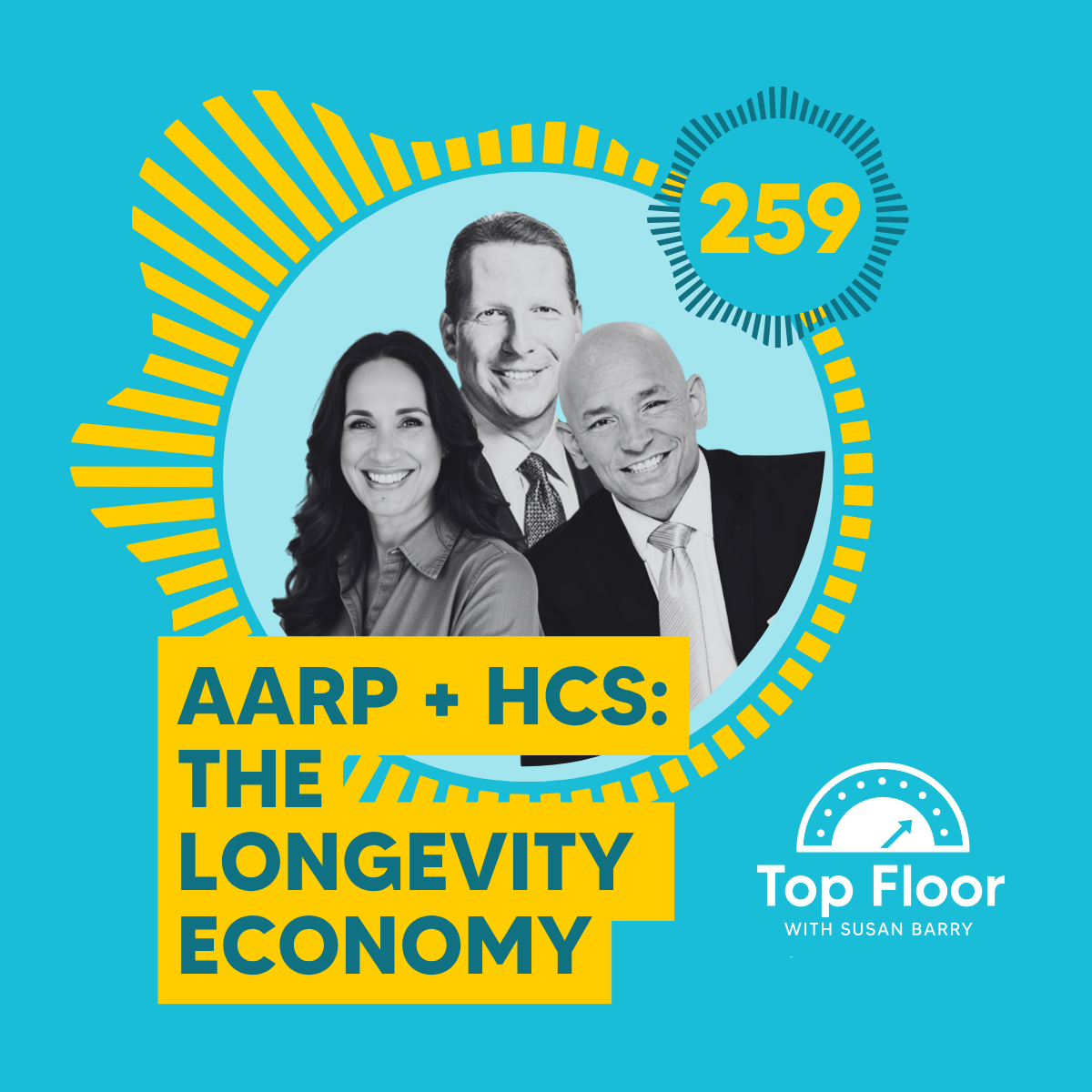
[00:00:32] Susan Barry: Welcome, hospitality creators. I am Susan Barry, host of Top Floor and Queen Bee at Hive Marketing. I am delighted to kick off today's webinar. Scott Frisch is... All right, take notes, CEO and EVP at AARP, where he has grown strategic operating reserves and launched major investment funds for health and wellness innovation and dementia research. A certified public accountant and Villanova graduate, he previously held finance leadership roles at AARP Services, Columbia Management, Putnam, and KPMG, and he serves on several boards, including the Milken Institute Center for the Future of Aging. Anna Blue, our sister who we all already know, is CEO of Blue Moss Group and co-founder of the Hospitality Creator Summit, a platform connecting hospitality leaders, creators, and brands. With over two decades of experience shaping purpose-driven strategy for companies like Disney, Apple, and Google, she now advises hospitality organizations. Anna speaks internationally on leadership, equity, and the future of work. And her co-founder is Anthony Melchiorri, founder of RJO Hospitality and a veteran hotel developer, operator, and asset manager with over thirty years of industry experience. Anthony is best known as host and executive producer of Hotel Impossible, Five Star Secrets, Hotel All-Stars, and Extreme Hotels, and he is the author of Show Up. Households headed by someone fifty or older spend more than two hundred billion dollars on leisure travel. Hospitality businesses that under-invest in older adult travelers or treat them as niche business risk missing the fastest-growing and most reliable segment of leisure spending. So now I will turn it over to Anna, Anthony, and Scott, who are going to dig into the longevity economy.
[00:02:54] Anna Blue: Beautiful. AARP came in as our first sponsor of the inaugural Hospitality Creator Summit, and immediately there was a lot of buzz about why AARP. Nobody sees your logo typically at hospitality conferences, so we are really excited to dig into why you've joined us, and why Hospitality Creators, and what the longevity economy is, and all of those things. So welcome. Level set, set the stage for us. What is the longevity economy, and why should everybody in hospitality care about what that is?
[00:03:26] Scott Frisch: Yeah. Thank you, Anna, and I appreciate you having me on. To answer your question directly, we've been looking at something called the longevity economy for a long time at AARP. I think we started about 10 years ago, really to help figure out how much of this audience that we represent, of which there are 125 million people over the age of 50 in the United States alone, what kind of economic impact, direct or indirect, is this cohort of people, which today represents roughly a third of the US population, what do they contribute to the US GDP? 10 years ago, we were at $8 trillion. We just came out last month with our new updated report. Americans 50-plus and older in this country contribute 12.5 trillion in annual economic activity. That's projected to double by 2060. So it is a massive cohort of people with a massive amount of economic impact. To put it into perspective, if you look at the US economy, the Chinese economy, the longevity economy would be the third-biggest GDP from a country's perspective in the world. So it's that large. Probably your first reaction is this a demographic issue or demographic subject or story? Yes, but also no, because it's more of an allocation of capital for businesses in the market in general. To think about how to tap into this cohort, people aren't always thinking of this cohort as a group with this kind of impact. Everyone automatically goes to the younger cohort of 18 to 35 from a Madison Avenue, from an advertising perspective, but this is really about a thirty of the US population generating $12.5 trillion, and we'll get into this in a little bit more detail, of which travel, leisure, hospitality is a huge component of that longevity economy.
[00:05:20] Anna Blue: Anthony, before you jump in, I just want a quick note. I should've said this already. Pop questions. We will have a conversation, but then we've got some time for questions from other folks as well that Scott's happy to answer. Sorry, over to you.
[00:05:34] Anthony Melchiorri: Those numbers are absolutely amazing, and I'm sure a lot of people don't realize that impact. But what's the one number or that really gets people's attention of 50 and over for travelers, where they're spending their money? What's the thing that shocks people the most?
[00:05:49] Scott Frisch: So I think there's two numbers. One really large one and one slightly less than that. But one number that should shock you all is that in our study, $1.4 of that $12.5 trillion is spent on travel, leisure, and related products. That's up 20% from the last time we looked at this review in 2018, and that's even after accounting for inflation. So think about it, one point four trillion dollars is not a rounding error. That is a structural market signal. The second number, which is a subset of that, is you look at just travel alone. Consumers aged 50+ spend $236 billion in travel alone, which is 59% of all US spending classified as travel. So if you think about it, you're looking at a trillion, one point four trillion. You can slice that number however you want. It's a massive amount of money being spent in the hospitality industry writ large. Early in the year, we do something of a travel trend study, and really that confirms that the momentum isn't slowing down. In fact, nearly two-thirds of our adults in that study said they're planning to travel this year. Anticipated trip volume is on the rise. Interesting point: even though the subject has been about affordability in this country for a variety of reasons, all justified reasons, things are getting more expensive, etc. These travelers in that latest traveler study, they're not retreating from the economic pressure. They're just getting smarter. They're using AI, they're using other tools. They're thinking about when they travel, where they travel, what time of day they travel to reduce the economic pressure of inflation and what have you. But it's not slowing down the anticipated volume or trip volume happening in the future. If you layer that along with the demographic map, people fifty-plus are again one-third of the US population by the end of the decade. Every time I say this, this shocks me. There'll be more Americans over the age of 65 than under 18, and that crossover has never happened in US history. So I think businesses, whether it's your industry or others, need to be cognizant of that. And if you think about looking forward, as a trend may suggest, I would say that trend line is going like this for the hospitality industry for that over 50+ population in the US today and growing over time.
[00:08:10] Anna Blue: Wow, those numbers are massive, and I don't think people think about that, including the people that are designing hospitality experiences, right? So as you mentioned, sort of the Madison Avenue, the 18 to 35, I think a lot of hospitality companies are still looking at designing experiences for younger travelers, people with younger families, they're trying to compete with the Airbnb market and get the college audience and the young professionals. What's the blind spot there? What do you think is missing as hospitality companies design these incredible travel experiences for people?
[00:08:47] Scott Frisch: How I would frame the opportunity is that you have an extended lifespan. On one hand, we're getting older, and for the most part, we're getting healthier as we age, which is opening up opportunities for people to do more things that they otherwise would not have been able to do, travel being a huge part of that. And you're right, the way hotels, as an example, the way we travel through airports, the way we think about travel as we get older is a little bit different. But I'm not sure the industry itself has followed through on that. I'll give you one unique pet peeve of mine. I have two daughters in their mid-twenties. I don't think they've ever used an iron or an ironing board, right? You go into a hotel now, most of them have the steamers, and the steamers drive me nuts, right? I like to iron my shirts, especially when I'm on business travel, right? So it's just one of those unique generational differences. Literally, I don't think my girls would ever even know how to turn an iron on, let alone use one. But that's just one little unique example. If you think about it, people getting older, there are health issues. Again, healthier than in previous generations, but still health considerations. You wanna think about how to shape travel, not whether they travel or not. So what you do to think about that audience is a different perspective. Advertising in some ways has caught up with this longevity economy, which is great to hear. If you think about people over the age of 50, there's more international travel. There are bucket list items. They commit earlier to destinations. What's happening is you have to be able to think about this cohort. What do they want? What do they need? What's gonna make you be that property or that experience that someone wants to spend their money at? And it's a little bit different than what your eighteen-year-olds are. And I can say that from personal experience, given my two kids. And then the other thing I think that is another back to, I think it's question four, another crazy stat is that, according to our studies, 25% of the hospitality industry workforce as a whole is over the age of 50. So think about it. Adults over the age of 50 represent 25% of the hospitality workforce. You're employing a huge population that lives and breathes this stuff every day. So I think there's a lot of room we have to just start to think differently.
[00:11:10] Anthony Melchiorri: Wow. These are crazy numbers. So you're in a room, basically, a virtual room, with a bunch of creators, and they really haven't thought of AARP and the 50 and over, so what's the one thing you want them to start thinking about and what do you want them to start talking about on their platforms? Cause there's a lot of them, and they're influential.
[00:11:29] Scott Frisch: Yeah, and it's a great question. I appreciate it. I think the first is awareness, right? Which is part of what this conversation's about. It's all these conversations that AARP or I have done over a number of years in different industry sectors, is to think about the cohort writ large. Think about $1.4 trillion of spending, a lot of money, in sphere of influence, and how do you translate that awareness into architecture, design, build, engagement, whatever term you want. That's the connection that we believe and that most industries need to make in order to continue that profitable growth line in whatever you're doing. So I really think the awareness of one point four trillion dollars, that audience attributes that I've just spoken about, think about how to translate that into more usage, more engagement. Social media, digital tools. There's this old myth that the older you get, the less inclined you are to be up-to-date on technology, which I think that myth fell finally, away after the pandemic. All the social media channels are reaching everyone in this age group, especially the younger age group within the 50 cohort. The last thing I would leave you with on this particular question is that I’ve been at AARP a long time, 20 years, a little bit more than half my career, and when people think about older individuals, they automatically go to the end of life, very old, the folks that aren't traveling, the folks that are have so many health issues that they're very limited in what they can do for whatever makes them happy. There's a whole lot of people that aren't like that in this country, and I think you have to remember that cohort is pretty big. So take it from awareness, think about how to attract those individuals, what kind of systems you need, buildings you need, services you need, engagement, travel, etc., and you'll have the recipe for something that can be very productive in the future.
[00:13:22] Anthony Melchiorri: Yeah. 50-year-old was definitely different when we were younger than it is now. Most 50-year-olds are in better shape than 30-year-old people I know.
[00:13:30] Scott Frisch: As a 57-year-old individual, I'll take that as maybe something I can strive for.
[00:13:34] Anthony Melchiorri: I'm a 61-year-old individual, so.
[00:13:36] Scott Frisch: There you go.
[00:13:37] Anna Blue: It's so interesting, I think, because with our creators, and I'm looking at who's on this call, and we have so many people that talk to the business side of the industry. We're not focused on the travel creators as much as we are the business creators who are talking to the CEOs and the leaders of all of the different facets, predominantly I would say the hotel industry, but really hospitality broadly. If you wanted all of them to post one thing to their audiences today to wake up the business side of the industry, what would it be?
[00:14:05] Scott Frisch: I would tell the story of that 50+ traveler in such a way that the reaction on the other side of the table is, "Oh my goodness, this is absolutely a no-brainer to figure out how to solve this." And that spark will start to create other sparks, which will translate into new services, new products, new hotel themes, whatever it may be. The numbers are so big, it's impossible not to be able to look at that and say, "I need to do something about that or with that." There's no ambiguity about this, right? These individuals of which I am part of that cohort, as is Anthony, we're spending money on hospitality, leisure, and travel. There's no disputing that. The question is, are you going to lean into it? The people you're having a conversation with, are they going to lean into that? And I think from our perspective, and probably hopefully after you guys listening to me for the last 20 minutes, that answer is yes, we absolutely have to lean into that. And then it's up to you all to figure out what that next step is.
[00:15:14] Anna Blue: We do have some questions I already see coming in that are specific to exactly what you're saying. So while Susan is popping back on, Anthony, you are the king of the interview. One more question for Scott before we open it up to everyone else. This is your opportunity. Whatever you wanna ask.
[00:15:32] Anthony Melchiorri: What would you say to the CEOs of the brands? Because 80% of hotels today are flagged, right? And none of them own properties. They just flag the hotel, and they really concentrate on the Bonvoy member or the preferred member. And so they look at it as, if you're holding this kind of card, we're gonna treat you special. Instead of looking at a segment, like A or B, whether they have a card or not, they're special. So what would you say to a CEO that's really just focused on bringing memberships on as opposed to a specific demographic?
[00:16:10] Scott Frisch: Yeah, great question. I'm gonna use this from personal experience. I am a longtime Hyatt participant in their loyalty program. At some point in my career, I once stayed at a Grand Hyatt Hotel, the same hotel, for roughly six years, almost every week. They became like family. So you have a loyalty program, and then you have non-people that are staying in hotels that aren't part of the loyalty program. To me, it makes no difference whether you are in the loyalty program, whether you're staying at a property for a variety of reasons. Obviously, I just described that loyalty to the Hyatt properties or the Hyatt brand. I'm gonna look for them first, just because I've been doing it for so long. That's one filter. Obviously, the location. They don't have the type of hotel that I'm comfortable with, right? I'm going to go on to the next chain or the next boutique hotel. I think what people think about loyalty programs is the end of everything. It's the end and be-all of everything. To me, that's the first phase, first step. If you don't hit it in the first step, you're gonna go to the next one. If you don't hit it in that one, you're gonna go to the next one. And because of such consolidation in the industry, for the most part, notwithstanding some of the hotels I've stayed in the last few weeks in Columbus, you have to be able to hit multiple levels, and you can't just assume that loyalty program is gonna get you everything you want. It's just impossible. Then you have the combinations of the Airbnbs and VRBOs in that segment, which is another wrinkle. And again, my cohort, my complex and friends that I have, do we do Airbnbs? Sure. It's mostly when we're traveling with family. But if it's just my wife and me or if it's just the two of us, we tend to go more towards the hotel for all the services that we like, the restaurants, the concierge service, the walk in there and have someone else tell us exactly what to do. But thinking about them aligned with this massive population that's spending money, I would say don't lose sight of either one of those. Combine them.
[00:18:14] Susan Barry: This episode of Top Floor with Susan Barry is brought to you by Lodgify. Here's one that will resonate with anyone who has ever managed guests in any capacity. Your phone does not care that it's 11:00 PM. Someone always has a question, a request, a check-in issue, and if you're the one running the property, it lands with you. Lodgify has an AI tool that handles guest messages automatically, so the routine stuff gets answered right away around the clock without you having to be the one doing it. You stay in control, but you don't have to be on call for every little thing. Top Floor listeners get 20% off on all one or two-year plans with the code TOPFLOOR20. Go to lodgify.com or the link in the show notes and use code TOPFLOOR20.
We've had some great questions come in so far, and just as a heads-up to our attendees, you may be looking for a chat. Instead, look for the Q&A. And if you don't see it on the bottom of your screen, click the three dots to more and that'll pull up the Q&A section for you, so you can type your question in there. So our first question is from Kate Parrish. Kate asks, "What are the biggest opportunities hotels are missing when it comes to serving and marketing to the longevity economy?" And then we've got a follow-up question from Kate. This marketing question is a popular one. There are a couple more about marketing, so I'd love for you to lean into that a little bit if you can.
[00:19:57] Scott Frisch: It's great question. Full disclosure, I'm not a marketer. I don't have marketing in my titles.
[00:20:02] Susan Barry: Not yet, Scott. You have some more C's in there.
[00:20:05] Scott Frisch: That's definitely not gonna happen. So take all this with a grain of salt from a marketing perspective. To answer the first part of the question, what's the biggest opportunity hotels are missing when it comes to serving and then marketing, we'll skip the marketing to the latter point. I think you have to remember as hotels are redesigning their properties or building new properties, you have to cater to the market that you think that you want. And if you're catering to a market that's older, you have to think about those attributes. You can come to us, you can come to plenty of organizations that can help you think through what does a 50+ traveler want in a hotel design, right? Do you want closets with doors or do you want open cubbyholes like kids like?
[00:20:46] Susan Barry: I feel like some of your biases are slipping out.
[00:20:51] Scott Frisch: These are definitely not quiet biases, but these are the common things that people think about as they get older. Part of this conversation is an awareness of that audience. Now again, the marketing of it, I'm not the marketer here. But I would say contrary to what I just said about hotel design and layout, etc., people over the age of 50, we're in every channel possible. We're in all the social media channels, all, they’re everywhere. The 20-year-old, the 30-year-old, the 50-year-old, 60-year-old, we're all there. Spend a day on Instagram and you'll see the older audience throughout the whole thing, right? Spend a day on Facebook, you'll see it. So obviously, the way you develop content and the messaging may be different, but the channels are the same.
[00:21:36] Susan Barry: The second part of Kate's question has to do with how technology can enhance the experience for this cohort of travelers without making it more complicated. Do you guys have a POV on that?
[00:21:48] Scott Frisch: I don't know if we as AARP have one specific, so this may be more of me speaking from personal expectations as an experience and expectations rather than AARP itself. I think there's always the effort to be more sustainable, reduce energy consumption, make things easier. But how many times have you walked into a very nice hotel room and you've got, like, 12 different buttons to or slides or whatever to turn the lights on, and you need the key card or the master holder at the front of the door? It drives people, it drives me nuts, and I stay in a lot of hotels all over the country. Drives me nuts. I can't tell you how many times I've picked up the phone in the room and called down to the front desk and be like, "Just tell me which button to press at this point. It's 2:00 AM and I'm tired and I've been on the road for 12 hours. Just make it easier for me." And that's my point. Make it easier for people, and do what it takes to make it easier. Technology's great, but sometimes it has the negative effect of I just don't wanna deal with it. Just give me one button to punch.
[00:22:51] Anthony Melchiorri: I really enjoy at 3:00 in the morning when the air conditioning goes off because nobody's moving in your hotel room and you have to get up and go put the air conditioning back on. That's my favorite.
[00:23:01] Scott Frisch: I've been there many times. That's a great point, Anthony.
[00:23:04] Susan Barry: That may have been the answer to Scott Eddy's question, but I will ask it in case you've got more. What is one thing you wish every hotel CEO understood about the 50+ traveler that they just don't seem to get?
[00:23:18] Scott Frisch: Anthony's comment's a great one. I think my previous one's a great one. The other thing I think is missing, again, is a lot of these, a lot of hotel properties will develop activities. The concierge desk gives you access to certain things, sometimes I think that's missing, that focus on the 50+. I think that's just a third element of make it easy to get in and get out, make it easy to use the benefits of your room, and then create the activities or access to activities that hit a broader range of the population, including the 50+.
[00:23:49] Susan Barry: Okay, we're gonna shift gears to the food and beverage side of things. This is from Meredith Marin, and she asks, "How do you see dietary habits and needs changing among this cohort, and how would you recommend hotel menus adapt?" I love this question.
[00:24:07] Scott Frisch: Yeah, it's a great question. Again, I would start off by saying the dietary needs aren't necessarily any different than the broader US population, right? You go to a restaurant today, you have gluten-free, you have dairy-free, you have whatever. It's no different for this population. So again, if you're thinking about your menu selection, think about it, look at the demographics. There's more research out there, but it's similar by cohort. People that are in their 40s today and 30s today that are, that may be drinking less alcohol or may be stricter, keto diet or whatever. Most folks are aging into this population, right? 10,000 people a day are turning 65 and will continue to do so for another 4 years, right? My dietary expectations aren't changing just because I turned 50. The low sugar move, the no sugar or low sugar movement, that's taking care of everybody, right? It doesn't obviously, a switch isn't flipped all of a sudden the day you turn 50.
[00:25:05] Anthony Melchiorri: I think your point about the generations is we've never seen it before, where the generations are just fitting into each other, whereas before a 30-year-old and a 60-year-old were completely opposite. Now it's today, to your point, because we're all online, we're all growing together, like, that line is blurred. The difference of how a 30-year-old or a 40 or 50-year-old travels and a 60-year-old travels, there's nothing really separating it anymore, whereas when we were younger, it was like two different countries.
[00:25:34] Scott Frisch: Yeah. I would agree with you to a point. I definitely think you're right. The generational differences today, in many ways, especially from a marketing perspective, the channels in that are the same. The messaging may be slightly different, right? Older folks may want more multi-generational activities, right? They may love the comforts and convenience of a hotel, but like the ability to have an Airbnb with the whole family, that takes out a little pressure of having to get three or four rooms. That's why you've seen some of the properties, Hyatt, Marriott, have the home and villas type segment of their own business model. So I think the channel maybe the same. The thinking is probably the same. I say activities most broadly speaking, may be different, and the messaging may be different, and the conveniences may be different. But does everybody like clean property? Yes. Does everyone want good food? Yes. Does everyone want convenience and access to amenities? Yes. Similarities, but potentially some differences on how you execute.
[00:26:37] Susan Barry: It sounds like there's a great opportunity for someone to do a huge survey of this cohort of people.
[00:26:44] Anna Blue: As you think about what you mentioned, Scott, with the phone, of like, "I just wanna know what button to push," now I think there, where we see the potential challenge and even more so on the horizon as AI and all of that comes into customer service, when you find that button and you push it to talk to a person, it's maybe a 50/50 chance if you're gonna get a person versus an automated system. Coming from the place of prioritizing the aging population, when you are working with companies, hospitality or not, how do you think about the integration of technology. I think about my 78-year-old mom who spends half the year with me and can't do anything on anything that has a button. It's just hard. How do we navigate that?
[00:27:28] Scott Frisch: Yeah. It's a very difficult question to answer because on the flip side, I have my 85-year-old father who just retired at 84, and he's fully integrated in technology. He's no different than I am. Maybe he's not as good as I am, but not that far behind, right? So that's part of the difficulty when you have 125 million people over the age of 50. They cut across every swath of the population, cut any way you could conceivably think about it, right? Political, social, economic, technology. Just pick an attribute, whatever it may be. There's gonna be an element of it and maybe not, right? So that's the hard part. So that segmentation and understanding the different attributes of those individuals can help you define how to approach it. I think technology, and I mean this sincerely, after the pandemic, I think the pandemic finally, if there's a silver lining in that awful event that happened to the entire world. One silver lining may be that older adults got more comfortable with the use of technology. You have telehealth, FaceTime and video chat became a means, a lifeline in some ways, right? So people are used to that now, and that's carried through 6 years later. It's when technology becomes a pain in the ass, quite frankly. Sorry for using that word. That's when it becomes a problem, right? To Anthony's point, there is no activity in the room and it shuts off at 2:00 AM and you're sitting in Alabama somewhere, and it's 90% humidity outside, and your room gets stiflingly hot. Great concept, no different than which button do I press to turn on the light next to my bed versus the lights underneath the bed versus the lights in the hallway versus the bathroom, right? You don't wanna hit the wrong button, wake up at three in the morning and have the room lit up like daylight. But on the other hand, technology needs to have a play in all this. It just needs to be the right play that's easy to use and designed in such a way that the human-centered design concept of product development is front and center.
[00:29:33] Susan Barry: We have some questions about doing business with this cohort of travelers, both from the travel side and from the investment side. So I'm gonna start with the travel side. This is from Cassandra McLaren, and she asks, "What are the top factors that influence the AARP market's travel decisions? You mentioned loyalty. What are some of the other factors?"
[00:29:58] Scott Frisch: I think for one, and I mentioned this earlier, I think of the concept of two items, everyday travel, and I would call it bucket list travel. I think the latter is really driving the needle here. You're seeing overseas travel to Europe spike to the point where our friends across the pond are thinking about overcrowding when it comes to tourism. So again, to my point, this cohort and a lot of those individuals are over the age of 50 that's driving that up, that overseas travel. So I think the type of travel is clearly pointed towards bucket list international travel, committing earlier to destinations, thinking about multi-generational travel that's beyond. And I love Disney, don't get me wrong, but beyond the trip to Disney. Lifelong learning as an element in travel has become a trend that is not necessarily going away, whether it's multi-generational or not. And I think those things, from what we're seeing in some of our research, point to a change in the way things have been done over the years, right? And then I think everyday travel, I'm gonna leave that category alone 'cause that's hard to segment down, but the trends are bigger, longer, bucket lists have to deal with affordability issues. How do we get around that? How do we change the elements of the trip to account for that without giving up the ability to go to that bucket list destination?
[00:31:25] Susan Barry: I love the call out of bucket list travel too. I think there's a lesson there for hoteliers to create bucket list experiences where they might not already exist. It doesn't just have to be Rome, Italy, it could also be Rome, Georgia. So Deirdre Martin asks, she is someone who works with hotel investors and encourages clients to look at not only assets, but experiences as revenue drivers. So she's curious, what is the best way to leverage co-brand marketing opportunities, not just to experience hotels as a consumer, but as a viable and exciting investment opportunity? So in other words, how can she get AARP members to invest in her projects?
[00:32:12] Scott Frisch: I'm gonna take that last part as an AARP consumer spending money in her properties as opposed to actually investing in the properties from a financial transaction perspective. I think the word experience or experiences is key to this conversation, right? If you put loyalty aside, what's gonna make you go stay at the X property versus the Y property in Maui, right? Everyone has their list of things, convenience, cleanliness, service, but what's the full experience? What does that property offer you that's different from the competing brand two blocks down on the beach, right? What do you think about new indispensable, new, such attractive opportunities for people to engage with your brand in the travel space that's different. Think about trying to think about a good example. Everyone can go to the concierge desk and say, "I wanna be able to go see the five following sightseeing stops in a three-day vacation." But how do you elevate that so it's unique and different? And then the other thing to think about, and this gets to an older population, post-retirement, this also gets to being gone overseas or even within the US or even with North America, is how do you build a community of like-minded folks that when you're traveling, it's not just you and your spouse that are going on their bucket list trip to X. Some of us may wanna go spend a month in a different city and live there for a month, either in a hotel or an Airbnb-type property. How do you build that experience around those people that are wanting to experience the authentic in the community experience as opposed to a tourist? I think you're starting to see that trend be elevated, especially as people go to Europe, but it can hold within the US. And there's one thing I didn't wanna forget to mention, is how do you build that community of experiences beyond just the typical historical tourist-type activities?
[00:34:27] Susan Barry: We have a couple more questions. This one is from Emily Johnson. She says, “When travelers say they're seeking longevity, what are they actually looking for? Are you seeing a greater demand for things like specialized treatments or diagnostics like longevity treatments or for destinations that help them maintain a healthier lifestyle through sleep, nutrition, stress, or all that stuff?”
[00:34:54] Scott Frisch: I can't give you the exact facts, but if my memory serves me correctly, it's both. It's not a or, it's an and. They're both equally important.
[00:35:02] Susan Barry: Interesting, further to this, Robert Wrightnick says, Chip Conley's Modern Elder Academy in Santa Fe, New Mexico, has reimagined hospitality around learning, wellness, and purpose. Do you see this as an emerging trend that more hotels should be paying attention to?
[00:35:18] Scott Frisch: Yes, absolutely. I mentioned earlier lifelong learning. That can be done in many ways, right? That can be done in the classroom, it can be done at the college level, it can be done seeking a group of others and being part of something. It can be travel and education wrapped together. National Geographic expedition tours do a good job at that, right? They're bringing both education, again, not in the classroom, education in natural habitats to a travel. Again, I wish I mentioned that earlier, but yes a very strong trend happening on both sides of the equation.
[00:35:50] Susan Barry: I have a tactical question about marketing that you may not wanna answer since you have not added CMO to your title yet. But I'm gonna ask it so that you can take it back to your team. In your research, have you found a difference in how the sort of AARP market travelers choose a hotel versus other cohorts? This is from Cassandra McLaren, and the example she gives is, do AARP travelers, for example, consider reviews on review sites more than they would, say, a travel influencer on Instagram?
[00:36:27] Scott Frisch: Great question. I don't know the answer to that one, but I can bring that back. I have a suspicion, but I don't wanna misstate.
[00:36:35] Susan Barry: It sounds like Cassandra has a suspicion too. I think she thinks it's the former.
[00:36:39] Scott Frisch: I would think so, too. I really do, but again, I'm gonna leave those to the experts who know this stuff a little bit different than I do.
[00:36:46] Susan Barry: And that also might mean there's some white space for those of us who are 50+ who can make some silly content on Instagram. Ladies and gentlemen. I think that takes care of the questions that we've got in the Q&A, so I feel like we should kick it back to Anna and Anthony for some more free styling for the last 15 minutes.
[00:37:10] Anna Blue: Awesome. Thank you, Susan, and thank you, everybody, for all of these questions. Wondering if we should do a follow-up with AARP's head of marketing on some of these big questions, put him in the hot seat. All right, Anthony, I'm gonna give you a final question to you.
[00:37:25] Anthony Melchiorri: One of the things I wanna state, and Scott was saying a lot of this, is I think the word that is the most important for any demographic, especially 50 and over, is anticipation, right? There's so much AI out there, there's so much technology out there to know who I am and what I like. We've lost anticipation in our industry, even at the highest level. I'm gonna go out on a limb, Scott, and say you're not a Moxy guest, you're more of a Ritz-Carlton guest. I certainly am but what I like when I get there, so why aren't we anticipating? A friend of mine says that he's been a platinum member forever, and they still send him golf certificates, and he's never golfed a day in his life. So I think what we've really lost in our industry is the anticipation of the guest, so 'cause we're focused on the details of just getting you in the hotel and getting you to spend money as opposed to really thinking for you, and I know at my age, that's what I'm looking for. And Scott, I do have to separate with you when it comes to an iron over a steamer. Everybody knows me. I have traveled with a steamer for 20 years. I will literally turn around the Uber and go back to get my steamer, so we have to disagree there.
[00:38:43] Anna Blue: And I am younger, and I love an iron.
[00:38:47] Scott Frisch: Might be the only one that I know, Anna. But this, again, even this little thing and gesture proves my point. It's 125 million people over the age of 50, and I know, Anna, you're not in that cohort yet, but we all have different wants and needs, and it's hard to make generalizations, but maybe have both, an iron and a steamer. That's the point of it, right? And Anthony, I may not be a Ritz-Carlton guy because I'm still loyal to my Hyatt, so I'll go to the Park Hyatt instead of Ritz.
[00:39:13] Anthony Melchiorri: Okay. Let me just ask a question just completely off the subject. Favorite place to travel if you had a week to do nothing?
[00:39:22] Scott Frisch: Favorite place to travel if I had a week to do nothing. I am going to say that I would do a week in the Scandinavian countries. I spent some time in Copenhagen when my daughter was abroad a bunch of years ago. I had fallen in love with the city, and I've yet to be able to go back and do the other Scandinavian capitals, but that is at the top of my list. Maybe not my wife's, but definitely at the top of my list.
[00:39:48] Anthony Melchiorri: My favorite countries are Norway, Sweden, and Finland. I could just live in that area for the rest of my life.
[00:39:54] Scott Frisch: Yeah. It's beautiful.
[00:39:55] Anna Blue: Amazing. Awesome. Thank you, Scott so much for supporting the Hospitality Creator Summit and this incredible group of creators and for taking the time to be with us and to share all of these insights. This has been great.
[00:40:07] Scott Frisch: Great. Thank you. Thank you for having me.
[00:40:09] Anna Blue: Awesome. Thank you, Susan. Thanks, Anthony. Thanks, Scott. Thank you all for joining us.
[00:40:14] Susan Barry: Thanks so much for listening. You can find the show notes at toploorpodcast.com/episode/259.
[00:40:24] Narrator: Thanks for listening to the Top Floor podcast at www.topfloorpodcast.com. Have a hospitality marketing question? Reach us at 850-404-9630 to be featured in a future episode.