
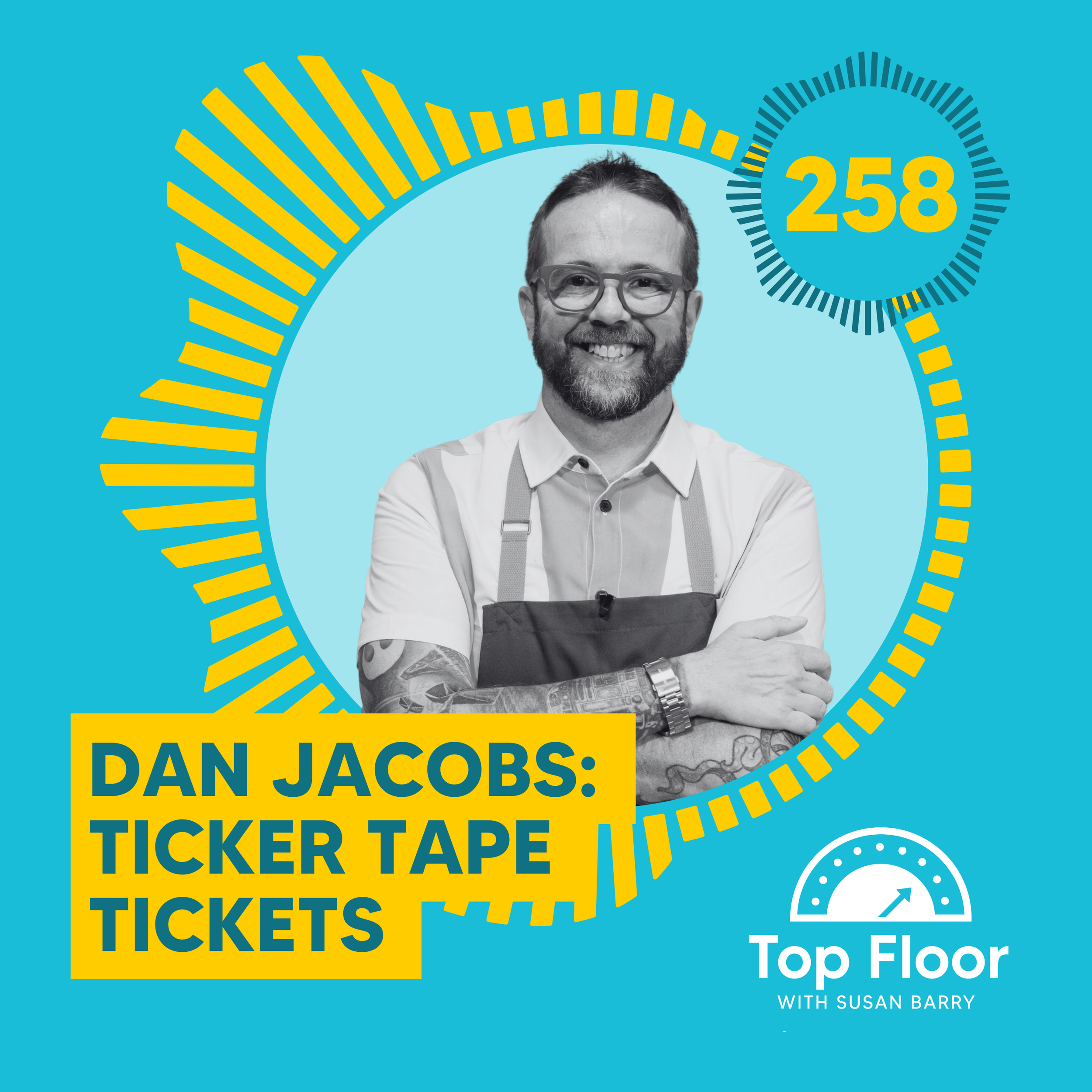
Transcript: Episode 258: Ticker Tape Tickets
LISTEN TO THE EPISODE:
APPLE PODCASTS | SPOTIFY | TOPFLOOR.COM
[00:00:00] Susan Barry: This is Top Floor with Susan Barry, episode 258. You can find the show notes at topfloorpodcast.com/episode/258.
[00:00:14] Narrator: Welcome to Top Floor with Susan Barry. This weekly podcast ride up to the top floor features tangible tips and excellent stories from the experts and characters who elevate hospitality. And now, your host and elevator operator, Susan Barry.
[00:00:32] Susan Barry: Welcome to the show. Dan Jacobs is a chef and restaurant owner based in Milwaukee, where he co-owns the restaurants Dan Dan and Esther Ev. He has spent decades working in professional kitchens and is a familiar face on TV shows like Top Chef. Dan is an advocate for independent restaurants and for awareness of Kennedy's disease, a neuromuscular condition he lives with. Today, we are going to talk about what it really takes to build, break, and rebuild a restaurant concept. But before we jump in, we need to answer the call button.
Call button rings…
The emergency call button is our hotline for hospitality professionals who have burning questions. If you would like to submit a question, you can call or text me at 850-404-9630. Today's question was submitted by Lynn, who asks, "What were some surprising things you experienced or observed on your first TV show?" I'm dying to know. Any behind-the-scenes surprises, or was it just a surprise to be there?
[00:01:48] Dan Jacobs: I think it's a little from column A, a little from column B there. My first show was Beat Bobby Flay, and this was back in 2018. It was crazy how structured it was and how long the day was, I think. I think that's what got me more than anything else. And that time was real. Like when they say you have 15 minutes to make something, you have 15 minutes to make something.
[00:02:13] Susan Barry: Oh, interesting. I would have thought that there's maybe a little bit of like fudging on that end. What did you make?
[00:02:22] Dan Jacobs: The first thing I made on television, we had 15 minutes to make something using fresh masa. I had never really worked with fresh masa before, so I remember that you can kind of flatten it and then just throw it in the fryer, which is exactly what I did, and made like a salad with a bunch of raw, sliced vegetables, and made like a dressing with fish sauce and lime juice and some sugar, and called it a day. And I beat the kid, who I went against, who tried to make shrimp tacos, which I was like, in 15 minutes?
[00:02:56] Susan Barry: It's a little ambitious.
[00:02:58] Dan Jacobs: Yeah, you just don't have time for anything, and I think that's the thing. More so than anything else is you have to be able to realize the time and what you can get done in that amount of time. Like, don't get too ambitious. Don't cook something that you've never cooked before. Like, just kinda stay true to yourself and who you are, and make something that you can execute in the amount of time.
[00:03:22] Susan Barry: Interesting. So if the time is short for preparing it, what is it that makes the day so long?
[00:03:29] Dan Jacobs: It's just all the resets and interviewing. I mean, that's the thing too is like you watch these shows and they cut to you interviewing, talking about your dish or talking about what your thought process was at that point. That all happens after the fact. And that's like three-plus hours. After we shot Beat Bobby Flay, that's what we did. We just did that. I think one of the other things that surprised me was the adrenaline crash from something like that. Like you're so jacked while you're doing it, and then as soon as it's over, you just, man, you crash hard. And that's always something that, like, as I've gotten older and I've done more of these, you just kinda realize that the day is still going on, so you kinda pace yourself a little bit better, I think.
[00:04:16] Susan Barry: Are you able to avoid that adrenaline crash, or does it still happen?
[00:04:19] Dan Jacobs: It'll happen from time to time. Especially if you end up doing like two competitions in a day or something like that. You gotta find it somewhere, find that well of energy to get back up and continue doing it. But it's always different. I mean, every show is different. Every challenge is different, but you just kinda go in there. I go in there with a real positive mindset, and I just try and have fun.
[00:04:50] Susan Barry: Well, you didn't start out as a television superstar. How did you first get into professional kitchens?
[00:04:58] Dan Jacobs: I was 19 years old. I had just moved from Chicago to Door County, Wisconsin for the summer. And that's, those of you unfamiliar, Door County is very much a resort-type area in Wisconsin where, Chicago, Minneapolis, Milwaukee, Green Bay, people come, they go up for like the weekend. They do the small town thing, like Harbor Town sort of thing. And I moved up there when I was 19 with a buddy of mine who was going into the Army. We just wanted to spend a cool summer. And I didn't really know what I was doing, but I liked cooking, and I got a job as a short-order breakfast cook at a place called The Cookery in Fish Creek. It just kinda spiraled from there.
[00:05:51] Susan Barry: When you were a short-order cook, did you know how to make everything that was on the menu? Or were you just, like, trying to figure it out as you went?
[00:05:57] Dan Jacobs: I mean, I was figuring it out as I went. It was lucky the gentleman who owned the restaurant was also with me in the mornings, and he was very patient. I think one of the big surprises was that we deep-fried our French toast, which, like, blew my mind. I was like, "What?" and just, like, the flat top was everything. I mean, you had this six-foot flat top, and everything went on there. Eggs, hash browns, bacon, sausage, pancakes. You name it, it was on the flat top. But I always remembered when the nighttime guys would come in, they'd come in at, like, 2:00 and start setting up their stuff. And occasionally, I would stay a little bit later and help to prep or something. And they would do stir-fries and stuff, and I was just fascinated by it. You know, those guys were always so cool.
[00:06:46] Susan Barry: They're pushing the envelope of the flat top.
[00:06:48] Dan Jacobs: Yeah, who knows? I mean, that was 19. At that age, the pinnacle of dining, at least in my mind, 'cause this is what we had growing up, was, like, the local Chinese restaurants and Red Lobster. So, like, that was my pinnacle of dining. That's what I had to mark things against. So everything to me was fascinating at that point. But being a 19-year-old kid, you're not gonna wake up at 4:30, 5:00 in the morning, and that job did not last very long. It was only about two months. And then started working nights at another restaurant called the Inn at Cedar Crossing in Sturgeon Bay. And, from there, that was the first time I think I was surrounded by people that had, like, chef coats, and people called each other chef. Again, still had no clue what I was doing, but I was a quick learner. The chef hired me because my T-shirt said, "Nobody knows I'm Elvis." And he liked it. He thought I had a fun sense of humor, and that was it. Six months later, the sous chef there was like, "You gotta get outta here." Like, "You can't stay here. You gotta go back to Chicago and go to culinary school." And so that's what I did. I went back to Chicago, started culinary school, and that was about it, and then just started working around Chicago.
[00:08:13] Susan Barry: And what was the point that you ended up in a hotel kitchen?
[00:08:17] Dan Jacobs: That was much later. I mean, I had been working in independent restaurants. There were a couple, as I worked at a Lettuce Entertain You restaurant, which was kind of corporate-y, but for the most part I worked in independent restaurants up until about 2000. So this was '97 when all this, when this started, and I started working in a hotel in 2005, was the first hotel I worked in.
[00:08:44] Susan Barry: Gotcha. What's the difference, if you just had to describe it to a layperson, like what's the difference between working in a hotel kitchen versus an independent restaurant? Or you know what I mean, corporate versus…
[00:08:55] Dan Jacobs: Yeah, no, totally. I mean, there's pluses and minuses to both of them. I think as I've worked in both, I've realized that I'm definitely more geared towards an independent restaurant than I am a structured environment like a hotel.
[00:09:07] Susan Barry: It's because you're Elvis.
[00:09:11] Dan Jacobs: Hotels really, like, lend to structure, and lend to systems. And I think these things are important, and I think, especially as I've gotten older, they're important. But at the same time, like, you lacked that freedom to kind of do anything you wanted. And I think that was tough. Plus the hours, I think that's something that people don't realize 'cause a hotel's open 365 days, which means you work. Our busiest day of the year is Thanksgiving at the Ritz-Carlton in Chicago, busiest day, Thanksgiving. And everybody had to work on Thanksgiving, and for me, that was like, that was a real shock. I had to work Thanksgiving, Christmas Eve, and New Year's Eve, but I was off Christmas Day. So you either had Christmas Eve or Christmas Day off, depending on how you celebrate, but I was also the lowest on the totem pole of the sous chefs, so I basically just got kinda shafted when, you know.
[00:10:06] Susan Barry: Just had to take what you could get. It's interesting because I moved into hotels after working for an independent restaurant group. I, like, ran the catering part of that business, and for me, going from off-premise catering for this indie to a hotel, my quality of life improved, like, so dramatically because I just got to work 8:00 to 6:00 every other weekend, and at that catering company, I worked 8:00 until 8:00 the next day every single day. I slept in my car. You know what I mean? So it's interesting to hear. And something else that I wonder about, I don't actually have a great, well-phrased question for this, but we're around the same age. In sort of late '90s hospitality, I feel like hotels always felt like where you went to get benefits. You couldn't get them at an indie. And maybe that's changed now, I don't know.
[00:11:06] Dan Jacobs: I mean, it's changed a little bit. Like, we try our best to do as much as we can. I think early on we started reimbursing people for their health insurance, like go out there, get it on your own 'cause you're gonna get it cheaper than we can get it through a plan. That's the toughest part in an independent restaurant, is you don't have the buying power that these large corporations have, so you don't have that ability to really drive the price of health insurance down. So it would actually be way more expensive for us to even pay half of everybody's health insurance than it would be for them just to go out into the marketplace and for us to reimburse them for their insurance. So we do as much as we can now, but that's only because I, like you, grew up in the '90s where that was not an option. There was no such thing. And it's funny 'cause I remember being a 25-year-old kid and being like, "Health insurance, I don't need that." And there are still 25-year-olds that work for me that don't believe in it. The one thing I do stress to them more than anything else, and this is something I wish somebody would have beat into me at 25, was a 401k. Like, start your 401k as early as humanly possible. If somebody offers you a 401k, take it. Give as much money as you possibly can because basically, I mean, I started my 401k over 40, and I wish I would've started it when I was 25.
[00:12:26] Susan Barry: Well, we're talking about health insurance. You talk publicly about living with Kennedy's disease, which is a neuromuscular condition. What do you want people in the industry to know about that?
[00:12:39] Dan Jacobs: So Kennedy's disease is very similar to ALS. It's progressive in the fact that you lose control of motor skills and muscles. I guess let's go back. Kennedy's disease affects the neurons. These are your receptors. So your brain sends messages to these neuron receptors that tell your muscles what to do, whether it's like grip something, point your finger, whatever it is. My neurons are smashed, so we get pieces of information that come from my brain. So you don't get full utilization, which leads to, like, muscle wasting and loss of strength, which progresses over time. I was diagnosed ten years ago before we opened up Dandan, and, at that time, I was still running. I was playing basketball. I could still do a lot of these things. Now I can't do any of those things. Like, I wear braces on both my legs just to walk around. If I have to walk long distances, I have to use a cane. Even when I'm competing, in between competitions, I'm using the cane the whole time. And it's tough. I think one of the things that's stolen from me that is the hardest one to kind of replace is the fine motor skills. So doing things like turning artichokes or peeling potatoes or peeling garlic. In these mundane tasks, I think, is where my brain, at least this is how my brain works, like, that's where my creativity kind of flows. Like, doing a mundane task puts me into a flow state, which allows, like, creativity to just kinda pop up and just kinda do its thing. Losing that, that's the hardest thing, is trying to find ways to replace that and trying to find things that you can do in that same way because it's gotta be a task you can do without really thinking about it. So you can't really be in front of a computer in the same way. So that's the toughest thing I think I've had to replace. And it affects people differently, which is also crazy. So my brother, who's a year younger than me, also in hospitality he has Kennedy's disease as well, so it's hereditary and we both have it. But he's still, I mean, up until, was it last year, he ran the Chicago Marathon every year. So I mean, it affects us so differently. Some people who it doesn't affect, like physically as much, have more internal issues. Like they have trouble swallowing, trouble breathing. Those are the things that I think are the scariest 'cause that's where your real quality of life, I think, really kind of tends to drop. For me, I'm willing to do whatever it takes to keep doing what I'm doing, whether it's having to use assisted devices like canes, walkers, wheelchairs, I don't care as long as I'm still active doing stuff and being involved in the things that I love to do.
[00:15:51] Susan Barry: Well, it's hard to transition from that to my next question. It's a very abrupt move, so just be cool about it. When you are deciding whether a new restaurant concept is really worth opening, what are some of the things that you're weighing? This is what I really wanna get into in terms of our conversation today, how you're making the decision about X versus Y. Does that make sense?
[00:16:23] Dan Jacobs: No, it does. And it's something that I think we talk about a bunch, 'cause we haven't really opened anything new in a while. It's been, it's been since, like, 21, I think. And that was because we had to reconcept something after COVID because we still had a lease. But even then, it's like we haven't really opened anything since then. I think one of the main things is, like, do people actually want this? Is there a need for this out there? If there's a saturation of steakhouses, why would I open another steakhouse? What's gonna differentiate my steakhouse from Joe Blow's down the street or whatever. I think that's one of the things that made Dan Dan so unique, is there was nothing like it when we opened it up. Same thing with Esther F., there was really nothing like it when we opened them up.
[00:17:13] Susan Barry: Talk through those two concepts briefly, if you would, just to set it for folks.
[00:17:17] Dan Jacobs: Sure. Dan Dan is your Midwest, American Chinese food. It's the stuff that I ate growing up, the stuff that I loved eating growing up, and it's my comfort food that I go back to time and time again. I always believe that if we could open something up that gave me joy, that I could translate that joy to other people. And it has worked. I mean, we've been here 10 years, and we're not going anywhere, and it's a strong business.
[00:17:46] Susan Barry: It's interesting with that concept because what you said before about, like, is this something people are really gonna want. I'm guessing the community of Milwaukee wasn't, like, doing a change.org petition for Midwest style Chinese food. But then when they got it, they realized. So there has to be some sort of, like…
[00:18:06] Dan Jacobs: There's a gut feeling there, I think. And I hate to say this, but I feel like it's like 70 or 80% super hard work and then the other 30, 20, 30% is just being lucky. Opening up the right thing at the right time in the right space, kinda catching a little bit of lightning in the bottle. The restaurants that I've seen, especially here in Milwaukee, that have succeeded have pretty much been like that. The restaurants that have been here for a long time, they found a way to catch lightning in a bottle at the right time, and that was it. And I think it's tough. I think the restaurant industry right now is the toughest business to be in, and I try to talk to anybody who's interested in opening a restaurant or getting involved in this industry, I immediately first thing is to try to talk them out of it. Because this is truly a labor of love, 'cause you're not making any money. I remember in- we'll go back to the '90s here for a second. I was working in a restaurant called Naha in, like, 2000, 2001. It was in Chicago. It was owned by Michael Nahabedian and Carrie Nahabedian. And this is something that stuck with me forever. Michael said something, and I think it was a few years ago, we were having dinner, and he said something to me that stuck with me. But it's in the '90s, restaurants, at the end of the month, you were netting 20, 30%. It was great. And nowadays, man, if you hit double digits, it's like a banner month. I mean, we're not even getting close to double digits anymore. And it's-
[00:19:41] Susan Barry: Wow. What is that? No, just what would you attribute that to?
[00:19:47] Dan Jacobs: I think there's a lot of things. I think you have the rising cost of rent. Rent never goes down. Rent is not what it was. It's not what it was. The cost of a burger has not changed that much, but the cost of rent, labor, and then the cost of our goods have changed significantly in the same amount of time. If you go back, I mean, you're looking at a 60 or 80% price increase on those three main factors, as opposed to the cost, or like what people are charging for a burger hasn't changed that much. You're looking at like maybe a 10 or 15% change from 2000 on.
[00:20:25] Susan Barry: Always think about the labor piece. I'm not directing this to your concepts or anything like that, but in hotels specifically, hotels were able to find their leverage by underpaying people for such a long time in certain roles that when the pandemic happened, and they started to compete with like Amazon Delivery, DoorDash, ba, ba, ba, raised labor costs, they lost that leverage. Margins are shrink, shrink, shrinking, plus all of the factors that you mentioned, like cost of goods, whatever. It just seems to me that there is a problem if a business model is predicated on leveraging cheap labor. Oh, yeah. For sure. You know what I mean? Who knows? Like, is it a business? Probably not, right?
[00:21:13] Dan Jacobs: No, I mean, it's not. It’s not, but it's also like, I think the expectation of the diner is also it has to change a little bit. Like, we're looking at it right, going out to eat is just gonna be more expensive. Like, there's no way around it. We are not capable. A business that is only netting 3 or 5% at the end of the month is not able to absorb the costs, and so they have to be passed on to the guests. I think that's why you see the uptick in the 5% surcharges for credit cards, or you see people switching straight to a no-tip model where it's just a 20% service charge. I think there's gonna be different ways that we can do this, but if you want your independent restaurants to survive, the number one thing is people need to go to them. If anybody can take anything away from what I'm saying, support your local restaurants 'cause if you, if you love your local tiny restaurant that's on the corner, go to it. Like, otherwise, it's not gonna be there.
[00:22:20] Susan Barry: You alluded to this a little bit earlier about having to change a concept because you still had a lease. When you look back on concepts that sort of didn't make it, was it the idea itself or something else? Just, like, COVID is a perfect example of this.
[00:22:39] Dan Jacobs: I mean, COVID was tough. I mean, we had a French restaurant in a very old building where the HVAC system, which was supposed to be serviced by the landlord or was serviced by the landlord, was about as old as I am. Yep, it was held together with some duct tape and some twigs and some matchsticks.
[00:23:04] Susan Barry: Little raccoon running the business in there.
[00:23:06] Dan Jacobs: Oh, my God. But in the summertime, the AC would break, and it'd be 85 degrees in the dining room. Or in the wintertime, the heat wouldn't work, and it would be 61 degrees in the dining room. So you're at a French restaurant eating, was it sauteed skate wing with a butter sauce on there in 85 degrees in a nice suit or something. They had that experience once.
[00:23:34] Susan Barry: They didn't enjoy that?
[00:23:36] Dan Jacobs: It was tough. It was really, really tough, and it was one of those things where, like, it was impossible. It just was what it was. And so, we did the best, you did the best you could, but you couldn't do anything with this. And then COVID hit, and I think that business or that restaurant was just starting to, like, kinda get its footing a little bit and kinda see, like, things were getting fixed and, whatever. And then the pandemic happened, and people didn't want French takeout. They wanted Chinese food, pizza, things that you inherently have takeout. Luckily, our one business was a Chinese restaurant, and we were crushing takeout, so we just moved. We were able to move pretty much everybody who was over at the French restaurant over to the Chinese restaurant who was willing to work at that time because we needed the hands.
[00:24:31] Susan Barry: Okay. And so the French restaurant is what became Esterev?
[00:24:36] Dan Jacobs: No. So the French restaurant became a restaurant called Fool's Errand because restaurants are a fool's errand. I loved it. It was really fun. We did American comfort food, so just really, like Monte Cristos, cheeseburgers, fried chicken, macaroni and cheese. Like nothing complicated. It didn't survive because it didn't make enough money to make it worthwhile. Like, its busiest days were always, like, lunch and brunch, and your check average for lunch or brunch is a third or a half of that of dinner.
[00:25:16] Susan Barry: Not enough booze at lunch anymore.
[00:25:18] Dan Jacobs: Oh, man, and it takes you twice as much to catch up. So, in order to do the same amount of numbers you do at dinner with 100 people, you're gonna have to do 200 people. The business just didn't really model out, especially in that space, and we ended the lease and were able to move on from it. And then Esterev was actually inside of Dan Dan. So we had this room that we had built out inside of Dan Dan that sat 20 people, and they were on two 10-top tables sitting communally. And I would serve everybody. We would do 10 courses, serve everybody at the same time. It was almost like a dinner party. The idea behind it. As a kid growing up, my parents' table always had a lot of people at it, whether it was kids from the neighborhood, dad's softball buddies, mom's work friends, my uncle, my grandmother. There were always people. And some people didn't know each other, and it was always interesting kind of just, like, being a fly on the wall and listening to conversations, and I kind of liked the idea of that. Like, it was almost like a social experiment and dinner at the same time. And it was great, and it worked. It worked, but then during the pandemic, people didn't wanna sit communally any longer. So we broke up that room, broke up the tables. And then after I got back from Top Chef, I did well, and I knew that we could really kinda bank on that if we were to open Esterev in its own unique space. And I just happened to be driving by, and the perfect space came up. It was just the perfect size, perfect space in the neighborhood me and my partner Dan live in, and it was great.
[00:26:59] Susan Barry: This episode of Top Floor with Susan Barry is brought to you by Lodgify. If you run any kind of hospitality property and you're relying entirely on third-party platforms to fill it, you're giving away a cut of every single booking, and you don't own the guest relationship. Lodgify gives you your own direct booking website so guests can find and book your property. It's not complicated to set up, it looks professional, and every booking that comes through it is yours with no commission going out the door to somebody else. They also have tools to manage your calendar, your guest messages, and your listings all in one place, which saves a ton of time. Top Floor listeners get 20% off on all 1 or 2-year plans with the code TopFloor20. Go to lodgify.com or the link in the show notes and use code TopFloor20. We like to make sure that our listeners come away from every single episode of the show with practical, specific things they can try either in their businesses or in their personal lives. What do you think operators should be vetting about a space besides the concept itself before they commit to a lease? It sounds like I already know the answer. HVAC.
[00:28:24] Dan Jacobs: HVAC is a huge one. Like, first off, I always liked, before we look at spaces, I don't wanna have to put in money on anything that I cannot take with me. So, HVAC, so any sort of anything like that, especially your hood system. Like, we would never do a restaurant where we would have to put a hood system in. It's one of the most expensive things that you're gonna put in, plus you can't take it with you. And so I think those are the two big things that we always look at. Same thing with, like, are they gonna cover costs for, like, plumbing and electric? 'Cause these are the not exciting things. Like, for us, I'm willing to put in money for your FF&E, your furniture, fixtures, and equipment, but I am not willing to put in money to bring a space to a white box, which is basically, like, your electric and plumbing where it needs to be. That's up to the landlord. Because, again, these are things that you cannot take with you. Also, realize that your rent has to be 3 to 6% of what your intended net sales are gonna be at the end of the month. 'Cause if that doesn't work, if that equation doesn't come out, you're not in the right place. Like, you gotta look for something else.
[00:29:42] Susan Barry: Oh, that's a good tip. I don't think I've ever heard that ratio before. Cool.
[00:29:47] Dan Jacobs: Oh, that's something that we live by. 'Cause your rent, garbage removal, insurance, electric, and gas have to be under 8% in order for you to be able to, like, basically make money.
[00:30:06] Susan Barry: Got it. Everybody take notes. What about when a menu or a concept isn't landing? What's usually the first thing that you try changing? Or do you just change the whole thing?
[00:30:19] Dan Jacobs: I think first it's like just taking a real good look inside, and are you doing this as a vanity project? Are you doing this because you wanna tell people how to eat, or you have to realize that, like, who's your customer? You take a real good look at yourself, and you take a look at the business, and what do you actually want out of it? It's in the first year or so you're like, "All right, this is either working, or it's not working." At that point, you have to be able to adapt to what it is. Like, this restaurant is this. It's not what I thought it was gonna be, and I gotta find a way to make that work. Or you gotta find a way to get out of that lease, which is harder to do than just kind of figuring out how to make this thing work and just get through it.
[00:31:13] Susan Barry: It's so funny. Every time I ask a question like that of a restaurant person, I expect them to say, "First thing we do is look at the general manager," or, "First thing we do is swap out the chef de cuisine," or whatever it is, and it's always this answer. Are we trying to force a square peg into a round hole? Are we trying to tell the consumer what they want versus them listening to what they say? So interesting. It's so interesting to me that that's as universal as it is. I would not have expected that.
[00:31:45] Dan Jacobs: Oh, it's almost always our fault. It's almost always y- you being vain and trying something that, like, maybe just doesn't work.
[00:31:55] Susan Barry: Interesting. Well, what about from a personnel side? What is something that tells you early on that, like, a young cook in the kitchen has real potential?
[00:32:06] Dan Jacobs: Did they bring a notebook? That I have to tell them to bring a notebook, I think, you can always tell the good ones from the bad ones right away, and it's usually the ones that bring a notebook and are taking crazy amounts of notes on stuff.
[00:32:23] Susan Barry: Oh, I love that answer. That's so good. Well, we have reached the fortune-telling portion of the show. So you have to predict the future, and then I will come back and let you know if you got it right. What is a prediction that you have about the future of independent restaurant concepts?
[00:32:39] Dan Jacobs: I think you're going to, like, I'm such a glass-half-full guy. Like, I'm a perpetual optimist, but as I think with this one, I think you're going to see fewer independent restaurants.
[00:32:51] Susan Barry: Because of the cost piece?
[00:32:54] Dan Jacobs: Just because of the cost of doing business. It's not just the money cost of it, but also the mental and physical cost of doing the business. 'Cause talk about sleepless nights and just being exhausted. Like it is what it is, you have those moments. And I mean, it is truly a labor of love, 'cause this is not the way to get a boat.
[00:33:19] Susan Barry: Well, something that I think is, I've maybe observed, like remember where you heard this. This is brilliant insight on my part. But so many independent restaurants have to find investors now. And it used to just be something that someone could do with their family or their business partner or whatever the case may be. I guess that is sort of a way to lead into if you could wave a magic wand and change something about how independent restaurants get funded, what would that be?
[00:33:52] Dan Jacobs: If I could wave a magic wand and change the way independent restaurants get funded, I think...
[00:34:07] Susan Barry: I mean, you can say the magic wand drops a garbage bag full of $100 bills in the middle of my restaurant.
[00:34:14] Dan Jacobs: I was about to say, having a no-strings-attached grant program would be great. Having the federal government subsidize us as we're the only, I have this weird feeling in the future that we're gonna be the only employer of real human beings, 'cause AI can't actually do our jobs.
[00:34:33] Susan Barry: 100%, absolutely true.
[00:34:35] Dan Jacobs: And maybe the federal government will subsidize us for employing people.
[00:34:38] Susan Barry: Interesting. You know what would be a crazy idea is if the federal government gave everyone health insurance, and then you wouldn't have to be subsidized, because your cost of doing business would decrease.
[00:34:52] Dan Jacobs: And we wouldn't have to compete in the labor market for people that have to take jobs that have to get insurance, 'cause I think that's another big thing. You look at earlier this year, we lost those extended benefits for the ACA. And we lost people, and I'm not talking about your regular line employees. I'm talking about your executive chef, your director of operations types, who had to take jobs to secure health insurance for their families because they couldn't afford to pay the premiums that were now going to be two, sometimes triple what they used to be.
[00:35:31] Susan Barry: Mine, ours almost tripled.
[00:35:34] Dan Jacobs: Yeah. And you gotta figure that out, and that's tough.
[00:35:38] Susan Barry: Yeah. Well, let's turn this into a political show. I'm just kidding. Let's move right along. We're gonna head down to the loading dock, because that is where all of the best stories get told.
Elevator voice announces, “Going down.
[00:35:57] Susan Barry: Dan, what is a story you would only tell on the loading dock?
[00:36:02] Dan Jacobs: So I thought about this one for a bit. We had a New Year's Eve, and this was during the pandemic. So we were doing some inside dining. This was early pandemic, so it was maybe New Year's Eve '21 going to '22 or something like that. There are vague memories as to which New Year's Eve this was. But we had set up, at the time we were using Aloha as our POS system, and we had had them make sure to set it up so that we would only get five orders every half hour for to-go, so that we could keep up with the amount of people that were gonna be inside dining at that time.
[00:36:48] Susan Barry: Oh, that's so smart. I never would've known you could even do that.
[00:36:53] Dan Jacobs: Well, it didn't. This is where the story gets fun. So our Aloha representative really screwed up super hard, and instead of putting in for five orders every 30 minutes, they allowed five orders every minute. At 7:00, we have a 60-car parking lot out here. Every parking spot was full. They would do a rail full of tickets, and then there would be a stack of tickets just waiting to go. And there was no helping the poor expo. It was one of the most nightmarish services I've ever had. We gave out, I think it was almost $3,000 in gift certificates that day because people waited two hours for their food. They were supposed to pick up their food at 7:00, and we hadn't even started the 6:00 orders yet. At 7:00.
[00:37:57] Susan Barry: First of all, my stomach hurts. Secondly, I'm hearing that ticket machine ch, ch, ch, ch, ch, ch.
[00:38:03] Dan Jacobs: It was a nightmare. It was an absolute nightmare.
[00:38:05] Susan Barry: Oh my gosh, and were you able to recoup any of that loss from the person who made the mistake?
[00:38:12] Dan Jacobs: So Aloha did pay for all of the gift certificates. And then there was some free for a while, but we ended up parting ways with Aloha shortly afterwards.
[00:38:22] Susan Barry: I mean, I'm not surprised. There's too much competition in that arena to allow for those kinds of mistakes. Holy crap. I'm, like, having a little bit of a panic attack on your behalf right now.
[00:38:37] Dan Jacobs: It reminded me, so, not that there's this show I think people call, it's called The Bear.
[00:38:43] Susan Barry: Yes. I wasn't gonna say it, but it is that total scene where they're like, Oh, God…
[00:38:49] Dan Jacobs: It was anxiety-inducing. I remember watching it. I watched the first season with my wife, and I really did enjoy the first season. And I remember we were watching that episode, and I was, like, cringing on the couch and like grabbing. I remember she's like, "Are you okay?" And I'm like, "I don't know. This is terrible."
[00:39:07] Susan Barry: It's PTSD. I mean, I don’t even own a restaurant, and it freaks me out. I have not watched the last season. I can't watch it. I can't.
[00:39:18] Dan Jacobs: It's not what it was. That first season was really good.
[00:39:22] Susan Barry: 100% agree. Well, Dan Jacobs, thank you so much for being here. I know that our listeners loved this conversation as much as I did, and I really appreciate you riding with us to the Top Floor.
[00:39:34] Dan Jacobs: Thank you so much. I really had a great time. Thanks for having me on.
[00:39:38] Susan Barry: Thanks so much for listening. Thank you for listening. You can find the show notes at topfloorpodcast.com/episode/258. Jonathan Albano is our editor, producer, and all-around genius. He even wrote and performed our theme song with vocals by Cameron Albano. You can subscribe to Top Floor on Apple Podcasts, Spotify, or wherever you like to listen, and your rating or review will go a long way in helping us give you more of what you like.
[00:40:14] Narrator: Thanks for listening to the Top Floor podcast at www.topfloorpodcast.com. Have a hospitality marketing question? Reach us at 850-404-9630 to be featured in a future episode.