
Transcript: Episode 245: Voyeur Beach Resort
LISTEN TO THE EPISODE:
APPLE PODCASTS | SPOTIFY | TOPFLOOR.COM
[00:00:00] Susan Barry: This is Top Floor with Susan Barry, episode 245. You can find the show notes at topfloorpodcast.com/episode/245.
[00:00:14] Narrator: Welcome to Top Floor with Susan Barry. This weekly podcast ride up to the top floor features tangible tips and excellent stories from the experts and characters who elevate hospitality. And now your host and elevator operator, Susan Barry.
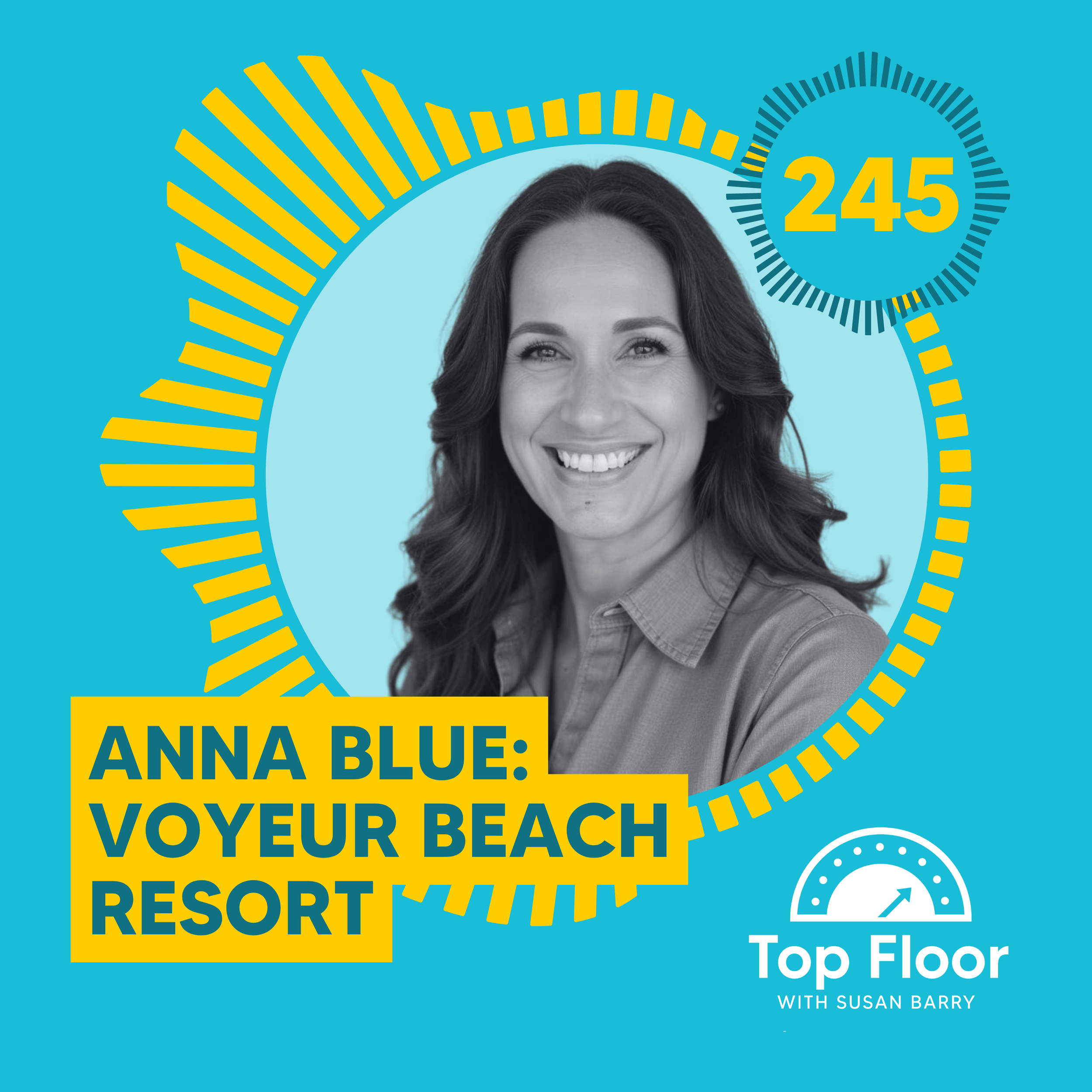
[00:00:32] Susan Barry: Welcome to the show. Anna Blue is a strategist focused on helping organizations align growth with social impact. As the founder and CEO of Blue Boss Group, she advises on brand strategy, leadership, culture, and purpose-driven growth. Her clients have included companies and organizations across the hospitality, technology, media, and nonprofit sectors. Anna has led initiatives in marketing, communications, leadership, and advocacy, including executive roles at the American Hotel and Lodging Foundation, Girl Up at the United Nations Foundation, and The Female Potion. Anna is also the founder of the Hospitality Creator Summit, a new event that will bring together hospitality content creators and brands, and full disclosure, I am attending and speaking. Today, we are going to talk about the future of influence in hospitality, but before we jump in, we need to answer the call button.
Call button rings…
The emergency call button is our hotline for hospitality professionals who have burning questions. If you would like to submit a question, you can call or text me at (850) 404-9630. Today's question was submitted by me, from my personal listener hotline, because I want to hear you answer this question, but it didn't make sense in the flow of our interview today. So Anna, what are your thoughts on imposter syndrome?
[00:02:21] Anna Blue: Oh, I have so many thoughts. I have to be concise 'cause we have a whole conversation. Imposter syndrome is a very carefully designed system to hold women back. Not the feeling of imposter syndrome, but the actual understanding that typically women and men who feel like they have imposter syndrome. The vast majority are women. And so this idea that I don't belong in the role that I have, or I'm uncomfortable, or my voice shouldn't matter as much as all of these people, is because the system is designed to make women feel that way. And it benefits a system to make women feel like they have imposter syndrome and need to cure their imposter syndrome, as opposed to focusing on the actual issues that are holding women back. The pay gap, promotion gap, all of those lovely things, let's make women feel like we are the problem and we have to be fixed. And so, with imposter syndrome, you feel like you don't belong there because you were never supposed to be there. That's the reality of it.
[00:03:28] Susan Barry: Magnificent. I couldn't have said it better myself, and I one zillion percent agree with every word you just said. There are no personal solutions to collective problems. All right. Moving right along. You've worked across politics, nonprofits, and business, but you at least seem to have planted a flag in hospitality. I'm wondering what it is about the industry that is compelling to you.
[00:04:00] Anna Blue: Ugh, it's the people. When I first came in, and I know everybody says that, when I first came into the industry, I was completely unaware, had no idea. Other than being a guest in a hotel, eating in a restaurant, and enjoying hospitality, I didn't know people from the hospitality and hotel industry. I didn't originally want this job. I did a favor for a friend in applying for the American Hotel Lodging Association Foundation, and then I met somebody through that process who was an executive at a REIT, and I realized, one, how much hoteliers love hotels, and it's kinda weird and cult-like at the same time. Let's be honest. But it's really inspiring, and when you are somebody who dedicates your life to change and purpose and all of these things, being in an industry where at the end of the day, people do matter. It's not to say that we're perfect or that mistakes aren't made, but People Do Matter is an ideal place to effect change and continue to pursue purpose.
[00:05:07] Susan Barry: It's interesting. So it sounds like you've never worked in a hotel, never worked in a restaurant. Is that accurate?
[00:05:13] Anna Blue: No. I worked in a restaurant. I waited tables and hosted when I was 20. I worked in a restaurant, yeah.
[00:05:20] Susan Barry: Interesting. And so you had a little taste back then. You founded Blue Moss Group around the idea that business strategy and social impact shouldn't live in separate hotel rooms. Why do you think that companies struggle with that?
[00:05:40] Anna Blue: They need an adjoining door, that's like the idea here to do the side-by-side rooms. Because social impact has always traditionally been seen as your volunteer day, your community service day, and those are wonderful, and I would never advocate for those going away. But I think people still, even though we've watched the world move to a direction where you can shop with your dollars, you can shop with purpose, you can decide with almost every decision you make as a consumer if you want to do good or not. There are companies that match that. There are hotels that absolutely match that. And even though that's happening from a consumer side, there still just seems to be this disconnect that a lot of companies have with the idea that social impact strategy, community engagement strategy, and workforce development strategy should be part of your business strategy. There is a ton of data out there as to why, but I think it's just in people's minds, especially the more old school you are, and we have a lot of old school thinking and old school leadership in this industry. And so it tends to be like, "Oh, that's the feel-good thing that we'll do to check the box and make our employees happy." But it shouldn't be.
[00:06:53] Susan Barry: You said something in that answer that I just wanna poke at a little or understand a little bit more, which is the workforce development piece. I don't know that I would have necessarily put workforce development in a social impact bucket. Can you say a little bit more about that?
[00:07:12] Anna Blue: I do because, to me, when I think about hospitality and the different lenses of social impact, taking care of our people is certainly a big piece of that. And the more the decision-makers get disconnected from the people who work at the property, which is happening as private equity and REITs and all of those things take over a lot of hotel ownership. The more that becomes disconnected, the more they forget the importance of workforce development. They're looking at it as they're just looking at their P&L and where they can cut, and who needs to be cut, and who's not hitting what, and they're not people, they're numbers. So I think that my work has been a really great way of being like, "Hey, you have to start inside before you can really have an impact outside." Like, the outside impact is great. What you do outside your doors is fantastic, but you start inside your doors first.
[00:08:09] Susan Barry: How has your perspective on influence changed over the years?
[00:08:14] Anna Blue: I think everybody's perspective on influence has had to change over the years because we didn't use to have influencers. We had people who were influential. Whether they're government officials, CEOs, it's typically people who are in inspirational, aspirational, or decision-making positions, were sort of the people with influence. Celebrity is another great, and that's what it was. Now, with the rise of social media content creation, all of those things we've seen influence look very different. People now tend to shop products that are sold by Instagram and TikTok marketers versus products that are hawked by celebrities or that are just actually good products that are good for you. So, influence in general has changed a lot. The way we communicate has changed a lot, and I think in our industry, we certainly see it, right? When you see the brands just from a consumer standpoint, they have shifted a ton of their marketing dollars away from commercials, traditional advertising, and traditional media into travel influencers because that's who people are following. Sometimes it's somebody who can't actually afford or is not physically able to travel, but sometimes I'm one of these people. I have a whole folder in Instagram where I tuck away all those resorts and all the things that somebody makes look really great, right? And so, it happened there, and now we have certainly seen in our industry, but in others as well, this shift to influence in terms of how the business is communicated, how the business is followed and tracked, and reported. So it used to be very heavy trade media, as you know. And now it's the folks like Glenn Houseman, it's the folks like your podcast. It's these places that talk about the who's who of the industry, what's happening, who's striking what deal, who's retiring, all of those things. How many more small brands are the big brands acquiring? Like, all of that happens. So, influence on the business side has also changed. It's not just those 20 people around a boardroom table anymore who sort of hold all the influence. It has broadened considerably.
[00:10:26] Susan Barry: Speaking of which, you are the founder of the Hospitality Creator Summit. Tell me what drove that. What gap did you see that you felt like an event made sense?
[00:10:40] Anna Blue: Well, we don't do anything with this group of people. We have this incredible group, and it's way bigger than I actually thought it was. I didn't know. I'm like, "Am I just gonna have a room of 20 people? Is that what it's gonna be?" And it still would've been a party, but the number of B2B creators that we have is actually massive. And, truly, for me, I came into the industry later in my career. I've been doing social impact. I've been on many, many stages. I've spoken ringside at WrestleMania. I've had this great career.
[00:11:12] Susan Barry: Wait, what? Is that real?
[00:11:14] Anna Blue: That's real.
[00:11:16] Susan Barry: What?
[00:11:17] Anna Blue: 2019, I was with Girl Up at the United Nations Foundation, and WWE had undergone this huge women's evolution, and so they looked for key sort of gender equity partners, and Girl Up was their first partner in that new segment of community impact for them. And so I got to go to SmackDown 1000, then WrestleMania, and all of these places, and I learned so much about the business of WWE. Like, I was not following who's got what belt. But it was absolutely fascinating and some of the most fun that I had. But at WrestleMania 2019 at MetLife Stadium in New York, Silva and I worked together.
[00:11:57] Susan Barry: Most ridiculous credit I've ever heard anyone have, so you win. Congratulations.
[00:12:05] Anna Blue: So I had done all of these things, but nobody in hospitality knew who I was, and I think it was week three, because when you're running a foundation, I'm asking people for money. They have to believe in what I am super passionate about. They have to want to give their personal dollars, their company dollars to something, and so my reputation, my visibility really matters. And immediately, I think I was on week three when Rachel Humphrey was like, "Hey, come on the podcast. Come and share your story. Let's get the industry to know who you are." And then I did No Vacancy with Glenn and Anthony, and so it was the business creators, it was those kinds of on-the-inside fold that really helped me claim my place in hospitality and become a voice, and somebody that is recognizable and supported, and I'm so grateful. And then when I left the foundation, a little over a year ago, it was the same thing. I got to share my hospitality journey and talk about what was next. I got clients out of that. So in some ways, I keep saying, The Creator Summit is my love letter to the hospitality business creators. Like, it really is. I'm so grateful for this group. I don't think I would've had the success that I've had if not for these creators. But they are also doing incredible things, and I don't think that they get the recognition. I don't think the appropriate value is placed on the power of the creator community, on the business side of hospitality as a whole. I think people see the one-offs. They see Josiah, they see Emily, they see you. They sort of see people in silos, and they don't recognize that, as a community, as a creator economy, there's a huge amount of value here. So really, that's what the gap is. I want the same emphasis that's placed on travel creators to be placed on our business creators.
[00:13:53] Susan Barry: It's so funny, when I started this show, I had surveyed one of my clients, it was a new account, and I'm like, "What channels are interesting to you in terms of marketing, and I put podcasts as one that they could choose. And the comments I got back were, like, not just not effusive, but outraged that I would suggest that these very busy and important people be on a podcast. Anna, that was five years ago. It wasn't in 2007. No. It was five years ago. Five years. Like, what in the what is happening? So, do you think of yourself as a content creator?
[00:14:41] Anna Blue: I don't. I don't. And it's funny, 'cause one of my clients actually, like, what we do together is thought leadership. So I do thought leadership for them. I do videos and things like that, and it's a company that I love, and I very, very much believe in, and I love talking about what they do. But even with that, when they ask me, they're like, "Oh, you have, you have an audience, and you have influence." And I was like, "So what?" So I don't think of myself as a content creator. I'm actually hoping that by the end of the Summit, when I learn all of the different things, I will then start to think of myself. I like to share my thoughts. I'm very opinionated. I am an activist and a justice warrior, and so, I do all of that, but I don't think of myself as a content creator. Maybe it's 'cause I don't make any money off of it.
[00:15:32] Susan Barry: Interesting. All right. Well, I'm gonna set my brain to spinning on the side, and I'll tell you what your content creator fortune shall be. Okay. In the meantime, we sort of touched on this already, but hospitality is pretty traditionally controlled. It took the brands a really long time to get onto TikTok, for example, or whatever the case may be. Creators and influencers, as we've discussed, are shaping perception of travel brands and destinations and all that stuff in real time. A lot of companies talk about a lot of things, as you said, but a lot of them talk about their sort of purpose and culture. I think that at the same time, the audience and a lot of the cultures are identical. It's so interesting. A lot of audiences are getting very good at not only spotting but also being turned off by performative messages. This is such a hard question to answer 'cause I think if we knew the answer, we would not record it. But what do you think, or can you sort of sniff around the edges and say what separates genuine impact from sort of branding theater?
[00:16:59] Anna Blue: So no, it is the platform that I built, and the work that I do on it's if you aren't doing it, don't talk about it, and if you aren't doing it genuinely, authentically, and in ways that are actually proven to work. I think that while DEI is incredibly important, and I will always say that, so much of even DEI programs are performative. They don't work, and when people are looking at a company, they're looking under the hood. They're saying, "Okay, they want my loyalty, they want my status, they want all of that. They want my dollars. They want me to get their credit card. Let me go on Glassdoor. Let me see how they treat their employees. Let me see what people say about them." And so this is where you have to align your social impact and your business. The companies that do that don't really have to sell it. You don't have to talk about it. It's not something you're carefully crafting for your annual report because it's everywhere, and it's authentic, and other people are reflecting it. If you are the only person speaking positively about your culture, your culture sucks. If everybody is talking about your culture, you have a great culture, and you don't have to say anything as a leader.
[00:18:18] Susan Barry: Oh, that's such a good point.
[00:18:19] Anna Blue: Yeah, that's the difference. If I get up on stage and I'm like, "We have such a great culture," and everybody's rolling their eyes around me. Then we don't. And so it's far more than what anyone person says. You know, you can tell.
[00:18:35] Susan Barry: This makes me think about Delta. I mean, obviously, I'm in Atlanta, so I'm gonna be a Delta person regardless. It is so evident to me, by following Ed Bastian on LinkedIn, by knowing so many people who work for that company, there are just so many breadcrumbs that let me know it's an excellent company. They don't have to say a word. Exactly to your point, they're not taking, buying billboards around the city of Atlanta and saying, "Our culture makes us so great." I am hearing it from people at restaurants or whatever.
[00:19:15] Anna Blue: Yes. People are experiencing it. I mean, I don't know... I know that eventually the world asked the founders of Ben & Jerry's to come and talk about their culture because what they had built was so unique, but they didn't have to do that. Like Ben & Jerry's is an OG in the social impact space. It is how they were founded, what they do. They also make incredible ice cream, but that ice cream came with a powerful message of purpose. They didn't have to talk about it, they were doing it. They were living it, and then people asked them to talk about it 'cause they were the anomaly, which is where it gets crazy.
[00:19:46] Susan Barry: We like to make sure that our listeners come away from every single episode of Top Floor with some practical, specific tips, ideas they can try either in their businesses or their lives. So, as a non-content creator, what advice would you give to an aspiring content creator? Perhaps give yourself advice, because I think you are or should be an aspiring content creator. So what advice would you give yourself?
[00:20:22] Anna Blue: Narrow it down. My biggest problem, and the reason I don't think I'm a great content creator, is that I talk about too many things. I talk about hospitality, I talk about women, I talk about power, I talk about all of these things because my career has been like this, and my expertise is all over the place. I would say if you are aspiring, like really know who you are talking to and talk to them. Your audience can expand over time. All of those things can happen. What you talk about can expand over time. But I think what a lot of people do is that they come in with all these different points of view and all these perspectives, and they wanna talk about all the things, and you lose folks real fast. So, as somebody who is aspiring, I would say really know who you're talking to. Who is your platform for right now? What do those people need to hear? And talk very specifically to them.
[00:21:15] Susan Barry: I feel like you're giving me a lecture right now. It's hitting a little too close to home. I wanna talk about everything because I wanna know everything, and I wanna talk to everyone on this show because it's so interesting. So thanks for nothing. I quit. We have reached the fortune telling portion of the program. So now you have to predict the future, and if you're wrong, I will never speak to you again. You're gonna be wrong on purpose, like, "Whoo, got rid of her." Okay, so what's a prediction you have about the future of hospitality influence and brand storytelling?
[00:22:04] Anna Blue: Cause we're gonna make this future happen, so my prediction is going to be, in the next year, we are gonna see a huge shift internally within the business of hospitality to understanding the power of influence, of content creation within the business side. There are other industries who get it. Retail is doing really well with this. We are behind. And so that's why we did the summit, but I actually believe that the summit is gonna work, and I think that the bigger picture is to really show the power and the value of the business creator community.
[00:22:44] Susan Barry: The answer might be the same, but if you could wave a magic wand and change one thing about the industry, what would it be? The hospitality industry.
[00:22:52] Anna Blue: Oh, how it treats its people, hands down. Yeah, the value placed on people, as I said, is disconnected. We've been telling this, like, bellhop to a GM story forever, and I think stories are getting further and further far between. We can't keep people. Young people are studying hospitality and then don't come into the industry. People come into the industry, and then they leave immediately. We have a massive turnover rate. All of those things point to we're not treating people well. It's not because they're lured away by more money or flashier things or things like that. If you have hotel employees who are leaving you to go work at the sandwich shop across the street, there's a problem. And so I think hands down, we have gotten away from the people who are on the inside because we are solely focused on making money off the people on the outside.
[00:23:49] Susan Barry: That's really interesting. We have talked about a lot of different sorts of root causes for that stuff. Like, I have many, many theories. I'll share a few now, and you can tell me if you think I'm right or wrong. The first is that this is an apprenticeship business, and we are pushing people to get expensive, debt-laden educations that then do not pay off in management positions. You still have to do your apprenticeship, as it were. Like, you still have to work on the line. So there's a big disconnect because, like, I'm not gonna take hundreds of thousands. Maybe I'm being hyperbolic, but many, many thousands of loans, and then come and work line-level positions for a year. That doesn't match up.
[00:24:39] Anna Blue: Not to mention no parent wants to pay for their child's education to have them go work the front desk at a hotel.
[00:24:44] Susan Barry: Right. And quite frankly, as I think we alluded to earlier, there are not a lot of hotel leaders who want someone straight out of a hospitality program. So there's a big disconnect between the way we're educating the industry and the needs of the industry, which I think is interesting and problematic, and maybe points to form profit education being a little out of whack, but that's another story. But I also think, and I'm so interested in what you think about this. Okay. Something that comes up over and over and over again, particularly with hoteliers of a certain age, is that they watched the show Hotel when they were growing up. And thought it was so glamorous and so appealing that it truly led them to at least have their minds open to the idea of exploring that as a job. But we don't have cultural touchstones at all anymore because everyone streams what they wanna stream. And certainly not ones that are positive about hospitality. Like, if I watch The Bear and The White Lotus, I'm thinking that I'm gonna get murdered if I enter this industry or at least have a nervous breakdown. That's the problem. So I don't know. I don't know how realistic that is, but anecdotally, it seems like a huge one. I have never seen Hotel, and it is not streaming anywhere, FYI. However, Leanne Elliott found it for me on YouTube, but I still haven't watched it.
[00:26:33] Anna Blue: Yeah, it is interesting. I think you're right with the cultural markers. When you think about something like Below Deck, because that is a show does not actually make that work seem fun. Like, if you have ever watched Below Deck.
[00:26:47] Susan Barry: It's horrible, right?
[00:26:48] Anna Blue: I don't wanna do those things. I don't wanna deal with those passengers. I don't wanna sleep in those teeny-tiny rooms with people who smell bad. Like, I don't wanna do those things. And yet what you saw is that they have had a massive flood across all of those types of private yachts of people applying because of this reality show. And so I do. I think I never thought about it, but I think you're absolutely right. There is a cultural connection. When you watch Top Chef, or you watch the restaurant shows where they're turning around a restaurant that's about to close, and now it's becoming this thing. When you watch ones about real estate, like, we're seeing more men, but more women go into, like, DIY and all of these things because you see those women on television. So yeah, I think you're right. We're missing the hotel culture. Hotel Impossible doesn't exist anymore. Shout out to Anthony. Throwing that in there. But yeah, we don't see this life, for better or worse. I feel like even when it's negative, like White Lotus isn't enough about the people who work there and that culture. But yeah, we need a reality show, Susan, I think, is what we just decided.
[00:27:58] Susan Barry: I mean, maybe. There was one about I'm gonna be so embarrassed because I can't think of the name of this, because everyone will know it, and be screaming at their Apple podcast player. But it was set in Palm Springs, and it was a reality show about this little hotel in Palm Springs, and it was okay, but it wasn't great. There's another one, though. It's on Netflix. There are two seasons about The Shelbourne, which is a fabulous, glamorous hotel in Dublin, Ireland. And it is magnificent. It's so well done, and it's so good. But I think the thing that happens is that you sort of lose new problems, so they start scripting a lot of nonsense, and then it's not thought out. Like, I wanna see the real reality. Like, do you do when the ceiling caves in? All of that stuff.
[00:28:56] Anna Blue: Yep. Or when everybody is evacuated for a fire alarm at 2:00 in the morning. And they're now disgruntled, and it shows up all over, even though that's the safe thing to do, but now they're all mad 'cause it's two o'clock in the morning. There are all of those things that happen. The best and worst of humanity take place in a hotel. And there is so much that can be said and documented about that.
[00:29:22] Susan Barry: Well, funny you should mention that because it's time, Anna, for us to head down to the loading dock, where all of the best stories that should be in a reality show get told.
Elevator voice announces, “Going down.”
[00:29:38] Susan Barry: Anna, what is a story you would only tell on a loading dock?
[00:29:43] Anna Blue: It's so funny, because I hadn't even thought about this outside of, like, conversation starters at a party. I hadn't really related this to my hospitality journey until you told me about this segment. So I was in my 20s. I was with my best friend. We would travel very cheaply, because we were 20 and each made $30,000 a year. But we were in the Caribbean and met a bunch of people out, a group of women, and I'm a gal's gal, and they were like, "Ooh, we should brunch, and we should do this, and you should come to our hotel, and we've got a bigger pool." 'Cause we were staying on the other side of town, where it was practically nothing to stay there. And what they left out until we got there is that it was one of those voyeur swingers type of hotels. And we had no idea. I'd never heard of this place. It wasn't hedonism, but it was a hedonistic type of hotel, right? And so they had rooms with clear doors where you could just watch what was happening on the inside. I mean, even just going through common spaces. It wasn't what was taking place in the rooms. As a person who loves to understand context and culture and all of these things, I was fascinated. A little bit grossed out in certain places. But we did not stay long. My friend is lovely, but was like, "What is happening?" "My eyes." Oh, my goodness. So, not a place I would choose to go to, but now I know. 'Cause you always wonder. Like, those places exist, and you're like, "I wonder what it's really like." Oh, I can tell you.
[00:31:41] Susan Barry: I don't think, Anna, that I knew it existed to that extent. I knew that there were sexy time hotels here, there, and everywhere, but I didn't know there were clear doors. What do those staff members do?
[00:31:57] Anna Blue: They're just working ...
[00:31:57] Susan Barry: Are they part of the show? Are they just, like, cleaning?
[00:32:01] Anna Blue: I mean, most of them are, like, literally it's just a hotel, and they're cleaning. Probably cleaning things and no more strange. More fluids than most hotels. But I would say most of the people are checking you in, and they're cleaning the rooms, and they're working in the restaurants. There were certainly some people who had, like, tiny short shorts and no top on and, stuff like that, so there was a little bit of that. But there were also just people, normal people, maintenance, going about their business, and working there. They just get to see a lot, and you have to wonder, it's like working at Disney. Like, after a while, do you even really see Mickey Mouse anymore? Like, you're just there. It's your job. Like, you're just going through. You've seen a million churros. You've heard the songs a million times. Like, I would have to imagine it's like that, but wild. This was like 20, 22 years ago, probably.
[00:33:06] Susan Barry: Maybe the undercover exposé of what do you think the level of loading dock story that takes place there is? Because what a shocker. Do what I mean? Would have to be insane. Well, I am now sweating from how much I'm blushing, so I'm gonna have to go. Anna Blue, thank you so much for being here. Thank you for having me. I know our listeners loved hearing from you, and I really appreciate you riding with us to the Top Floor.
[00:33:37] Anna Blue: Absolutely. Thanks for having me.
[00:33:40] Susan Barry: Thank you for listening. You can find the show notes at topfloorpodcast.com/episode/245. Jonathan Albano is our editor, producer, and all-around genius. He even wrote and performed our theme song with vocals by Cameron Albano. You can subscribe to Top Floor on Apple Podcasts, Spotify, or wherever you like to listen, and your rating or review will go a long way in helping us give you more of what you like.
[00:34:16] Narrator: Thanks for listening to the Top Floor podcast at www.topfloorpodcast.com. Have a hospitality marketing question? Reach us at 850-404-9630 to be featured in a future episode.