
Transcript: Episode 244: Pigeon Shoot Out
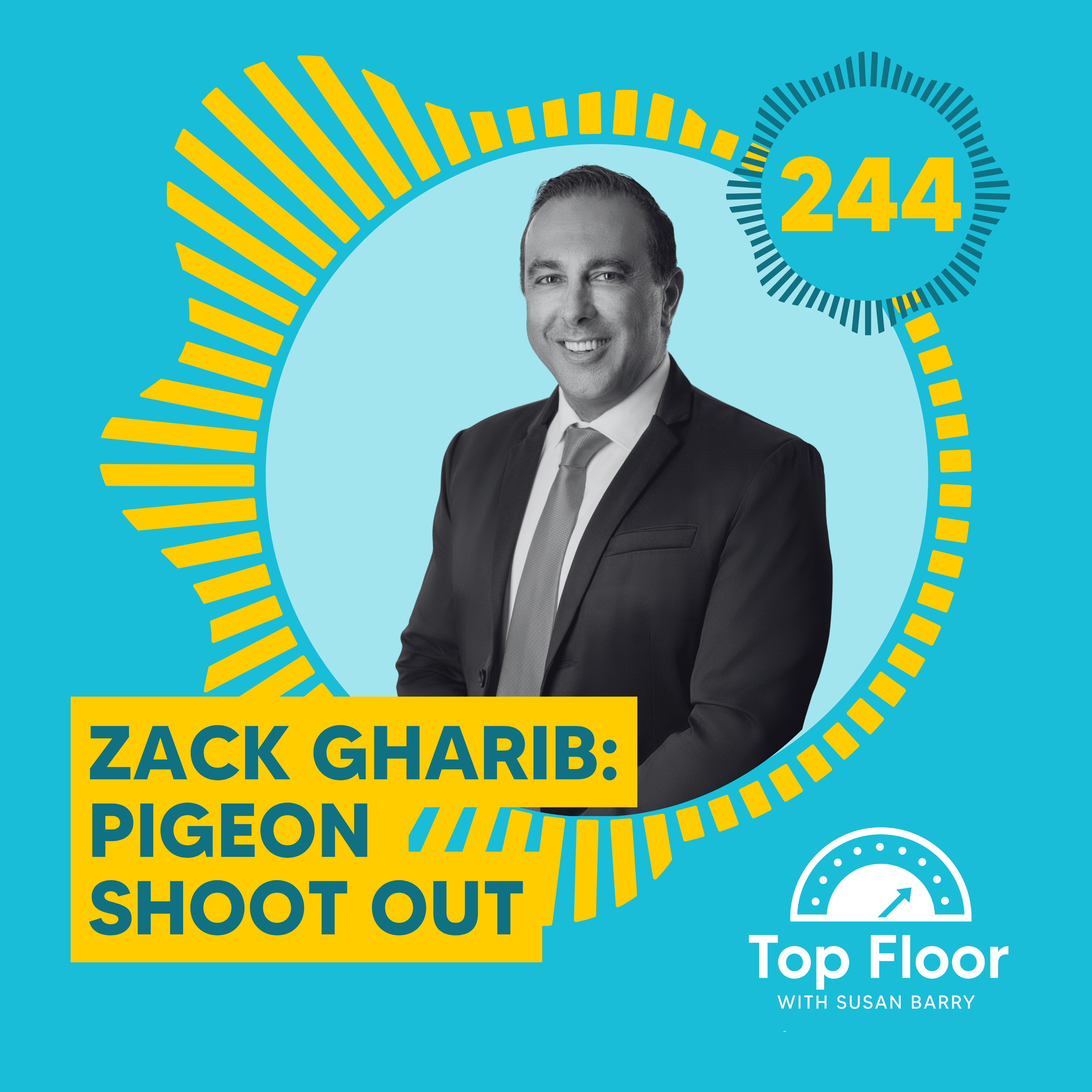
LISTEN TO THE EPISODE:
APPLE PODCASTS | SPOTIFY | TOPFLOOR.COM
[00:00:00] Susan Barry: This is Top Floor with Susan Barry, episode 244. You can find the show notes at topfloorpodcast.com/episode/244.
[00:00:14] Narrator: Welcome to Top Floor with Susan Barry. This weekly podcast ride up to the top floor features tangible tips and excellent stories from the experts and characters who elevate hospitality. And now your host and elevator operator, Susan Barry.
[00:00:32] Susan Barry: Welcome to the show. Zack Gharib began his hospitality journey in Lebanon before a trip to Athens sparked a life-changing realization. Hotels were where he wanted to build his career. After earning a master's degree in hospitality management from Texas Tech University, Zack joined White Lodging and helped open the Indianapolis Marriott, eventually rising through leadership roles at Marriott International, La Quinta, Wyndham Hotels & Resorts, Vacasa, and Highgate. Today, as president of Red Roof, he's leading a transformation focused on AI, franchisee support, and operational efficiency across the economy and extended stay segments. Today, we are going to talk about the future of those hotel segments. But before we jump in, we need to answer the call button.
Call button rings…
The emergency call button is our hotline for hospitality professionals who have burning questions. If you would like to submit a question, you can call or text me at (850) 404-9630. Today's question was submitted by Linda. Linda asks, I love this question, "What is the worst advice you ever got?" All right, Zack, what do you got?
[00:01:54] Zack Gharib: Oh my God. I guess, don't follow your dreams, follow what you know.
[00:01:58] Susan Barry: Oh, interesting.
[00:02:00] Zack Gharib: I followed my passion, and I followed what I love to do, and I followed what my heart told me to do, which is be in hospitality, and it's been an amazing career. So I guess I will take that.
[00:02:13] Susan Barry: Excellent. Well, speaking of which, what was it about this pivotal hotel experience in Athens that made you think, "This is what I wanna do"?
[00:02:23] Zack Gharib: Yeah. So, we were on the basketball team, every time we went back from the games, the hotel general manager, he was my inspiration. He would come and hang out with us in the lobby, and we shared stories and asked, "How did you guys do?" And he was having a lot of fun. You could tell that he just had a lot of fun. And I looked at him, and I'm like, "This is what I can see myself doing this." And that really was the pivotal change of my career. That's why, when I decided to do my master's, as you indicated, Susan. In hospitality management, and to come to this amazing greatest country on Earth to do it here. So that was it.
[00:03:04] Susan Barry: Well, that was it, except that you have now worked across every single sort of category and corner of the hospitality industry. Branded hotels, franchise operations, vacation rentals, which a lot of people in your shoes haven't touched, and now brand leadership. As you think about that progression, what do you think connects all of those experiences?
[00:03:31] Zack Gharib: It's people. When I look at our business, serving people is really what we do, and I think whether it's your guests, your franchisees, your teams, I think it's all about people in our business. And having that hospitality heart is so essential in our industry. And I think everybody that I meet around that enjoys the industry, enjoys the business, are successful. I believe we share the same vision, which is serving people.
[00:04:00] Susan Barry: When you moved from hotels to vacation rentals, which obviously I think is the most fascinating part of your career, what was surprising to you about sort of the complexity or many moving parts of managing scattered homes in Vacasa versus a single hotel property as a general manager or as a leader?
[00:04:26] Zack Gharib: Yeah. I mean, there were a lot of things that were different. It was an eye-opening experience. I'm just gonna be from a detail perspective, like inventory control, right? When you have your hotel, your inventory, it's in one box. You know what's in, what's out. Inventory control when you have a lot of homes, laundry operations that are sometimes offsite, was very interesting to learn how to do this. Laundry operations were interesting. And the one thing that really is managing trash operations. Every house they have different pickups of trash bins, and different dates. And obviously, when you have guests coming in, guests coming out, how do you take care of all of them. These are small things that I never thought of before. But when you join, it's like wow, this is, this is a completely different game that you really have to plan for and partner with a lot of people in the local communities to help you get these things done. But every house also has its own specific rules. They have their own technology gadgets. For our operations manager and even myself, when I was a regional director overseeing multiple states, learning a lot of these things and each house's personality takes a lot of work. And so, when a guest calls you in the evening after they check in, for example, or calls the operations manager and says, "Oh, how does this security system work? Or how does the TV work?" You have to remember 'cause every house has different things. But one thing I also learned, Susan, is you really have to have trust in your team. I mean, the team is scattered out there. They're all in the field. They're all doing their own thing. So you just wanna make sure you give them the tools, and you really have to trust in them that they're gonna get their job done at the end of the day.
[00:06:25] Susan Barry: Do you think it's harder to do vacation rentals or harder to do hotels?
[00:06:30] Zack Gharib: I think vacation rentals are harder.
[00:06:32] Susan Barry: Yeah. Because of all that. Because they're more spread out.
[00:06:34] Zack Gharib: From an operational complexity, absolutely. It is easier when you are in the same box. Your employees are there. Your tools are there. Your inventory is there. Your guest is there. You can talk to them, in person, one-on-one. I think that piece is easier.
[00:06:52] Susan Barry: It almost seems like you have a little bit more wiggle room on the vacation rental side. Like, maybe the service expectations aren't quite as high, or people are more willing to be like, "Oh, there's a knife missing from the silverware drawer. No big deal." Is that true, or am I just making that up?
[00:07:11] Zack Gharib: No, this is true. I mean, having clear standards and great cleanliness in the vacation rentals is more of a challenge. It's just more of a challenge, and I think guests really are forgiving there. As long as they like the house, and it's clean, and it's comfortable, and they have most of the stuff that they need, I think they're usually happy.
[00:07:39] Susan Barry: Makes sense. Yeah. Red Roof is undergoing a significant technology transformation right now. Tell us about what you're doing and what is driving it.
[00:07:50] Zack Gharib: You're absolutely right. We have been busy for the last two and a half years, Susan. So, it all started with our property management system, which was Hotelkey. Obviously, that was a game-changer. It allows us now to do a lot more integrations with different systems that are easier and faster. I mean, speed to execution when you're doing integrations is so critical right now. So that really was a great success. And because of this, we were able to connect all our OTAs directly to our PMS, which really resulted in our franchisees saving that third-party transaction fee, or most of it. So that was started there. And from there, we integrated Sojern, which is a guest experience platform. So now we can have in-stay surveys with our guests and make sure we take care of them before they check out. We're doing a Freedom Pay, which is our payment processing system that's gonna be easier and more efficient for our franchisees, and we actually cut their costs in half because of that integration. We launched our new guest app last September, and it's been wildly successful, 65% year-over-year performance. We're introducing a new revenue management system that's AI-driven. Takes a lot of pricing points, trend, and pace, and different factors, so it's all really AI. We are launching, hopefully soon or by the end of this year, our new website. I mean, as you probably know, I'm not sure if you've done it yourself, Susan, but the guest experience right now in booking, ChatGPT, and Gemini, I mean, they're starting to play a bigger role. And it's usually, it used to be Expedia and booking.com, and so now that AI and all these channels, having the right website with the right content, with the right connectivity, all this is really gonna drive more bookings on redroof.com, which is the best way to drive bookings. And then we're also overhauling our entire loyalty program to create more tiers and create more experiences for our guests through AI-driven platforms. So we've got a lot on the horizon, and we are excited about where we are.
[00:10:09] Susan Barry: Well, you are doing a lot, and I'm guessing spending a lot of money, but at the same time, the economy and mid-scale segments are facing some headwinds in terms of performance. How should those owners of those types of hotels, both yours and in other brands, what are some things that they can do to stay profitable in this kind of more challenging operating environment?
[00:10:39] Zack Gharib: Yeah. You nailed it. Honestly, the last couple of years have definitely been challenging. But I think that's where, as brands, we really have the opportunity to be more focused on initiatives that either drive revenue or cut costs at our hotels and help our franchisees that way. That's really critical, right? So, having a common-sense approach to our brand standards. I mean, if something is really not needed, it's not a great value to the guest, let's remove it because it adds cost. Having a common-sense approach to our property improvement plans. We don't need a hotel to go renovate from A to Z. Let's figure out where we need to renovate to create a guest experience that's good, but also doesn't break the bank on the owner's expense. Operational excellence is really critical right now. Making sure that the room inspections are happening. And then one thing, for hotels, and I always see that really firsthand, online presence right now is absolutely a big driver of profitability. So if you don't have the right pictures, if you don't have good reviews, and then I spoke about AI-driven booking engines right now. ChatGPT or whatever. So having the right content. Let's say someone goes to ChatGPT today and says, "Book me or find me a hotel. I'm going to the Kentucky Derby. Find me a hotel in this price range that has a microwave and a fridge." So if the content is not there, if you don't have Kentucky Derby mentioned, if you don't have the right pictures, if you don't have a microwave and fridge, all this like really detailed stuff, these engines may not pick your hotel up at all. So having the right pictures, reviews, contents are critical. That's in our control. And then we always say, look, the world economy can be impacted by so many things. The US economy can be impacted, but we're gonna focus on your street corner. I mean, that's really the important thing is to focus on your street corner, understand what's coming in, what the demand drivers are, and let's put a plan together to really tackle that. Because I think you gotta focus on what's in your control, and that's really a key factor.
[00:13:04] Susan Barry: We like to make sure that our listeners come away from every single episode of Top Floor with practical tips that they can try either in their hotels, their businesses, or in their day-to-day lives. Having worked with both hotels and short-term rentals, what do you think each side of the lodging industry could learn from the other? Like, what can hotels take from vacation rentals, and what can vacation rentals take from hotels?
[00:13:33] Zack Gharib: That's a great question. I think when you look at hotels, we excel at consistency, clear brand standards, and also the guest service training is at a high level. So I think when guests go to a hotel, they expect the cleaning standards, the check-in process. You're gonna walk into the lobby. You're gonna have somebody at the desk. And also the 24/7 support, right? So those are things that we, as hotels, excel at. And I think short-term rentals can learn from that aspect by adopting higher cleaning standards, and also improving their communication timing and issue resolution. That's something that there's a struggle with. Because of the distance sometimes between the houses, because the technology is not there. Some short-term rental companies are more advanced from a technology perspective, but a lot of them need to catch up. But I think that's what short-term rentals can learn from hotels. Now, on the flip side, I think short-term rentals really shine when it comes to personalization, uniqueness, and flexibility in the design and the way they do things. So that's where I believe hotels can possibly learn from this. I think as hoteliers now, hotel companies, we're getting much better at personalization. But I think we can, we can lean more into localized experiences, personalized touches. I think we can do that more on a hotel level, just like the vacation rentals do. But if I have to think about the future of hospitality, I would say it's likely a blend of both, which is delivering the reliability of a hotel, and I think with the uniqueness and flexibility of a vacation rental. I think that would be ideal.
[00:15:25] Susan Barry: I think you're absolutely right, particularly when you consider sort of multi-generational travel or theme trips, like girls trips, bachelorette parties, all that kind of stuff. You need that flexibility of just the four walls in order to accommodate those trips. So a little from column A, a little from column B seems to make a lot of sense. Okay, where do you think hotel companies are wasting money right now? You're not gonna wanna answer this one.
[00:15:53] Zack Gharib: Yes. Look, I don't know if they're wasting money or not, but I can tell you on a hotel level, from an operational perspective, right? I think some hotels still miss the mark on the synergy and communication between team members and departments, especially the front desk, housekeeping, and maintenance. So there's still a lot of wasted time, sometimes or not very good immediate communication, and I think that's where technology can really play a big role, should be front and center of finding the technology that helps that communication become really in real time.
[00:16:33] Susan Barry: Is it something different than texting, though? Like, can't they just text, or does it need to have layers that I'm not thinking of?
[00:16:39] Zack Gharib: Well, it really depends on the hotels if the housekeepers and maintenance keep their phones. If they all first of all share their numbers together. Because texting, you're interacting on a personal phone. But when you are on a business, when you are at the hotel, usually you gotta provide, like, either an app, right? So it's all documented within your hotel technology because you wanna see that communication and understand it and follow it. So if I'm a manager or if I'm an owner, I want to see that circle of communication. If everybody's texting on their own phone, that can get lost, right? But that's where I think technology can help. But also something very small, when I travel personally or whatever it is, some team members don't have the right tools or enough supplies, so they have to go back and forth. For example, housekeepers may have to go to the laundry to grab more towels because we didn't have enough. Now, they're ready from the dryer there. So I think there is some wasted time and efficiencies there. And great hotels, and I think great general managers, great owners really understand that very well. They deliver great operational excellence, but some struggle. And it can be a waste of time and money that way.
[00:18:14] Susan Barry: You mentioned technology as a solution for that. What advice would you give hospitality leaders who are feeling, I'm gonna say overwhelmed, but what I really mean is scared to death by the pace of technology and the emergence of AI, and all of the change that seems to be happening rapidly? What advice do you have about that?
[00:18:37] Zack Gharib: Well, I think learning how to say no would be my advice. Honestly, because it's like a kid going into a candy store. You wanna have it all, but it's not good for you. Obviously, you can't have it all. Personally, I think at the organizational level, every time I go to conferences, there's a lot of great things out there, AI stuff and systems. And understandably so, everybody thinks that they have the best new thing, and you respect that. And a lot of people wanna come and tell you how they can improve your business, and this, and that, and there's a lot of great things out there. But my say is learn how to say no. And if you say yes, you gotta develop a process internally where you really have to just build a strong business case. And once that business case is built, you're gonna have to get a group of people, whether it's your own leaders in the hotel or brand or business, and also advisors. In our case, we'll bring in our franchise advisory council members. They're owner-operators, and they give us their feedback, right? So that's how you'll know whether there's a clear ROI or not. If there's no clear ROI at the end of the day, just walk away. It's not worth it.
[00:20:06] Susan Barry: Technology implementation is a big operational change. What about something small? Can you think of a really small improvement that a hotelier can make to her hotel, to her operation, that would have an outsized impact on profitability?
[00:20:26] Zack Gharib: Look, I come from philosophy, and I worked with companies like Marriott, and I was a full service, a limited service, and Wyndham and La Quinta. So I worked with a lot of different companies with different visions and standards. But I can always say, Susan, that the two small operational things that matter the most. You can complicate it, or you can make it simple. The two that matter the most are one, a nice smile at the desk. I think we, as owners or general managers, should always make sure that we're offering at least something that doesn't cost anything, to smile, and that really puts the guest at ease and welcomes them in a nice way. And the other two piece is every guest wants a clean, comfortable room, so those room inspections are critical. So I would spend time in those, and I think that really makes a big difference when it comes to operational aspects.
[00:21:25] Susan Barry: Just back to the basics. Back to the basics. That makes a lot of sense. We have reached the fortune telling portion of our show, so you have to predict the future, and then we will test you and see if you got it right, so you better be careful. What is a prediction that you have about the future of non-luxury hotels? Everybody wants to talk about luxury right now. Such a thin slice of our industry. What do you think about non-luxury hotels?
[00:21:53] Zack Gharib: Well, I think the future is into non-luxury hotels. That's really the backbone of the American traveler and American hotel industry. But if I had to predict, non-luxury hotels will become more automated and specialized. Using technologies like self-check-in kiosks and AI customer service, because you wanna reduce that cost and also that staffing, instabilities that we have. I mean, it's really hard today to staff mid-scale and economy segment hotels. Its staffing shortages are a real thing. A lot of hoteliers or a lot of people would like to work at a luxury hotel if they get a chance at the Four Seasons or Ritz, or whatever it is. But to go and work in the mid-scale economy is more of a challenge, and I think that automation is going to be front and center for non-luxury hotels overall. Instead of offering broad amenities, I think many hotels now will start looking at, okay, the specific travelers like the families, people working from home, road trippers, and how do we attend to these? And I think that's where my prediction comes from. AI automation is going to be a key in that aspect.
[00:23:30] Susan Barry: Okay. If you could wave a magic wand or an AI robot, I guess in this case, and change one thing about the relationship between hotel brands and franchisees, what would that be?
[00:23:44] Zack Gharib: I guess if I have to change one thing, there's probably a bunch of things I would change. If I have to change one thing, especially in macroeconomics. You said it earlier, margins are being squeezed. Our hoteliers in the field, our franchisees, are facing those head-on. So if I have to change it, it would be to create a true economic alignment and transparency between the brands and franchisees. I think too often the relationship can become or feel transactional. If you look at brands overall, brands drive brand standards, fees, system initiatives, but who's really carrying the bearable? It's the franchisees. So that's where I think the magic wand comes into play. I shift that dynamic so both sides are more directly tied to the same outcome, which is the profitability at the property level. I think when we start really thinking about it from that aspect, we can join forces in everything we are doing. I think franchisors and franchisees join forces in tackling all the issues that are coming our way. We will be a lot more powerful, and I think that really is important, and that's what we're focused on at Red Roof. Specifically, that profitability at a property level is so key for us. So everything we're doing now is about driving that profitability.
[00:25:16] Susan Barry: Okay. Let's dig into that just a tiny bit, if you don't mind. I cannot tell you the number of guests that I've interviewed who talk about the misalignment and the focus on things like top line instead of profitability, or fees instead of profitability, or whatever it is from all angles, from owners say this, management companies sometimes say this, brands say this. You know what I mean? Everyone talks about it all the time, and nothing ever changes. So what has to change? What's next? Everybody agrees, it seems like, so what do we do? Solve the problem immediately, right now.
[00:25:57] Zack Gharib: I can't solve it, but I think it really goes to your core values and your culture. So you have to be true to your vision, and execution on what you say you're gonna do is extremely important. So I mean, I can tell you what we do. So we are committed to driving top-line revenue. We are driving to cut costs. So I mentioned some of that technology, right? So finding the right partner to, for example, cut the credit card transactions in half. That's an execution. You gotta say, "We're gonna do it," but you have to go find it, integrate it, execute it at a fast level. The OTA transaction fees. We partner with the right PMS to cut that by more than half. And so, driving revenue is now, we are manually putting rates and such. Well, now we're introducing a revenue management system that's AI-driven, that goes and does it all for you to lift your revenue. But you have to execute. And then I think that's when I go back to saying to what I said earlier, if you have that process of making sure the franchisees are involved in the initiative. It's not just at the corporate level, you're coming up with ideas and rolling them out. If you have the ROI, you share it with our franchise advisory council, and they bless it. "Yep, it makes sense." Then you're really working together. And I think it's really about executing on it. And I think that's where some brands do very well, and some brands can really be better partners in that sense.
[00:27:41] Susan Barry: All of the efficiencies, cost savings, cost cutting in some ways of technological advances, new deployment of software, better credit card fee negotiation, all of that stuff, do those initiatives allow owners to make more money, or are they the way that we are keeping our head above water as costs rise? Like, is there a world in which all of this innovation suddenly unlocks additional profits, or is it just a way to fight against the rising tide of labor costs going up and all that stuff?
[00:28:25] Zack Gharib: We don't know the P&L of every franchisee, right? So what we can do is we can continue finding ways to reduce their cost and to hopefully drive their revenue. Now, their property taxes, if you're in New Jersey, for example, maybe your property tax is double. But maybe if you're in another state or another city, your property taxes are slightly higher. So, the cost savings, the revenue drivers are really making a more impact than maybe someone in a different state or different city, that they're seeing their insurance go up because maybe they also had some, a couple of litigations against them that drove their insurance much higher, versus a hotel that has been safe, there are no incidents for a long time, their insurance is stable. So it really depends, it's a case-by-case, but I think the goal is to continue finding ways to really drive these cost measures and drive these revenue, drive revenue for them. From a brand perspective, I talk about Milestone and our website. But other brands are doing it too, which is driving bookings more to the brand.com. Well, that saves the OTA fees, the 15 or 14%, whatever the OTA fees. If you can save that now, that's also a big chunk that goes back to your profitability. So we don't know that from a P&L perspective, but we're gonna keep our head down, and we're gonna find every way to really help our franchisees, and I think that should be the goal.
[00:30:00] Susan Barry: Okay, folks, before we tell Zack goodbye, we are going to head down to the loading dock where all of the best stories get told.
Elevator voice announces, “Going down.”
[00:30:10] Susan Barry: Zach, what is a story you would only tell on the loading dock?
[00:30:15] Zack Gharib: Well, I have a couple of good stories if you want. One is really crazy, maybe, and one is inspirational. But I think there are actually three stories I always tell, but I'm gonna share two. So the first one, I'm gonna start with the edgy one. The first one is that I had just become a general manager at a hotel in Austin, Texas. And then I was sitting, this was like my second week on the job. And I'm sitting in my office, and it has a glass wall, so I can see the lobby. I'm sitting in my office on a summer afternoon, and I see this guest and her daughter running into the lobby, and the guest is screaming, "Oh my God. Oh my God." Obviously, naturally, she's coming from the pool, they're in their swimsuit. So naturally I'm thinking, "Oh my God, something really crazy happened." So I immediately walk out to the lobby, and I personally say, "What's going on, ma'am?" She's like, "My daughter and I are swimming in the pool. All of a sudden, this dead pigeon falls from the sky." And I'm like, "Oh, I'm really sorry. I wonder what happened." She's like, "Well, the thing is, 30 seconds later, another dead pigeon falls from the sky." And I'm like, " What, ma'am? I'm really sorry." I had the front desk give them some water. I said, "Let me go check it out." So I walk out to the pool, and there they are. There are two dead pigeons in the pool. I'm like, "What's going on?" And then, as I'm standing, a third pigeon comes out. And I could see where it came from. So my head started turning. We have an attic and a storage room up there. So I'm like, "Let me go check it out." So I went to the third floor. I opened the attic room, and I see Billy, our chief engineer, with a BB gun. And as soon as he said, and like shooting, I'm like, "Billy, what the heck are you doing?" And he got startled. He's like, "Oh, my..." He's like, "Well, we can't get rid of these pigeons on this side of the building.” I'm like, "You can't do that. Give me the BB gun. Give me the BB gun." So, I'm not gonna go over to what happened there, but I was like, "Oh my God, this is insane."
[00:32:33] Susan Barry: That is craziness. But I love it.
[00:32:36] Zack Gharib: So, that's my first story. But another story that I was blown away by was when I was a GM at a hotel in San Jose, California. This guest and his wife are trying to check in, and they're talking to Laura, the front desk agent at the time. And she's asking them like, "Well, what kind of room would you like?" And the guy jokes with her. He's like, "We would like an ocean view." Now, if you are from San Jose, California, it's nowhere close to an ocean. There's no ocean. So they joke about it, and they go to their room. She checks them in. They go to their room. 30 minutes later, they're coming out, going to dinner. And Laura asks them, "How is everything in your room?" And they said, "Oh, it's great, but we didn't get the ocean view." So again, they joke about it. They go to dinner. So, Laura, what she does next is she goes to the back. She got a flip chart. She got markers. She drew some water and sand and water. She took that flip chart. She felt comfortable enough. She took that flip chart and went to the room and posted it on their window. So the guests came back from dinner. They went to the room, and they were wowed. I mean, they were wowed. They wanted to meet me the next day and compliment her. They wanted to write a letter to Mr. Marriott, which they actually ended up writing a letter to Marriott corporate. Laura won Employee of the Year at Marriott that year. We celebrated at the brand conference in San Francisco.
[00:34:16] Susan Barry: Oh, wow. I have chills. That's so cool. It's so funny, like a piece of paper and some markers, and they probably still tell that story to this day, right?
[00:34:28] Zack Gharib: I'm sure she does. I say it all the time.
[00:34:32] Susan Barry: That's so cool. I love it. Zack Gharib, thank you so much for being here. I know that our listeners got a lot of good ideas and tips, and I really appreciate you riding with us to the top floor.
[00:34:46] Zack Gharib: Susan, I really appreciate you. Thank you for giving me the opportunity to talk to you and your listeners, and I very much appreciate it. Thank you so much.
[00:34:55] Susan Barry: Thank you for listening. You can find the show notes at topfloorpodcast.com/episode/244. Jonathan Albano is our editor, producer, and all-around genius. He even wrote and performed our theme song with vocals by Cameron Albano. You can subscribe to Top Floor on Apple Podcasts, Spotify, or wherever you like to listen, and your rating or review will go a long way in helping us give you more of what you like.
[00:35:32] Narrator: Thanks for listening to the Top Floor podcast at www.topfloorpodcast.com. Have a hospitality marketing question? Reach us at 850-404-9630 to be featured in a future episode.