
Transcript: Episode 243: Run Through Walls
LISTEN TO THE EPISODE:
APPLE PODCASTS | SPOTIFY | TOPFLOOR.COM
[00:00:00] Susan Barry: This is Top Floor with Susan Barry, episode 243. You can find the show notes at topfloorpodcast.com/episode/243.
[00:00:14] Narrator: Welcome to Top Floor with Susan Barry. This weekly podcast ride up to the top floor features tangible tips and excellent stories from the experts and characters who elevate hospitality. And now your host and elevator operator, Susan Barry.
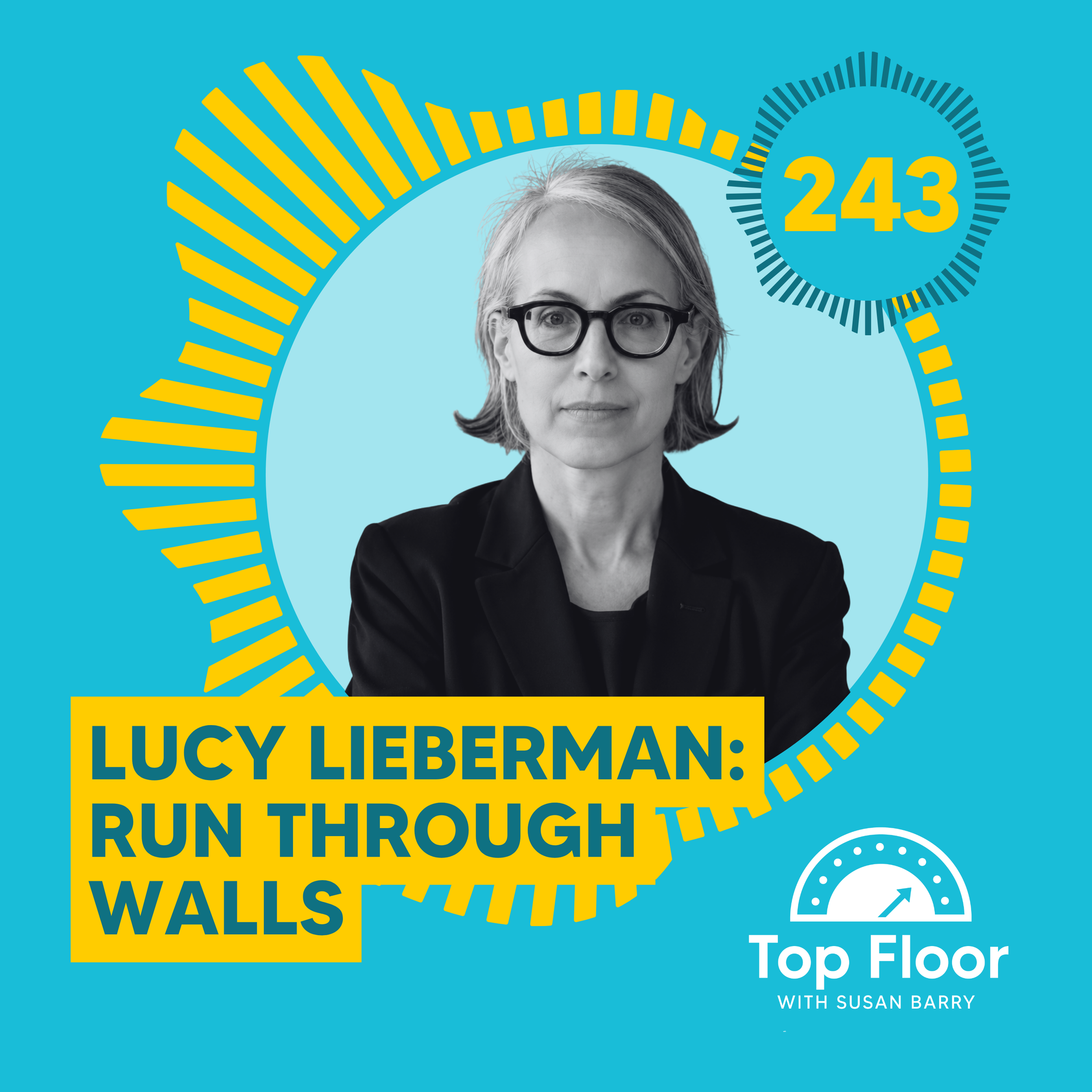
[00:00:32] Susan Barry: Welcome to the show. It's Susan, and I'm jumping in here to introduce the episode. This was recorded at the inaugural Female Founders in Hospitality Summit held in New York City in early March of 2026, and I had the great pleasure of interviewing Lucy Lieberman. Her introduction follows here shortly, but I wanted to explain why this is gonna sound a little different from a normal episode of Top Floor. As always, thank you so much for being here, and enjoy the interview with Lucy. Lucy Lieberman has built her career at the edge of what's next. She started in the earliest days of interactive media, helping launch some of the first brand and e-commerce websites, like Kellogg's and FAO Schwarz, when most companies weren't even sure the internet mattered at all. She moved from CD-ROMs to websites to online advertising to mobile to streaming, joining all of these categories before they were proven and sometimes even before the market was ready. Lucy then spent a decade at Ogilvy, helping companies like IHG and Amex integrate digital into their core business strategies. More recently, she became CEO of Michelin Guide Hotels, leading the integration of the hotel business into the Michelin Guide that we all know and love, and transforming a legacy publishing brand into a modern, digital, global travel platform. Lucy has repeatedly operated at inflection points: new technology, new business models, economic downturns, and industry disruption, and she's had to answer the same question many of us face as founders. How do you build something ahead of the market without getting so far ahead that no one will follow you? So that's what we're going to explore today. Lucy Lieberman, thank you so much for being with us.
[00:02:55] Lucy Lieberman: Thank you.
[00:03:00] Susan Barry: You're like, "And now I'm leaving." So Lucy, you have a pattern of arriving early, as I just outlined, sometimes very early to major shifts, websites, online advertising, all that good stuff. What do you think were the signals you saw that other people maybe weren't taking seriously yet?
[00:03:21] Lucy Lieberman: In some ways, I feel like I was way too early, way too many times. I should've learned a lesson along the way there. But I think when you sent over these draft questions, one of the things I was thinking about immediately was one of the first interactive experiences that I had, which was with a music recommendation platform called Firefly that came out of the MIT Media Lab. This was way back. Started out as an email thing where you could send five bands that you didn't like, that you liked to a bot, and then it would send you back five bands that you might like, and then you could say which of those that you liked and sent that back, and it would send you five more bands.
[00:04:06] Susan Barry: I want that now.
[00:04:08] Lucy Lieberman: I want that now, too. And what I was really into was how it was essentially reaching this vast data set and building this vast data set to make content and recommendations more relevant to me and my personal taste. So when I think about, like, what do I look for? It's like I'm looking for things that are naturally making my life better or making me smarter or making me more informed in ways where the hurdles to do that are lessened. And in a lot of ways, this was early in my career, which is really focused on tech. So it was like, where can tech speed things up, lower barriers, broaden things, target things, unearth things in ways that you just could never do in an analog way.
[00:05:12] Susan Barry: Have you ever had to distinguish between being too early and a wrong idea? I'm wondering for the founders in the room, I think there are a lot of you here that probably feel the same thing, you're ahead of the curve, and you're hoping that the market will follow you. How do you know when it's right to keep pushing or when you need to pivot?
[00:05:34] Lucy Lieberman: Yeah, that is one of the million-dollar questions. This was a thing that we really honed at Ogilvy, which was really working with clients to figure out what opportunities they had in their business. It's definitely around marketing and brand growth, but really around their product and services and how they delivered those to unlock their maximum potential. And we would get into trying to really articulate what the barriers and drivers are along the consumer journey. Going back to my sort of first thought around what are things that are gonna make your life better, you smarter, more informed, or able to better reach people? Like great, you have this idea, it does one of those things, then what are the barriers and drivers to actually get access to that or learn about it, and then use it, and then see the results, and then repeat. And by getting clear on those things, you're also identifying, like, who is your audience and what are their alternatives to your thing? And are there enough of them? And then what they're willing to essentially pay for that, marry with, what value they'll get out of it? And does that equation line up? I just think about conversations that I've had where people are like, "I have this really cool tech idea," and then I break it down into, well, how do people do that today, and is that way they do it today actually better? And you're just really into what the tech can do.
[00:07:24] Susan Barry: Right, like every store has its own app. How very dare they, right?
[00:07:30] Lucy Lieberman: I was working with a friend of mine who was launching in 2005, essentially a Netflix for indie films. I think Netflix was still mailing CD-ROMs in.
[00:07:44] Susan Barry: 'Cause I was getting 'em.
[00:07:45] Lucy Lieberman: Yeah, so it was a modern, the online version of Netflix for indie films, but it was such a drag to connect your computer, which is where you were getting all your streaming content, to your TV. And I was like, "Oh my God, maybe you could like sell a kit of cables- that you could sell at no cost or no markup just to make it easy for somebody to like hook their computer to their TV and actually stream content." But the costs of bandwidth were so high, streaming quality was low, but all the foundations were there, and voila, now everyone has streaming video.
[00:08:25] Susan Barry: Very early, once again to that market. If I am jumping ahead too much, please let me know. But can you tell the story about Kellogg's?
[00:08:38] Lucy Lieberman: Oh yeah, Kellogg's. So Kellogg's is a big cereal brand. In 1995, Kellogg's had the thought that the internet could address one of its big customer retention problems. They were observing that families fed their kids Kellogg's products their entire childhood. Like, I personally loved Frosted Flakes. I especially loved Frosted Flakes with half and half. Was, like, over the top, like sugar, creamy. Ugh, that was the best. Okay, so you grew up eating Frosted Flakes, and then you went off to college, and you were poor, and so you diverted and started buying sugar bombs or Safeway-branded Fun Flakes or whatever it was, and Kellogg's lost you. So it was this high cost of re-entry for them to rekindle that love of those branded flakes and then start feeding those flakes to their kids as they were going along. So they were like, "This internet thing, we hear college kids are on it. Is there a way to use the burgeoning web to actually keep those kids engaged during college so that we don't lose them during that timeframe?" So I was at a small digital agency at the time, and we worked with them to build what was essentially this, like, super snarky, kinda off-brand, interactive, time-wasting website for college kids, who were the only ones who had access to the web at the time, to do things like interactively do coloring books of Tony the Tiger. So you would click. I mean, this is dial-up. You would click on a color that you wanted, and then you would click, and the page would reload, and then you'd click on a space that was white, and then the page would reload and fill in that white space with this color. And people freaking loved it. I could get into the server and actually see which file, how many files were made on a daily basis, so new coloring pages created, and which had the highest file size, which meant that somebody had spent a lot of time building their coloring book page. And then we could go and look at the things, and we're like, "Holy crap, people are going crazy." And then we added in new features, like now we would make a pile of stickers, and then you could add them to your coloring book.
[00:11:38] Susan Barry: Again, I want this now.
[00:11:40] Lucy Lieberman: I would love this now. And it became this way to both open up Kellogg's to an audience that they typically didn't have, and engage them in a way that was really natural to them. And speak to them in a tone that was very focused on the specific audience, and they really deemed it a success.
[00:12:11] Susan Barry: So you talked about the fact that the website was a little bit snarky and off-brand. And I think it's interesting to think about being on brand versus having a point of view, and what the difference is. So a lot of companies tout their features, but try to be all things to all people. What do you think is the difference between just talking about features and grasping for any kind of business you can get, and having a distinct point of view?
[00:12:45] Lucy Lieberman: Yeah. I feel like this is the total trap that almost every hospitality brand falls into, trying to compete on features and amenities, which are totally not defensible unless you, hospitality brands, are inventing your own machine or your own super proprietary methodologies for delivering service. You cannot defend your position on features and amenities. I saw this when I worked with IHG very closely. We had won their agency of record business for their loyalty program, and they were trying to just shove the loyalty program down the throats of every traveler on the planet. And we were like, "Your loyalty program, one, is mostly for business travelers to bank a ton of points to then take their family on vacation, and bank most of those points staying at a Holiday Inn or a mid-scale brand, and then blow them on an InterContinental resort, preferably in Bora Bora." But Marriott had really just wanted to crush IHG, and so they had boosted their loyalty program, so it was rationally better than IHG's. So we're sort of showing the leads at IHG, like, "Here's, here's your point structure, here are the tiers that you get to, here are the benefits, and Marriott's are better. But let's not just boost your tangible stuff so that it's better. Let's actually get to really having a purpose and a meaning and a point of view." A lot of you probably know how the whole points program is reliant financially on breakage. You are counting on the majority of people not using their points, which is so sad. They don't think they're gonna get anything out of them. And so they'll just mine you for that current promotion and double their points on their next stay. And then they'll move on to Marriott to double, to triple their points on their next stay, and then they'll move on to Hilton and get some points over there, and just sort of run through all of the different programs. Like, you had to be a scientist to gain the system in your favor. And we're like, "That's a sad state of things. Can we take a position that we actually understand the point of points, and we're on your side, and we actually want you to win?" What makes a customer more loyal than actually accruing a bunch of points and then literally blowing them on a trip to Bora Bora, and then having a great time and feeling like it was really worth it. So they bought it and embraced it, and then jacked up the benefits, the rational side of things, including being the first global loyalty program to offer free Wi-Fi. Cause that is a huge pain point. This is 13 years ago. You check in, you go to your room, you open up your computer 'cause you have to get online 'cause you're traveling for business most likely, and then someone asks you for, like, $5.99 a night.
[00:16:20] Susan Barry: $14.95. Please raise your hand if you worked at a hotel that charged for internet, and you remember. It was horrific.
[00:16:27] Lucy Lieberman: To make yourself able to compete better, you have to stand for something and then connect with consumers beyond reason. You must have this emotional attachment, and when you have that, it literally drives down your costs of marketing and costs of customer retention, which then makes you better able to invest in things that make your business thrive more. When I look across the travel industry specifically today, and to a certain extent hospitality, but less so, travel is like this to see a sameness. Consumers will never know your business as well as you do, and they will not be able to tell the difference.
[00:17:14] Susan Barry: Well, many of our founders here are either in that specific category or other very crowded categories. I'm wondering what your advice is for making ourselves into categories of one.
[00:17:31] Lucy Lieberman: Yeah. You talked about that.
[00:17:36] Susan Barry: She's like, "Hire me, and I will help you.”
[00:17:39] Lucy Lieberman: Getting at what people need that they don't know what it is, versus giving people what they want, especially giving people what they're asking for, is how you get there. I love research. But I hate when people are like, "We're gonna do research, and it'll tell us the answer." Or when people say, "Oh, I'm gonna AB test to spit out what I should do," and I'm like, "No, no, no, no, no. You use research to test a hypothesis." So I kind of go back to that, my friend's video 2005 startup thing, and how she was really convinced that people wanted better entertainment. So she was like, "People aren't necessarily asking for a platform to stream independent movies and get recommendations from their peers and data-driven recommendations and a great searchable engine to access all this incredible content," but she was like, "No, people want more intelligent and provocative and, novel and independently minded entertainment in their lives, and so I'm gonna build this thing." Are you truly delivering on something that is an unmet need that people have today, versus just trying to respond to asks?
[00:19:27] Susan Barry: It's almost like the research question is you don't research what people want you to make for them, you research what problem they want you to solve for them.
[00:19:37] Lucy Lieberman: Yeah, and why is that a problem? And what alternatives do they have today? My favorite kind of research is ethnographic research. I was working with IKEA North America, and they were wondering why sales were declining when everyone said they love IKEA. And I was like, "Well, do they? Do they really love it?" So we actually sent a team of an interviewer and a videographer out to a company, kind of the best type of IKEA consumer, mostly like the Philadelphia area. And they went to their homes and had them show the team, like, how they lived and where IKEA fit into their home, and then they literally got in the car with them and then went to the store. And they're like, "How do you navigate the store and what do you look for, and what's going on?" And it was this incredible experience of figuring out what they say versus what they're actually doing and what they're actually looking for. And so you can get a lot of information out of a well-crafted survey, but you can also just get unbelievable insight when you're that close to your customer.
[00:20:57] Susan Barry: When you're in their house.
[00:20:58] Lucy Lieberman: When you're in their house, and they're willingly showing you their, like, hamper.
[00:21:04] Susan Barry: That's insane. Well, we haven't talked a lot about your time at Michelin hotels, but I do wanna ask a question or two about that. You stepped into that CEO role right at the worst moment.
[00:21:18] Lucy Lieberman: Jan 2021.
[00:21:20] Susan Barry: The literal worst moment in modern travel history, for a hotel company, for a travel company, right as the pandemic was beginning. Can you reflect on that time and maybe talk about something that happened or a decision you made around then that you're proud of, and why?
[00:21:39] Lucy Lieberman: Yeah. So I played two roles. I initially joined Tablet Hotels as the chief marketing officer in May of 2019, about six months after Michelin had acquired Tablet. And Michelin had acquired Tablet because they had the Michelin Guide, and they acquired Tablet 'cause Tablet had figured out how to marry curation with commerce, and had all these B2C skills and e-commerce skills. And it was gonna be a great way to evolve the Michelin Guide into a real modern consumer-awesome platform. So I spent the first six months, I was there really developing a go-to-market plan for Tablet, now that it had the backing of the Michelin Guide. I was getting ready to launch this whole thing in the beginning of 2020, which was bad timing, and then we suffered through 2020, and then at the end of 2020, one of the two co-founders said, "I'm gonna leave the company, and myself and the other co-founder think that you should be the CEO now in the worst time for travel on the planet." And so they made that recommendation. Michelin was like, "Sounds good." "We don't know what that business is anyway." So, it was like, "Okay, business in shambles. Go get it back, and also help steer the transformation of the Michelin Guide and integrate your team into Michelin, 'cause it's really been operating on its own in this island. So I was like, we are never gonna see a recovery here if we don't actually, like, get a grip, one, and then work together to unlock all of our glorious potential. So, like my first week as CEO, I put together this, like, terrifying presentation of the financials over the last several years and where we were today and what Michelin was expecting us to get to and what period of time. It was this, like, shocker. None of these guys knew how much money we had made in the past and how sort of the performance of the business had been sort of declining over time, and then it just, like, went to the toilet and was still in the toilet. And we're like: "People aren't traveling still. How do we even get there?” But there were all these positive trends. I'm sure you all were feeling this. Like, I remember monitoring TSA checkpoint numbers and being like, "They are increasing."
[00:24:36] Susan Barry: And the throughput on TSA when all travel was banned was still a million travelers. Do you remember that? That was wild.
[00:24:44] Lucy Lieberman: People were still going. So it was like TSA numbers were on the rise. People had so much pent-up demand. They were just, like, freaking going stir crazy. Bank accounts were fat. Like, people were ready to spend as soon as they could. And then there were a couple of other just little symbols of spring. Like, I saw a crocus blooming on the High Line yesterday. I was like, "Thank God." So it was just like, okay, guys, things are going to get better, and travel will totally rebound and then some. And when people are ready to rock and travel, they should be traveling in style, and they should be traveling with the best providers in the business, and the most incredible hotels around the world, and that's us. So we have the best taste and the most elegant platform to book them, and the most crackerjack team of customer service people on the planet that are gonna make sure everything goes flawlessly. And so we are, like, ripe. So, can we start to really, instead of focusing on your responsibilities for your department, can we really start to look at what this whole customer journey is, and where can you all have an impact? I was like, let's focus on conversion rate. How much time are people spending to actually make the booking? And let's look at the historical conversion rate, and then let's try to get back to what that historical conversion rate is. And it became this thing that everybody could get their heads around, having just, like, a really simple, relatable North Star that was a tangible thing that everyone could impact.
[00:26:42] Susan Barry: That's amazing. I have to tell you this because I think this is a direct reflection of that. The hotel business right now is very bifurcated. Luxury's doing great, everybody else is not so well. And one of the theories is that because people's bank accounts were fat in the pandemic, and because companies like the one that you led were convincing people to upgrade their stays, it's not that just the rich people get richer and keep going to luxury and everybody else is screwed, it's that people's taste has improved, and they have a taste for luxury that they didn't have before. So thank you, Lucy, for bifurcating the hotel under. I'm just kidding.
[00:27:23] Lucy Lieberman: No, that was Instagram that did that. It wasn't the consumers, it was the spreading of their experiences.
[00:27:31] Susan Barry: 100% true. Okay, if you were sitting in the audience right now, building a travel company, building a hospitality company in 2026, where would you be looking for opportunities, maybe like the ones you teased out of the TSA throughput, or maybe somewhere else?
[00:27:58] Lucy Lieberman: Well, one amazing thing is that everybody's like, "AI is going to destroy everything." Having grown up in tech, and tech is a disruptor, I'm like, "Ooh." AI is like so juicy to me. It's this hyper-powering, crazy 24/7 insatiable set of researchers and tools that I can stand up and instantaneously. But what I love about travel and hospitality is that AI is not replacing that anytime soon. This is a future-proof industry. It's like the original category. It will live on forever. It will take a while to replace smell, taste, and touch in an artificial environment. And then when they do, it'll be artificial. I really love The Matrix, but I don't want it. So when I just think of, like, where is there an opportunity? So, like hospitality and travel are, it's like a rich place to be, really doubling down on that authentic, incredible experience. I'm sure a lot of you guys have like incredible subject matter expertise and know innately how cumbersome, time-consuming, tedious, or just like annoying things are in what you provide to your clients and partners. And you should be thinking about how AI can just like eliminate those or do them for you. And so I think there's an opportunity around. Can you build platforms that let other people take advantage of that knowledge that you have and those tools that you could potentially stand up to make your business more fluid, strengthen your relationships with your customers, and drive more positive outcomes for your constituents. So I'm just like, oh, I don't wanna sound like everyone else, but like AI is like the web. But then, as I said, I think authenticity is increasingly valued, especially among younger consumers. Like, I don't know, I did read recently that kids are buying iPods off of eBay. They like buttons. I'm like, cassette tapes are selling more now than they did in the '90s. I have a cassette player from this awesome, cool French company called We Are Rewind, and I've hooked it into my Sonos player, and I resurfaced all my Kate Bush.
[00:31:10] Susan Barry: What about your mixtapes?
[00:31:12] Lucy Lieberman: Yes, yes. Yeah. I have old mixtapes. I even have like a tape, like a really old tape that I think I recorded with a tape recorder next to the radio. That's old.
[00:31:27] Susan Barry: We'll explain what all those terms mean in just a little while. Sorry. Okay, I'm gonna give you one final question. Obviously, the women here are founders. Some are bootstrapped, some are venture-backed, and some are never planning to exit. Any thoughts on what separates founders or leaders who scale from those who stall? Final thoughts.
[00:31:51] Lucy Lieberman: Okay. So I have three thoughts here. One is ego, and having a giant one. I feel like I'm a great operator and like a great partner to a lunatic. And that you need like, you need to be sort of crazy and have like total conviction to like overcome all the obstacles to actually like do it. The other is just being super clear-minded about your vision and, as part of that, being very clear about who you're for and not trying to be for everybody. You will never make everyone happy, so figure out who the people are that you wanna make really happy and just, like, triple down on that. And then the third is just being really honest. And I would say that is getting really close to the customer and insisting that they don't tell you what they like, but insist on them telling you what sucks and what they wish was better and why your thing doesn't measure up to something over there. And a lot of times when you have a new thing, and you're really excited about it, and you're telling your friends, and they're like, "That sounds so cool." You have to get into this mode of figuring out why. Like, what do you like? I recently had an experience with a company I was working with, and they were like, "You ask why too much." And I was like, "Ooh. Okay, well, this is not the right culture for me." Why is my favorite question, and so if you can get to the why, and you are bold and badass and super clear-eyed, you can run through walls and do anything you want.
[00:34:14] Susan Barry: What a great sentence to end on. Thank you so much, Lucy.
[00:34:17] Lucy Lieberman: Thank you. Thank you, guys.
[00:34:25] Susan Barry: Thanks for listening. You can find the show notes at topfloorpodcast.com/episode/243. Jonathan Albano is our editor, producer, and all-around genius. He even wrote and performed our theme song with vocals by Cameron Albano. You can subscribe to Top Floor on Apple Podcasts, Spotify, or wherever you like to listen, and your rating or review will go a long way in helping us give you more of what you like.
[00:35:01] Narrator: Thanks for listening to the Top Floor podcast at www.topfloorpodcast.com. Have a hospitality marketing question? Reach us at 850-404-9630 to be featured in a future episode.