
Transcript: Episode 239: Karma is a B
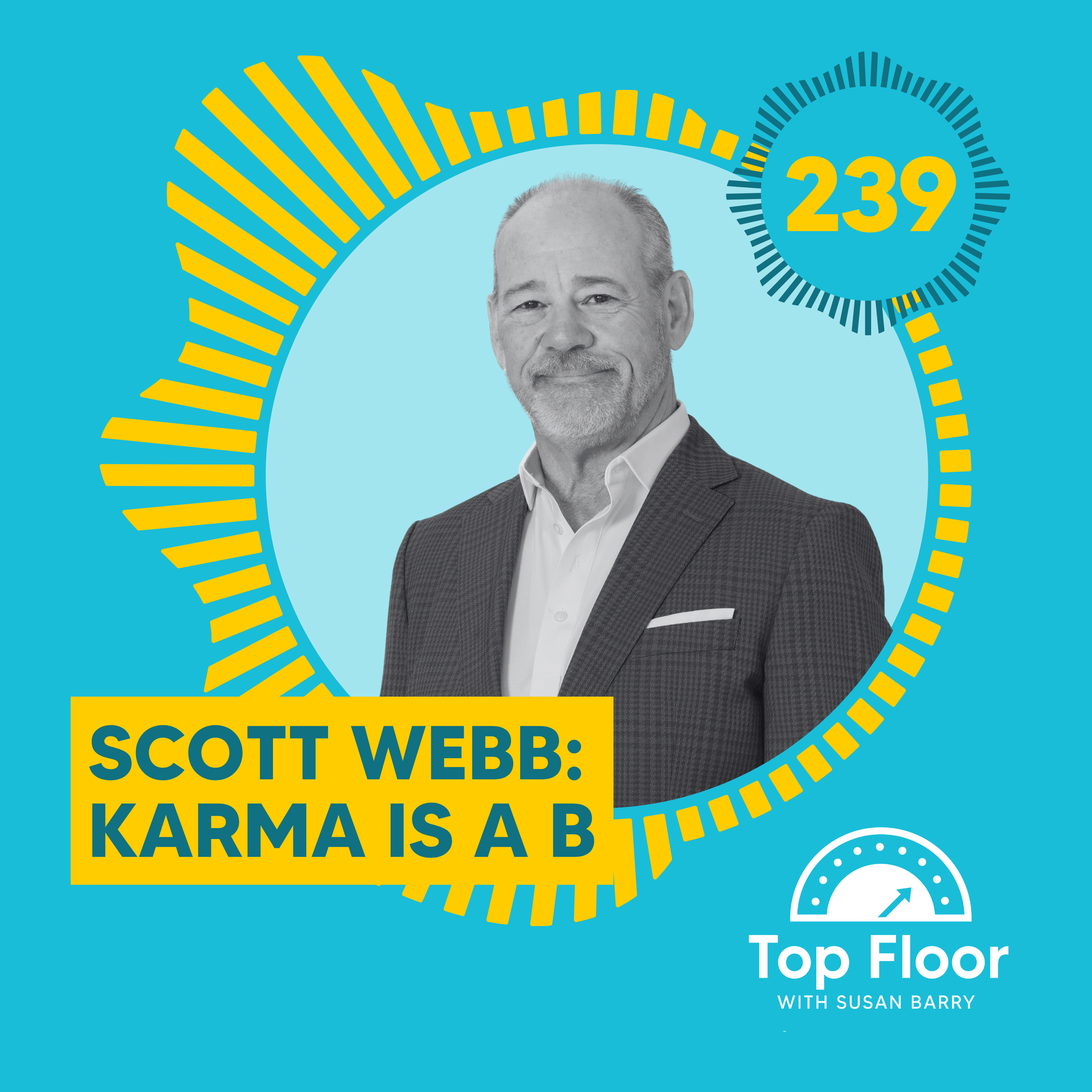
LISTEN TO THE EPISODE:
APPLE PODCASTS | SPOTIFY | TOPFLOOR.COM
[00:00:00] Susan Barry: This is Top Floor with Susan Barry, episode 239. You can find the show notes at topfloorpodcast.com/episode/239.
[00:00:15] Narrator: Welcome to Top Floor with Susan Barry. This weekly podcast ride up to the top floor features tangible tips and excellent stories from the experts and characters who elevate hospitality. And now your host and elevator operator, Susan Barry.
[00:00:32] Susan Barry: Welcome to the show. Scott Webb is a seasoned real estate and hospitality executive with more than three decades at Kolter Group, where he began in property management and rose to lead the company's hospitality division. Building hotels on stalled condo sites started as a strategic pivot during the 2008 financial crisis and evolved into a portfolio of owned and operated hotels across major brands like Hilton, Hyatt, and Marriott. Under Scott's leadership, the company has expanded from a single hotel to a diversified portfolio while maintaining a disciplined ownership-first approach to operations, asset management, and growth. He brings a unique perspective shaped by both real estate fundamentals and the realities of operating hotels. Today, we are going to talk about the evolving role of management companies, but before we jump in, we need to answer the call button.
Call button rings…
The emergency call button is our hotline for hospitality professionals who have burning questions. If you would like to submit a question, you can call or text me at (850) 404-9630. Today's question was submitted by Josh and Josh asks, as a hotel owner, what is an expense you will never cut because it's too important to the guest versus the bottom line. This is a really hard question to start off with, Scott. What do you think? Do you have something off the top of your head that you would never cut?
[00:02:22] Scott Webb: I mean, guests look for so many different things. It's kind of hard to say, but for me, I guess it would be, the guest doesn't see it directly, but continued investment in our own team members to make them better at what they do service our clients. Those kinds of things. Constantly teach them how to better relate to the guest experience.
[00:02:50] Susan Barry: That is a wonderful answer. I thought you were gonna say par levels of Terry in the guest rooms or something like that. So, to hear that it's associate training is pretty surprising and impressive.
[00:03:02] Scott Webb: We take that very seriously. We run training programs to help all of our team members grow. So we have a housekeeper who wants to get into food and beverage, or they want to get into something else. Well, corporately we run training programs for 20 to 30 people and we start giving 'em the skill sets to move up 'cause we firmly believe wherever we can, we promote from within.
[00:03:21] Susan Barry: Wow, that's amazing. Well, speaking of which, at a time when longevity is pretty rare, you've been with the same company for more than 30 years. What has kept you there and what's kept you engaged for so long?
[00:03:37] Scott Webb: It's a good question, actually. I have been with him for 31 years and it is really driven by our CEO, Bobby Julian or Robert Julian. He empowers his team members, understands commitment and loyalty, and he is very philanthropic. There is no micromanagement here. He's readily accessible and he works more hours than anybody else in the company. He's not just sitting at home. He’s a very, very impressive person. For me, every day is different. It's always a problem to solve, deals done to right for my personality. I love a career that takes you out of the office, meeting people and solving complex issues. I couldn't sit behind a desk for 10 hours a day and just sit at a computer. It's just not for me. I love the challenges created with a position like this.
[00:04:25] Susan Barry: So what have been some of the biggest, I don't know, moments or inflection points as your company grew from 1 to now almost 20 hotels?
[00:04:40] Scott Webb: I had to think about, I have to think about that one. But basically, I would say during the time when we first started out, we had very little staff. We had the VP of HR, the VP of accounting, the VP of marketing, sales and marketing. And that was about it and myself. So when we hit about 8 hotels, it became clear we really needed to grow and we needed to hire team members. I realized I had to hire a senior operations person, a construction management person. I realized it was time, as we grow, to get a really strong bench in for us. And as my mother always used to say, the proof is in the pudding and I am humbled by how these team members have stepped up together and helped us build one great management company.
[00:05:31] Susan Barry: Do you think you needed different people or a different sort of resources added to your team because your background was in real estate instead of hotels? Or was it just that you needed more people 'cause you had more hotels?
[00:05:47] Scott Webb: No, I was comfortable doing what I was doing, but you know, we started getting into full-service hotels. Well, that's a whole different animal than just a select service or hotel like a Hyatt Place or a Courtyard. So we decided we needed to hire someone very seasoned that understood that part of the business and it was the growth. I mean, we're getting to the point now where we're gonna have to expand the game because we're getting up to 16 hotels, and I think by the time you hit 20 or so, 18 to 20, we're gonna need to add more staff again and take that next step.
[00:06:22] Susan Barry: How do you evaluate hotel deals as compared to your background in commercial real estate? So, as compared to like office buildings or retail or apartment buildings, what are the different elements that somebody might not realize go into making an evaluation?
[00:06:44] Scott Webb: Most people think hotels are just another form of real estate. And in fairness, we did too when we first started. It's not, it's an operating business, right? So you really need to understand the deal because if you have a contracted lease, well, there are very little issues with that. But when you start getting into hotels, it's a totally different animal altogether. Here's an example I have for you. So you're buying a hotel and it has crew business, and that crew business is gonna expire in nine months after you close. Well, you need to figure out how you're gonna replace that business. If they go to a competitor, you're not gonna get credit off the purchase price for it 'cause it's not there yet. So you have to kind of figure that out. So you need to do a deep dive into the revenue streams first off, where in a lease you really don't, then, you gotta start looking for abnormalities, like was there high occupancy 'cause of storms or, Super Bowls, those kinds of things. So you really need to look into it. Then you gotta go into your operating statements and do a deep dive because a lot of owners have a tendency once they're selling to alcohol. Clean the balance sheet a little bit so they get rid of some labor. They get rid of this and get rid of that. And if you don't really understand how hotels operate, you can make that mistake and miss those things that you're gonna have to fill in later.
[00:08:10] Susan Barry: That's where that reduced par level of Terry comes in.
[00:08:15] Scott Webb: Yeah. All of that comes in. They laid off, they kept the chef, but they laid off the sous chef. They did this. There are lots of things that are basically done that you just need to understand how hotels work 'cause it is an operating business, in order to protect yourself properly.
[00:08:31] Susan Barry: Has anything like that ever bitten you? Like, oh God, all I didn't realize, but they had a part-time general manager for six months. No wonder labor was so low. Like, you know what I mean? Anything like that.
[00:08:43] Scott Webb: Not really and I'm not being smart. We do deep dives and we understand hotels, so we know what the labor force is required to make this operate properly. And if they don't have that on their P&L’s, then we add it in anyway 'cause we know we're gonna need it. Like you can't operate with one maintenance person. You need a minimum of three, potentially four and it could be much more depending on the number of keys. And that's where you have to be careful. So it is a different animal altogether. It really is.
[00:09:16] Susan Barry: It's interesting what you said about the sort of like crew business or revenue streams. I mean, obviously, I know that you have to take a look at where the sources of revenue are in a hotel, but I never really thought about it. Like, you really have to know, not just big picture, but pretty granularly who the customers are. And you would never have to do that, like at a subway, for example, like, let me make a list of everybody who comes in for a ham sandwich on Wednesdays. You don't do that.
[00:09:50] Scott Webb: Well, one of the things that you really have to look for is one-time revenue that doesn't repeat. And one of those that kind of gets lumped into categories that you don't really notice unless you really deep dive is termination panel or termination penalties or cancellation fees for a large contract, like we looked at one and they had a half million dollar payment because the contract was gone. Well, that was in one year, but it's never coming back. If you don't dive deep down into the system, you're not gonna know that and you'll carry that. It'll have a negative impact on your overall returns.
[00:10:27] Susan Barry: It's all similar to like the holidays that change every year, like easter, for example, and stuff like that. I think I've seen a lot of people mess up or trip up on that. Well, aside from understanding revenue sources and where the business is coming from, when you are underwriting a hotel deal today, what are some of the challenges that you're facing? Is there one that particularly stands out?
[00:10:56] Scott Webb: For me, like a lot of management companies and owners kind of clean house with senior management, we like to keep everybody in place. They already know what's going on. They have the relationships. It's keeping staff and finding people that wanna work in the hospitality industry has typically not been that easy. In reality, though, it's one of the few businesses that you can start off as a housekeeper or a server. And if you work hard, you can end up being a general manager or a vice president, and you don't need a university degree to do it. And you can make a very good living. Most people don't understand that. There are certain people who just come into the business and out of the business 'cause it's a job. But if you're looking for a career and you have the ability to build on it. It's a great place to start.
[00:11:49] Susan Barry: That is absolutely true, and that is a running theme on Top Floor. The idea that the hospitality industry is the American dream when it comes to businesses, that you can start with very little training or very little knowledge, and ultimately become a CEO if you play your cards right. You have done something which I think is kind of a look back in terms of operating models, but it's the one that I would prefer, which is you are vertically integrated, and so what that means is that you own and manage your own hotels. I know that that's important to you, but I want you to tell me why.
[00:12:30] Scott Webb: The answer is simple for me. I think an owner will do a much better job managing the asset than a third-party manager will. You're vested and you're at the bottom line. Most management companies only ever look to the GOP, so they don't focus on insurance and mortgage and all the other stuff that goes with it. It doesn't really make sense for you to start your own management company if you have one or two hotels. The economics don't make sense, but once you hit five hotels, or say 800 keys, it makes sense. You're gonna be paying millions of dollars to a management company that you could be saving a substantial amount of that money by doing it yourself. But more importantly, when a problem comes up, as an owner, you can pivot quickly and deal with it, but as a third-party manager, they now have to go to the asset manager. The asset manager has to go to the owner. The owner has to get back to the asset management company, and they have to get back. And by that time, you could have missed whatever opportunity or problem-solving that you needed.
[00:13:34] Susan Barry: I think you left out a step, which is they have to figure out if they can fix it without ever having to tell anyone and keep it a secret forever.
[00:13:43] Scott Webb: That is true. Sometimes, like you, you never hear about good staff that left you, they just replace it with something else. Well, the reality is simply that if you have a great DOS, it comes later in the conversation. But for me, if you have an example, a great DOS that runs a lot of business. Well, most people take that as loyalty to the hotel. It's not that's created between individuals and if that DOS person leaves, the group business is gonna follow them. They're not typically gonna just stay at the hotel. And you could get hammered badly on your revenue stream by losing a solid performer, but you're not gonna hear about it. But from the management company, you're not gonna hear about it from that kind of thing. If they're active, involved in the business every day, you know what's going on. You can react, you can deal with it, and just solve problems much easier and much quicker.
[00:14:44] Susan Barry: We like to make sure that our listeners come away from every episode of Top Floor with some really specific practical tips to try, either in their businesses, their hotels, or maybe in their personal lives. What do you think are the most common mistakes you see in how hotels are operated as an owner? What are the things that are the worst mistakes operators make?
[00:15:15] Scott Webb: The first one is reinvestment in the assets. It just doesn't happen. They get extensions, they negotiate with brands. A lot of REITs don't put their money into the hotels, so it really is the wear and tear. And team members wanna work in a nice environment. They wanna know that owners care about them. They want to know that they have a path of growth. And if you don't, then you're sending a very negative signal to both your team members and your guests. So for me, if team members are happy in what they do and they know they have a path of growth in this business, then they're gonna go out there and perform. But more importantly, the guests are gonna see that. And the reverse is opposite. If they don't, and the hotels run down and people aren't happy and guests are complaining all the time conditions, then that's gonna translate into all kinds of bad press and bad responses from employees. So it's really about putting money in your assets. We own everything long-term. We don't really sell, and you've really gotta invest the money back in, and a lot of people don't.
[00:16:28] Susan Barry: I love your point. From a team member's perspective, it's so unfair to have to be the one bearing the brunt of a guest's dissatisfaction with the physical plant. Like if they're complaining about service or they didn't like the way the eggs came out or whatever the case, that's a whole other story. But if you're at the front desk and they're complaining because the building is run down, how unfair that feels to have to endure that?
[00:16:57] Scott Webb: The front-facing employees for us are the most important employees we have because they deal with stress every day, and most of it's stress beyond their control. We empower our people as best we can, so you need to make sure they know you have their back, that you're there for them. And I think you can create a lot of loyalty and once you do that, it really goes a long way. I mean, surprisingly enough, a lot of people that have left Coulter for better jobs, I will tell you in the last week for them. Have been gone for maybe a year or more, and they've all come back and asked if there's a position somewhere. They wanna come back because when they move, they realize that what they had here is not what they ultimately got somewhere else. And that's a testament not to me, that's a testament to the teams in the hotels and my senior management team. We do a great job to try and promote and support our team members.
[00:17:59] Susan Barry: For owners who are still outsourcing management, what do you think might be missing?
[00:18:05] Scott Webb: Well, outsourcing management, you're not involved in the day-to-day operations, and you have a very substantial equity investment in the asset. So you aren't involved in the day-to-day. You don't know what business decisions are being made without your involvement. So I think that's critical. I think once you get to, as I said. Five hotels or 800 keys, you can manage it yourself. You can either go to school on the management, or you should always at minimum asset manage your own hotel. Don't get a third-party asset manager. Go to school on the hotel manager and learn what operates and what they do. Monthly meetings with the team, not the manager, with the hotel team. I did that, that's how I learned. And then once you get that and you get to that level, you're saving, literally, you can save millions of dollars in fees that you're paying to a third party. As I said, you can pivot quicker, you can deal more and it's rewarding, honestly, to see people grow in the business and you're able to help them. So you take a housekeeper and you take 'em into sales and marketing and it helps them. It helps their families grow. And that to me is part of what the business is all about. Hospitality is taking care of people, so take care of your team members.
[00:19:26] Susan Barry: Well, we have reached the fortune telling portion of the show, so now you have to predict the future, and then we will see if you got it right and give you a score. What is a prediction that you have about the future of hotel ownership and investment? Just a small question.
[00:19:46] Scott Webb: My crystal balls are a little fuzzy. The world around us is in total turmoil, as you know. New lines are being drawn. Trade agreements are being drawn, redrawn and patterns don't come back once they do. So you gotta start figuring out, the daily challenges and quickly and constantly evolve and think out of the box to solve them because it's a whole different world these days. Clearly, international travel from outside the US is down, but US inbound travel is up, and that's probably one part of world turmoil. US citizens don't wanna travel outside the country. And two, the weather up north was horrible this year. So we had an amazing first quarter in Florida. What I see going forward is if we can limit the world conflicts that are going on and we can get control of the oil to limit inflation. As a point, gas is almost doubled and as we all know, that's gonna impact everything that we do. Our food, our clothes, housing, everything. So if we can get that under control, I think we have some clear ceiling debts coming into line, which is helpful and I think the other thing that will really help us, it's been incredible, is AI. AI has been incredible over the next five years. Opportunities for advancement from everything, medical, hotels, you name it, will be exponential. It's almost limitless what's gonna happen. So I feel good about the future. I think it's just getting control of what's going on right now in the macro environment.
[00:21:33] Susan Barry: If you could wave a magic wand and change one thing about hotel incentive plans, like bonus plans, what would that be?
[00:21:42] Scott Webb: I'm not sure I have a magic wand, but incentive plans, you need to be intentional, right? You mean what you say and say what you do kind of thing, right? I've had a lot of team members that I've hired who have come to me and said, after they got their first bonus, I never thought you would pay it out. I said, what do you mean? And they said, well, my old employer would always just change the goalposts, and we would never get paid out. So you need to be intentional and take care of your people. If you said you're gonna do something and give it, then do it. If they hit their performance metrics, you do it because otherwise you're gonna lose really good people and you can't.
[00:22:22] Susan Barry: It's so mystifying to me that there still exist companies that can change incentive plans at the 11th hour and not go out of business. Like, what do you think is going on there? Obviously, they're trying not to pay the money, but do you think there's ever a good reason for something like that to happen? Or is it just greediness?
[00:22:48] Scott Webb: As I said, say what you do and do what you say. Then there's no good reason. You know your words, who you are. That's all you have in life is your word. And if you tell somebody you're gonna do something and then you don't do it, that's your reputation. That's what you carry around. And over time, it's just gonna impact your bottom line because employees are gonna leave. They're gonna know they're not gonna get paid, they're not gonna wanna work there. It doesn't work that way. You need to empower your employees. You need to respect them and take care of 'em. And my answer to everybody is the same. If you were in this position, would you want to get shortchanged on your bonus? No. So why are you doing it to me? It should never happen.
[00:23:31] Susan Barry: Those folks are only ever gonna get terrible folks who can't get hired anywhere else, ultimately, because people talk, it's crazy.
[00:23:39] Scott Webb: Now they get on things like Glassdoor, everything now.
[00:23:42] Susan Barry: Yes, that's true. I didn't think about that. All that stuff didn't exist when I was still on property, but it sure does now.
[00:23:49] Scott Webb: It does. It does.
[00:23:51] Susan Barry: Okay, folks, before we tell Scott goodbye, we are going to head down to the loading dock where all of the best stories get told.
Elevator voice announces, “Going down.”
[00:24:04] Susan Barry: Scott, what is a story you would only tell on the loading dock?
[00:24:09] Scott Webb: Have to think about that, but I guess let's talk a little bit about karma and the B word, it can be. So I won't say the word, but the B word. And most people say, karma will get them, but you never get to see it to happen. You never see it happen. I personally had the opportunity to deliver that karma once, so I was doing a deal on a large commercial asset. And we had to place two escrows in place. One was for environmental contamination and one was for a 10 allowance that was owed a tenant for doing the improvements in their space. So the environmental escrow was three years. And after the first year, it was natural attenuation, it was cleaned, and we went to the buyer and said we would like a release of the escrow. And they said, well, it's there for three years if you want it. No problem. You gotta give us 25% of the money.
[00:25:08] Susan Barry: Wait, is that a normal thing?
[00:25:12] Scott Webb: I don't know what normal is or normal isn't anymore but no. And I asked them why they were doing this. It's not the way to do business. And the response was simply because I can. The best advice I got when I started in this business was simply do things because you should not because you can. And if you understand the difference, you're gonna have a good life. So we took the settlement, we gave 'em their 25%. We just moved on, several years later, they came to us requesting the release of the TI allowance and there was a whole section in the purchase and sale agreement of all the things they had to produce in order to release the money. So they came to us and they had nothing, so we politely declined. Then they came back a few months later with a bunch of documentation that made no sense and wasn't anything relative to the release. So we politely declined a second time. Then we heard that the lender was looking to take the property back, and they showed up a third time asking for the money. And I said, well, no, we're not approving this. And then the question came. Why are you doing this? I simply replied, “Do you remember when you took the percentage of our escrow?” And I asked the same question and you said, because I can, well, you have your answer. Welcome to Karma.
[00:26:35] Susan Barry: What did they say? Did they lose the property?
[00:26:37] Scott Webb: Uh, yeah. They did.
[00:26:39] Susan Barry: Oh, man. Be nice.
[00:26:43] Scott Webb: For me, if they had to been fair with us, we would've worked something out. Life's too short. You're dealing in good faith is always the best practice, in my opinion. But yeah, they lost the property, but I gotta deliver the karma. So it was fun.
[00:26:58] Susan Barry: Well, karma is in fact a B. Scott Webb, thank you so much for being here. I know our listeners learned a lot, and I really appreciate you writing with us to the top floor.
[00:27:12] Scott Webb: It was a fun ride. Thank you.
[00:27:15] Susan Barry: Thank you for listening. You can find the show notes at topfloorpodcast.com/episode/239. Jonathan Albano is our editor, producer, and all-around genius. He even wrote and performed our theme song with vocals by Cameron Albano. You can subscribe to Top Floor on Apple Podcasts, Spotify, or wherever you like to listen, and your rating or review will go a long way in helping us give you more of what you like.
[00:27:50]Narrator: Thanks for listening to the Top Floor podcast at www.topfloorpodcast.com. Have a hospitality marketing question? Reach us at 850-404-9630 to be featured in a future episode.