
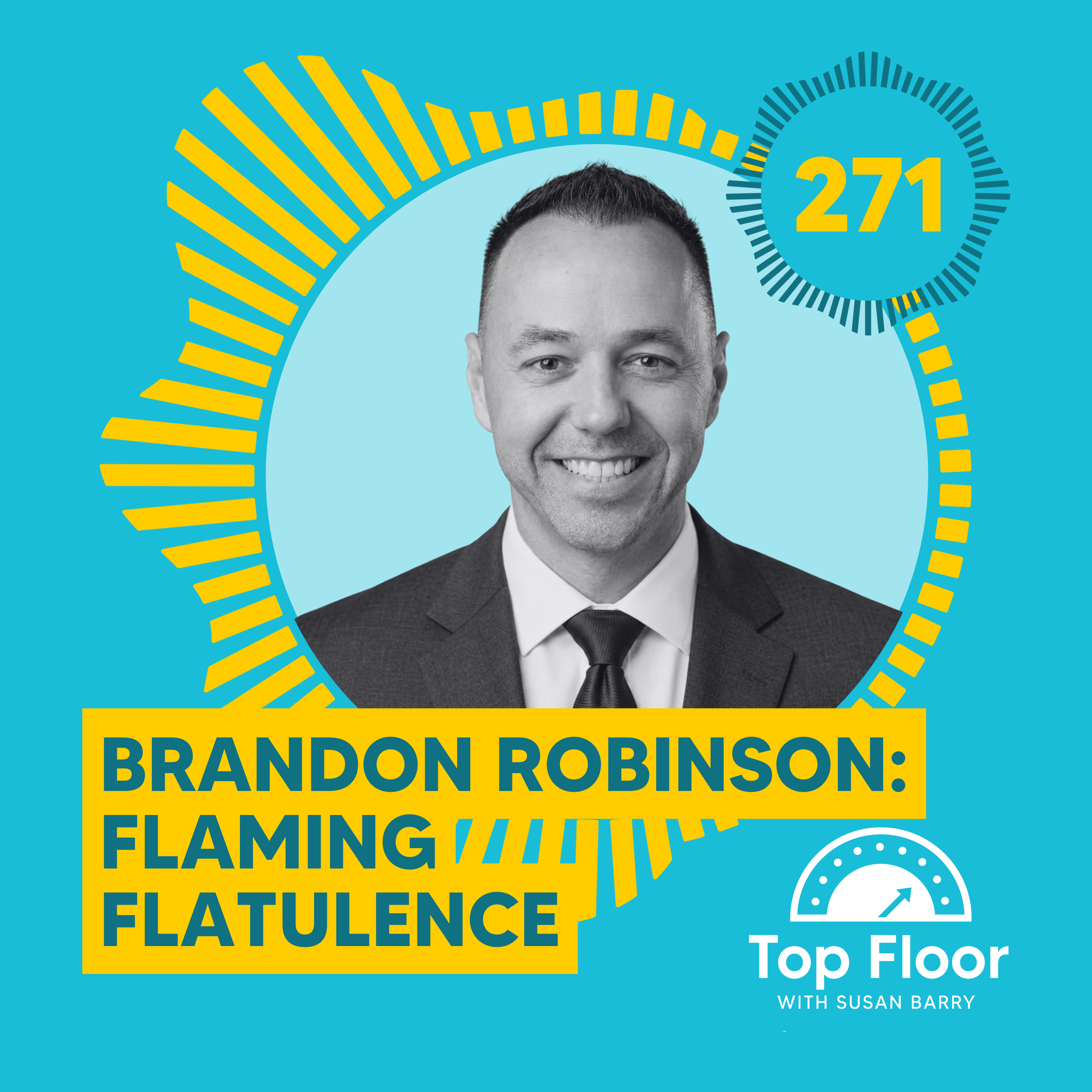
LISTEN TO THE EPISODE:
APPLE PODCASTS | SPOTIFY | TOPFLOOR.COM
[00:00:00] Susan Barry: This is Top Floor, episode 271. You can find the show notes at topfloorpodcast.com/episode/271.
[00:00:13] Narrator: Welcome to Top Floor with Susan Barry. This weekly podcast ride up to the top floor features tangible tips and excellent stories from the experts and characters who elevate hospitality. And now, your host and elevator operator, Susan Barry.
[00:00:32] Susan Barry: Welcome to the show. Brandon Robinson is the founder of Tipsy Putt, an indoor mini golf bar concept with a fifth location on the way in Denver. Before he was in the business of putters and pints, he built Skin Body Soul into a membership-based multi-state med spa company and sold it to a private equity firm. Brandon is a lifelong golfer who grew up around a pro shop, and he has a knack for spotting a business model hiding in plain sight. Today, we are going to talk about eat-ertainment, but before we jump in, we need to answer the call button.
Call button rings…
The emergency call button is our hotline for hospitality professionals who have burning questions. If you would like to submit a question, you can call or text me at 850-404-9630. Today's question was submitted by Lauren. Lauren asks, "Is it really possible to own a restaurant or a bar and not have to pull shifts? I've always heard that the owner working in the business is how you protect against thin margins." So, Brandon, the listener doesn't know this, but I know that you do not pull shifts at Tipsy Putt. How do you get away with that?
[00:02:00] Brandon Robinson: Yeah. First of all, Susan, super excited to be on the pod. Thank you so much. So one of the most valuable business tips I ever received in my life from a business coach was to set up your business a state away from where you live. It was a great lesson because what it taught me from a business owner's perspective, as someone who worked in their business every single day, in my previous business, was that in this new venture, and at the time it was a company in the medical spa industry that I started was that I'd have to build the systems and give people the autonomy in order to succeed and fail on their own. It's the only way. And then learn from those systems, replace those systems, repair those systems, and make sure all your checklists are in place, etc. That's truly how you can mitigate against ever having to have a shift in your actual spot.
[00:03:02] Susan Barry: I gotta tell you that that is making the control freak in me feel highly unsettled, but we'll move on. So med spas to mini golf isn't exactly what I would call a well-worn career path. Not a lot of people are taking that trip. Connect those dots for us.
[00:03:20] Brandon Robinson: Yeah. So, I started a company called Skin Body Soul Med Spa. I saw an opportunity in the medical spa space for a membership, and I saw it because of the different types of products, such as fillers and those basically injectable fillers, Botox, Xeomin, things of that nature. And saw that you had a repeat customer who had to come back after a certain number of months to have another treatment to see the efficacy of that treatment. So it got my wheels turning, and I started Skin Body Soul, and I started operating Skin Body Soul, and we had locations throughout the United States. In 2017, I was up in our Bellevue, Washington location. We had just opened a brand-new location, and we were taking our team members out after our grand opening party. We went out to downtown Kirkland, discovered this place called Flatstick Pub, and when I walked in, I immediately saw something that I'd never seen before. First of all, I'd never seen an indoor mini golf bar anywhere. It's like never.
[00:04:26] Susan Barry: Yeah, I think probably most people listening have never seen one still, right?
[00:04:30] Brandon Robinson: Yeah, yeah. It's definitely an emerging space. And I'd seen parkades, I had seen bocce concept, bowling concepts, obviously billiard concepts, and I had never in my life seen an indoor mini golf bar. And then also what absolutely floored me about it was the simplicity of it and the fact that it had this ability to just create an environment of competitiveness where they had league nights, and we had happened to stumble into this facility during a league night. And I was blown away that on a Monday evening at 7:00 PM we couldn't even go on the golf course. And it was full of people, and the atmosphere was absolutely lit. And I said, "This is incredible," because every single bar anywhere in America at this point in time on a Monday night, generally speaking, is not busy. And this place is wall to wall because of the leagues. And it got my wheels turning. I reached out to the ownership group of Flatstick Pub, these two brothers whom I got their emails, and I said, "Hey, I'd love to bring your concept to California." I am not the typical candidate to own or operate a restaurant, but I'd love to be a partner. I'm familiar with the marketplace. And they basically told me to go pound sand. They literally told me in multiple emails there was zero interest in communicating with me. The fact that I even got an email back was a miracle. So that's how this whole thing started in 2017. Again, I reached out to them in April and May. I think I gave up in May. And then my wife, my beautiful, incredible, intelligent wife, was going back to school to get her MBA at Sac State, and she had this entrepreneurship course in the fall of '17, and she looks at me, and she says, "Hey, I need an idea for this class. I need to pitch the class on a concept." And I said, "Try, try Flatstick Pub, that place we went to in Seattle in Kirkland, and try it out and give it a shot. And, let's call it Tipsy Putt. It's a better name." So she went to her class at Sac State. They voted, and they took that concept, and then they wrote an 80-page business plan. I actually emailed that business plan to the brothers, and I said, "Hey, I'm gonna open this with or without you." This is now 2018. "And I'd rather be your partner than your biggest competitor." And they immediately emailed me back and said, "Oh, you're very serious. I see how serious you are." You know, this is an MBA business plan. And they immediately took my meeting, and we hit it off, and within not even a week we had a kind of a handwritten note in place of how we were gonna open the first Flatstick Pub outside of Seattle, 'cause they were opening their third site in Seattle, and this would be our first site in Northern California. So that's the story of how I got in the industry, and it was a lot of fun.
[00:07:52] Susan Barry: So did they ever explain why they were so resistant at first? Like, had people just been hitting them up all the time? Like, they had six beers and were like, "Yeah, man, let's be partners."
[00:08:05] Brandon Robinson: Yes. They said they got hit up by, no joke, hundreds of people.
[00:08:12] Susan Barry: Okay. So I know you have never worked in a bar or restaurant before. What are some of the things that you had to learn on the fly that the people who are, like, experienced bar and restaurant people will be like, "Yeah, told you so, buddy"?
[00:08:27] Brandon Robinson: Oh, I wanna preface this by saying that the smartest people I have met are operators in the F&B industry. And I say that after working in an industry with some of the greatest specialists, some of the best minds in medicine, and both on the manufacturing side and on the provider side. And operators of restaurants, many of these people are some of the greatest problem-solvers. I've always thought there are three groups of people, and the first group of people is problem people, people that cause problems, people that go about their lives and just are just messes. You know who these people are. It's very easy to define and find these people. Then there's a second group of people, and these people make up that 20%, about 20% of all people. And by the way, all three of these groups are always in the problem set occasionally. It's just that they move around the chart. But for the most part, 20% are problem identifiers. It is very difficult to identify a problem. And then a third group of people is problem-solvers, and that is what I consider the 1%. In the F&B industry specifically, I am enamored by the amount of problem-solving that happens, and the amount of talent that is there. So when it comes to moving into the restaurant industry and learning what I need to learn real quick, I can tell you a couple of things off the get-go. One, it's almost as if the consumer, especially I think today, needs more than they ever needed before. There's never enough. You're never giving them enough. I don't know if this is a Gen Z and sense of entitlement thing. I would disagree with that. I would just say that life, things in the world have gotten so much better, and so when you're serving someone anything today, they're always referring to these outstanding experiences that they've had, and you're always compared to the greatest experiences, anywhere, and I think that becomes really difficult. So I think the big wake-up call for me was, especially in this industry, I don't want to say the customer's never satisfied, but it almost feels like you have to give more to the customer today than you've ever had to give in, in at least the history of the FMB. I could be wrong. Maybe it's been this way since the 1900s. I'm uncertain, but I'm new to this industry. But I can tell you that if you read Yelp reviews, if you see what people are demanding, it feels like the customers are always wanting more.
[00:11:07] Susan Barry: Interesting. So for anyone who hasn't heard the term, what is Eatertainment? I'm sure we could probably guess based on our conversation so far, but what is it, and why do you think it's taken off so much?
[00:11:20] Brandon Robinson: Yeah. Eatertainment is essentially experiential dining. I mean, you can look at it in several different ways. If you've gone to Las Vegas, dinner and a show, if you've been to Bowlero, bowling with a meal, it's just an activity and something additional to do other than just experience the food and beverage, or alternatively, it's in addition to just a mini golf facility. So you can go to many facilities that have mini golf where you just purchase the game, and you come, and you go. Whereas with an eatertainment concept, you'd be able to go out and have that experience, and then also there's alternative activities, or, what I should say is alternative food and beverage options along with that entertainment. And it is one of the fastest-growing categories in the hospitality industry for good reason.
[00:12:22] Susan Barry: So if the game is what's getting people through the door, how important are the snacks or the food and the beer and all that stuff? Do people care? Are they distracted by the mini golf?
[00:12:36] Brandon Robinson: You know, that is such an important question. What came first, the chicken or the egg, right? Why did this person walk through the door? I think with Tipsy Putt, what makes us extremely unique is that we, unlike other competitors in our market space, let's just call out Topgolf, for example. You have to go. It's more of a destination eatertainment, whereas with a Tipsy Putt location, we can squeeze into a box of 10,000 square feet. So we prefer to be amongst other F&B concepts in almost, like, a bar crawl destination. A pub crawl site. And I think that gives us as a business a massive leg up, but I also think it gives us as a business more reasons to come and visit us. So for example, in our Sacramento location, we're attached to the Golden 1 Arena, where the Sacramento Kings play, and there are tremendous rushes in and out for both concerts and live sporting events. And we get a tremendous amount of traffic from that. For people that do not play, I would argue, and I don't have these statistics, but I would say that on an event evening, we would have over 80 to 85% of our customers not play any games. They are coming there to enjoy the atmosphere and watch. We have over 40 televisions to watch a live sporting event or to pre-game before a sporting event and/or a concert. And I think that is another reason why we are doing well, and others in our market are not, or some others in our market and some restaurant concepts, unfortunately, in the hospitality industry are struggling, is that we do have these other things that people love to do. I wanna say one other thing to that. You have to have outstanding drinks. I mentioned it earlier, how fickle the current consumer is. It is so true that you cannot serve a bad product, because what you've done is you've eliminated your customer from coming back ever again. They have one small excuse to not visit you, and they won't.
[00:15:03] Susan Barry: There's too many choices. Like, there's just too many choices. We say that about Atlanta, where I live, all the time. Like, if we have bad service, we're never going back again because there are too many places to choose from. It's insane.
[00:15:18] Brandon Robinson: It is incredible, and again, hats off to all of these incredible hospitality leaders that are listening to this, but also just out there, because you have to check all the boxes. You need the atmosphere. You need the music right. You need the lighting correct. You need outstanding food. You need a great beverage program. You need your pricing in line. It is everything all at once. And you're right, you're not just competing today against other F&B concepts. You're competing today against people staying home on their screens. I heard this statistic that someone said something to Reed Hastings, who's the founder of Netflix, about the cost of the fee on Netflix going up. And it was laughable to him, because the cost per hour to watch Netflix on average throughout the United States is under 20 cents, and his response was, "What can you do for less than 20 cents an hour?"
[00:16:28] Susan Barry: Wow, that's crazy. I wouldn't have thought about it that way. So speaking of competing, there are a lot of players in this space now, not just mini golf, but there are darts concepts and F1 and all kinds of stuff. How do you think about where you fit in that landscape? I'm mostly curious about is there a first-mover advantage? Like, being first to market with an idea like this, is it an advantage or a disadvantage?
[00:16:57] Brandon Robinson: First to market is always an advantage. If you're the first Italian restaurant in town, you have a market advantage. There are a few things that give any business an advantage. First to market's always gonna be it doesn't matter. If you're the first restaurant in town, and the only restaurant in town, you're arguably the busiest restaurant in town, right? Until a second restaurant appears. So, first to market is key. A moat or some sort of reason why people come back to you or something that differentiates you from everybody else. This question was a great question, because how do you separate Tipsy Putt from other competitors in the space? There are a tremendous amount of competitors in the space. And I think what gives us a huge differentiation for us is that we are inherently built around a sports bar atmosphere. We are a golf bar, but we are a sports bar. You're a place where you can watch the game. There are other activities to take advantage of.
[00:18:05] Susan Barry: We like to make sure that our listeners come away from every single episode of Top Floor with practical, specific ideas or tips that they can try either in their businesses or in their day-to-day lives. So speaking of first-time guests, what are some ways operators can turn a first-time guest into a regular? And the reason I'm asking you this is I think I would have guessed that an idea like a mini golf restaurant is a one-and-done. As you go, you have fun, you try it out, but you're not a regular there. Do you know what I mean? But I think I'm wrong, so tell me what you think.
[00:18:47] Brandon Robinson: You're not wrong. You can look at entertainment concepts like PuttShack. You can look at entertainment concepts like Lucky Strike, Topgolf. They have a very low customer return rate, or what's called a very high churn rate. Otherwise, they come, and they don't return. Tipsy Putt is very unique in that our churn rate is very low and not very high. And so we have a lot of customers come in, and repeat customers come back. I think the answer to that is that there are two main key components to it. I think the first key component is that you have to give an outstanding experience. You have to give the customer start-to-finish reasons for them to come back. That can be a rewards program. That could be a membership program beyond the great experience that they're having. And then the second, and you guys, all the listeners, I really hope you guys are listening, restaurants are location, location, location. You can go to almost any boulevard or any street in America and know that there's one side of that street where the restaurant is there, and it's turned over three times in the last seven years, whereas the restaurant on the other side of the street has been there for seven straight years. And there are reasons for that. I don't know, the way the sun hits the building. A lot is going on there. But generally speaking, location, location, location. If you aren't where people want to go, and you're the single reason why people are going to that site, it's gonna be very difficult to succeed in the 2020s and beyond. Because people don't leave their house for just one thing anymore. People are multitasking and leaving their home to do a couple of things, and then stop by your restaurant or visit a friend. So, location and geography are critical in people coming back and becoming regulars as well.
[00:20:54] Susan Barry: Well, you're getting ready to open the fifth location of Tipsy Putt. What needs to be true about a business before you open a second, third, fourth, fifth location?
[00:21:08] Brandon Robinson: We were on the Inc. 5000 list, number 26 in hospitality. Number 1889 in the United States and for all businesses. And this is my second company that I have scaled, and I think there are two key components when you can scale your company. And I think the first one, and a critical one, is that the business can operate without you there. And again, this goes back to Susan's comment about being a little bit of a control freak when it comes to the operations and her experience in the restaurant industry, and what a lot of operators are like, but you have to empower the people around you. You have to let people fail, and when they fail, they have to fail forward. You have to encourage them to fail. You have to give them a credit card and allow them to spend and make decisions, and give them those parameters, and set those systems in place. Without that, you cannot scale, nor should you scale. There are so many examples of restaurants that open their second locations, and immediately their second locations don't make it. And it has to do with this owner splitting time. The owner cannot be there at all. That is truly how you know the business can run itself and operate itself. Of course, there are obviously thousands of other factors, not just a great concept, a great menu, great cost of goods, or great service, great atmosphere, great locations. I mean, all of that is a factor. But ultimately, you as an operator have to leave. And I've done this. This is that stress test I mentioned earlier. Like, a business coach taught me early on, you gotta leave your business. You gotta set your business up in another state. You need to take a vacation for three months and not respond to an email and come back. Is the business there? Is the business demolished? That is truly the stress test you need. Now, three months might be an extreme. It might be better to say a month. But you have to give people the autonomy, the authority, and empower them to feel like leaders. Because if you're ever gonna build your business or scale your business, you need leaders within your organization.
[00:23:34] Susan Barry: I think that's amazing advice. Well, we have reached the fortune-telling portion of our show, so now you have to predict the future, since you've given advice already. And we'll come back and see if you got it right. We'll give you a grade. What is a prediction that you have about the future of Eatertainment?
[00:23:53] Brandon Robinson: I think Eatertainment is going to grow in one segment, and it's gonna fail in another segment. And when I say that, I think that large-scale, large-format type entertainment concepts, think TopGolfs, think acreage of land, parking, let's just say concepts in excess of 30,000 to 50,000 square feet. I think those concepts are going to struggle over the next 10 years. I mean, the costs of everything are exploding. Not to mention the utilities and servicing those types of spaces. I mean, huge, massive overheads. I think those spaces are going to struggle, while I think that smaller concepts, for example, barcades, retro, I think small music venues, if you wanna expand outside and go into entertainment more than just entertainment, I think that those types of businesses in our space are going to explode. You're gonna see more of them. You're gonna see creative and really cool concepts come out where people are gonna invent games, people are gonna create really cool stuff, and I think that the consumer's ultimately gonna win. I think the next 10 years are gonna be great in our industry, for that matter.
[00:25:15] Susan Barry: I hope so. Well, if you could wave a magic wand and change one thing about opening and growing a hospitality business, what would that be?
[00:25:24] Brandon Robinson: Oh, man. Landlords. They all suck.
[00:25:28] Susan Barry: That's funny. I was gonna ask you if you buy the real estate or if you're a tenant.
[00:25:33] Brandon Robinson: Because of the landmark locations that we are trying to enter, we are tenants. I would love to buy these locations? Yes, but in my circumstance, still renters are winning, but the rolling up that's occurred in the private equity money that's gotten into the ownership of these buildings, and the layers and layers of absolute bureaucracy, and, to be honest with you, has gotten insane. The amount of insurance coverage is insane. The requirements are insane. The triple net and CAM expenses have gotten insane. Property management fees have gotten insane, and unfortunately, even as an owner of the building, you're dealing with just expenses that are exploding across the board that you have to deal with. So I do think that geography, the landmarks, and your location, and the landlords, if I could wave a magic wand, I would love that all landlords basically bought their buildings for very little and want to hold them and don't want to flip them, and you're not involved in any type of exploding of CAM expenses underneath you while you sign a great lease.
[00:26:48] Susan Barry: What are CAM expenses?
[00:26:50] Brandon Robinson: So, common area maintenance and taxes. So if you own, if you're a lessee, generally speaking, in the United States, I don't know the statistical amount. I'm gonna guess it's somewhere around 80% in retail, maybe higher, under some sort of what's called CAM or triple net expenses, which basically means that you're covering all the pass-through expenses from that landlord to the building, and essentially you're an indentured slave to the landlord. It's unreal, the protections in place between the tenant and landlord, and I know that a lot of people would argue, "Hey, the tenants have a lot of rights today that they didn't have previously. They could default. They could try to squat in their building." Sure, cool, but eventually the landlord's gonna win, and furthermore, these costs when they sell these buildings, they carry throughout these leases. So you have a tax basis of, let's just say, we'll call it Gertrude and Bob, and Gertrude and Bob bought this building in 1946. Their children inherited it, and the tax basis on it is $150,000 for their property taxes. Meanwhile, Bain Capital comes in and buys the building for $26 million. And now your $150,000 of tax basis is $26 million. The kids made out like bandits, but the tenant is left in place, having to pay all these triple net expenses. And unfortunately, there's not a lot of landlords that are willing to negotiate. So that's my magic wand, and I will stop bitching.
[00:28:22] Susan Barry: Okay, folks. Before we tell Brandon goodbye, we are going to head down to the loading dock where all of the best stories get told.
Elevator voice announces, “Going down.
[00:28:35] Susan Barry: Brandon, what is a story you would only tell us on the loading dock?
[00:28:39] Brandon Robinson: I struggled with this, Susan. I talked about this, like I've heard your pods, and I'm like, "What am I gonna tell a story about?" I think that the one that would probably make people's eyebrows raised, literally because someone's eyebrows were seared off. We were in the med spa business, and we did laser hair removal. And let's just say that on occasion, very rare occasions, and again, it happens, one in 100,000 pulses. It's called pulses, where a patient would be receiving a treatment at the exact same moment when they have flatulence. Extremely rare circumstance. It can create, and does create, a flame. And that has happened. Yes, it's real. It really happened. And, yeah, that has happened. And we've had incidents, and that's why you wear your safety goggles as the provider. So essentially, that's the one story I'll say is that we've heard some crazy stories about a lot of private areas that are, to be brutally honest, some embarrassment involved. But at least some acknowledgement, and in many circumstances, there's zero acknowledgement that it even occurred, and we find that to be pretty funny.
[00:30:15] Susan Barry: That's insane. Do you think that they are not acknowledging that it happened because they don't know, because they're embarrassed, or because they don't care?
[00:30:25] Brandon Robinson: I don't wanna get into the disgustingness of laser hair removal because we did a lot of it, and it serves its purpose. But what I will say is that in sensitive areas, in these areas, we advised our patients to clean shave prior to these procedures, and they oftentimes did not. So there were some things to be seen. Now, the good news is I wasn't the provider.
[00:31:06] Susan Barry: I feel like you need to make a line of T-shirts that says, "There were some things to be seen." Oh.
[00:31:12] Brandon Robinson: Yeah, there were things, yeah. There were some, from Botox to butt holes, that were Skin Body Soul's motto, and we got it done.
[00:31:20] Susan Barry: Brandon Robinson, I'm not sure if I can thank you for that, but thank you for being here. I know that our listeners are all now itching to go play some mini golf and drink a beer, and I really appreciate you riding with us to the top floor.
[00:31:35] Brandon Robinson: Thank you, Susan. Such an honor. Thank you so much.
[00:31:40] Susan Barry: Thank you for listening. Thank you for listening. You can find the show notes at topfloorpodcast.com/episode/271. Jonathan Albano is our editor, producer, and all-around genius. He even wrote and performed our theme song with vocals by Cameron Albano. You can subscribe to Top Floor on Apple Podcasts, Spotify, or wherever you like to listen, and your rating or review will go a long way in helping us give you more of what you like.
[00:32:15] Narrator: Thanks for listening to the Top Floor podcast at www.topfloorpodcast.com. Have a hospitality marketing question? Reach us at 850-404-9630 to be featured in a future episode.