
LISTEN TO THE EPISODE:
APPLE PODCASTS | SPOTIFY | TOPFLOOR.COM
[00:00:00] Susan Barry: This is Top Floor, episode 270. You can find the show notes at topfloorpodcast.com/episode/270.
[00:00:13] Narrator: Welcome to Top Floor with Susan Barry. This weekly podcast ride up to the top floor features tangible tips and excellent stories from the experts and characters who elevate hospitality. And now, your host and elevator operator, Susan Barry.
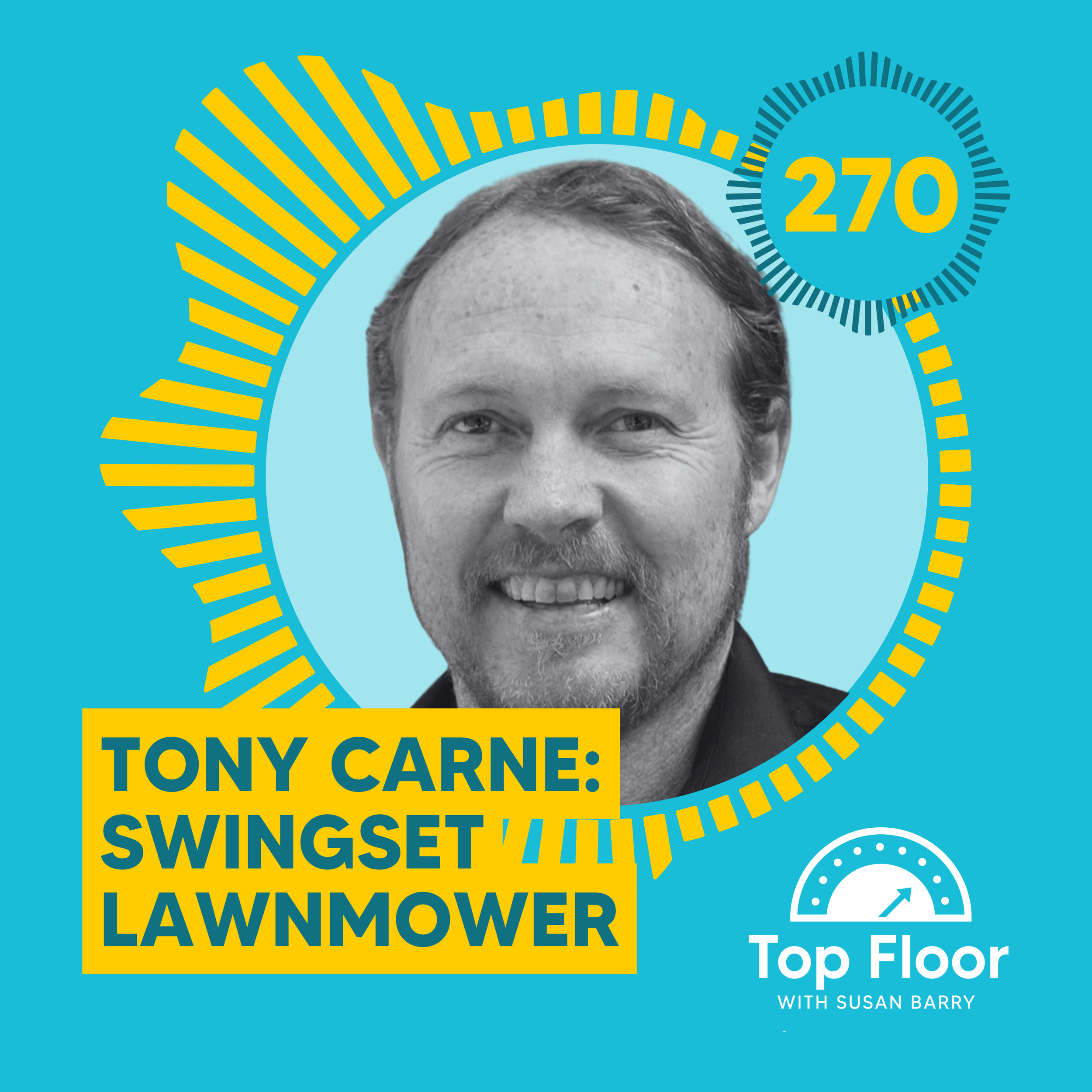
[00:00:32] Susan Barry: Welcome to the show. Tony Carne grew up in an Australian motel, worked as a hotel night auditor, and guided travelers through the Outback before landing a job with Intrepid Travel. An assignment in Egypt turned into a career building travel experiences across the Middle East, followed by a decade developing urban adventures in cities around the world. After the pandemic disrupted his next big idea, Tony became fascinated by AI, started writing about its impact on travel, and eventually co-founded CollabsMap, which connects travel businesses with content creators. Today, we are going to talk about how hospitality businesses can make creator marketing more useful, more efficient, and a lot less awkward.But before we jump in, we need to answer the call button.
Call button rings…
The emergency call button is our hotline for hospitality professionals who have burning questions. If you would like to submit a question, you can call or text me at 850-404-9630. Today's question was submitted by Tim, and quite frankly, Tim doesn't know he submitted this question because he and I have been having this debate on LinkedIn, so I figured I would ask you and get your opinion. Here is what Tim asks, in a manner of speaking: "Why do hotels pay more attention to follower count than they do to actual booking results?" I know that you're not a hotelier, Tony, but I'm curious if you have a take on this given your sort of content creator experience.
[00:02:22] Tony Carne: The answer is, I don't know why they do that. This is content or creator marketing or influencer marketing from five years ago. It's not how things work today.
[00:02:36] Susan Barry: I mean, that may just be the answer. Hotels are usually lagging by about five years.
[00:02:41] Tony Carne: But I mean, just for FYI, for people out there that are considering creator marketing, most creators these days will put your content into what are called trial reels on Instagram, which means that they deliberately go to everyone who is not their followers. All right? And this is how most creators get their content to get great results in terms of reach. And only when a piece of content actually achieves a sizable result do they move it to the grid, which then their followers will see. So, look, you need to have some metric to be able to judge people on, and I totally get that. But our advice to the people that we work with is, like, look at the last 10 posts, average out what their views are, and then you get an idea of what results you can expect to achieve by working with that creator in general. Yeah, follower count, it's a dead metric these days.
[00:03:49] Susan Barry: Agree. It's interesting, though. I think in the particular case of Tim, who we're talking about, he has been writing travel journalism for, like, 25 years, but I don't think he has a huge Instagram presence, and so that is probably in and of itself, right? Content creators need to be on Instagram. Would you agree?
[00:04:12] Tony Carne: It's kind of primary. There are specialists on TikTok. There are specialists on YouTube. Most people do have an Instagram as well. We use all platforms. We work with whatever the client needs, and we'll find the creators that will fit with whatever campaign they're trying to run. But I would say 90% of what we do runs through Instagram.
[00:04:38] Susan Barry: Interesting. Well, let's take it back a little bit. You grew up around travel and hospitality. What was life like in your family's motel? Did you have to clean rooms?
[00:04:48] Tony Carne: Sometimes, yeah. So Sunday mornings I always stripped the beds. That was my job. And what was life like? So when you grow up, you don't really understand what your parents do for a living. So my mom and dad were salary earners until I was 15 years old, and that's when they bought the motel. And so, up until that point, I left for school, they left for work, they came home from work, I came home from school. Didn't really know what they did. I knew Dad kind of worked in travel, and Mom worked in real estate, but that was about all I knew. Had no idea about their day-to-day. And then all of a sudden, as a family, we're all in this small business that literally never stops, right? 7 days a week, 24 hours a day, 365 days a year. In a motel, you are always on, and so you get to see your parents in action for better or for worse, you know? So that was kind of one part of it. And then I guess the other part, probably the thing that I've taken through the rest of my life with me, was that it wasn't a successful business. I don't know how much I took that in. I mean, obviously it affected me at the time, but throughout my life, I mean, some people call me Tight Ass Tony these days. But that's the reason. That's the reason why I'm a tight ass because I've seen how things can go terribly wrong if you make risky investments. And on paper that probably wasn't a risky investment in 1986, but by 1989 it was a horrible place to be.
[00:06:31] Susan Barry: Wow. I am unfortunately gonna have to skip around a lot in your background because there's so much there. So instead, we'll just wait for your book to come out. How did you go from guiding people through the Australian outback to building travel experiences around the world? I realize I'm skipping, like, a huge chunk of time, but that leap is pretty dramatic.
[00:06:57] Tony Carne: For sure. I was actually traveling around Australia, with a big beard in a Kombi. It was like a massive cliché. And I actually grew up in Alice Springs, which is the center of Australia for those who don't know. Like, you couldn't be further away from water if you tried.
[00:07:13] Susan Barry: But yet it's called Alice Springs. Okay, fair enough.
[00:07:18] Tony Carne: But I was driving back through that town and went to visit some old family friends, and they said, "What are you doing?" And I said, "Oh, you know, just kind of driving around Australia, picking up backpackers to help split the bills and have some more fun." And they said, "Oh, that's a job here." And I said, "Is it?" They said, "Yeah, yeah. Like you should go and see those guys over there at Adventure Tours, because that's what they do. They take backpackers out to Uluru and Kata Tjuta or Ayers Rock, as people might know it, overseas. The two kind of main geological sites out in Central Australia that people travel a long way to see." And so I went and got a job with those guys, and that's how I fell into tour guiding. And I loved it. Like it was an absolute dream job to be out camping under the stars, 5 nights a week in God's own country with these people whose minds were blown every day. It was such a cool experience. But it didn't quench my thirst for traveling myself as well. So I'd work a year, travel a year, work a year, travel a year. And on this occasion, I'd spent a year in South America, and I really didn't wanna go back to Alice Springs again. I saw a job in the paper for this company called Intrepid Travel, which I'd never heard of. But I had a look on their website, as it was in the early 2000s, and I saw that they had South America as a destination that they sent customers to. And I thought, "Oh my God, I could turn around and go straight back to South America."
[00:08:49] Susan Barry: And it was tour guiding, like what you already knew how to do.
[00:08:51] Tony Carne: Tour guiding. It was like, it actually said the job that I did was the one job I knew how to do. So, that was pretty cool. And so I went through their application process, and it's fairly intense, and we got to the end of that, and they said, "Tony, we'd love to have you on board." And I said, "You beauty. Okay. Quito, Caracas, Buenos Aires is where I'm off to." And they said, "Cairo." And I went, "Ooh." I had been to Egypt, but it wasn't somewhere that I was yearning to get back to in a big hurry. But I was so invested in the process by that stage, and I think I was living with my mom and I had no money. So, Cairo it was. Off I went. And, as life and fate often turn out, it was the best thing that I ever did. I was one of the first three tour guides they ever sent out to operate in the Middle East. It was year one of them operating their own tours out there. It went really well that year. We sold out everything, even though we only had two trips in Egypt at that time. And by the end of that year, they said, "We need more in the Middle East, so we wanna set up everything from Morocco to Iran, and who would like to do that?" And I put my hand up, and they said, "You." I got the dream job.
[00:10:06] Susan Barry: I mean, you had a pretty successful career with that company, such that you ultimately helped create a I don't know if you'd call it a subsidiary or a side business for Intrepid, which was Urban Adventures. What did building that business teach you about turning a sort of good travel idea into a real viable commercial property?
[00:10:33] Tony Carne: That it's hard work. That's what it taught me. So yeah, I mean, just some background on that. For those that don't know how Intrepid works, all about homestays and eating with families, and getting in the back streets, and chatting with vendors who are doing things that are unique and endemic to a certain place. And we try to really get customers behind the scenes and deep into the culture of a place, which is fine over 14 days, right? You've got plenty of opportunities to do that, and this idea was like, can we do this in two hours in a city? And so that was the challenge.
[00:11:11] Susan Barry: Like two hours, go to someone's home and meet someone who's a citizen?
[00:11:15] Tony Carne: Sometimes. Yeah, so exactly. Exactly. So it had to be kind of some sort of experience but where we could plug people. So they'd walk away thinking, "I understand this place better than I did before." So we deliberately didn't go to the Eiffel Tower. We deliberately didn't go to the pyramids. Like, we did things that were kind of urban. Often, like, doing those little components where we'd visit a vendor who did something crazy and endemic that people wouldn't see in their own country, and talk to them about it, right? And maybe learn how to do it ourselves and have a try and that kind of thing.
[00:11:50] Susan Barry: It sort of sounds like what the first iteration of Airbnb Experiences was trying to be. I don't think they do like that anymore, but that was what it was supposed to be, like something cool that you couldn't get anywhere else.
[00:12:06] Tony Carne: Correct. Correct. So we did this from 2009, which was actually the year that Airbnb started their accommodation business. And we had some very lengthy conversations with Airbnb when they were starting their Experiences business, along the lines of, "You should just buy us. We're already doing it." Wouldn't that be cool? Instead, we had kind of multiple conversations with them, and they sucked all the knowledge out of us and then didn't buy us. But I digress. And obviously, they never really cracked it either. But that Urban Adventures business, we ended up growing out to 160 cities around the world. It turned over $25 million a year. We carried half a million customers a year. So it turned out to be a really successful piece within the Intrepid ecosystem, so much so that it became the third strategic pillar of the company behind the multi-day trips and the DMC business within that company.
[00:13:10] Susan Barry: Does it still exist?
[00:13:11] Tony Carne: It does in a much diluted fashion. So it was run as a franchise business, and Intrepid, kind of near the end of my time there, took a really strong stance on vertical integration. That was gonna be their business model, and the franchise model didn't sit comfortably inside of that. So particularly through COVID, etc. They reorganized it so that it was only their own DMC operations that ran the Urban Adventures trips. Much to my disappointment, having spent 10 years building a family, more or less of these wonderful kinds of small operators around the world who are heavily invested in the brand and we had a hell of a lot of fun over 10 years. But when I wasn't there, it's hard to change what the suits are.
[00:14:04] Susan Barry: It kills me, like, sorry, I know that's not what we're here to talk about, but I think this is so interesting because that is the kind of thing that travelers want. People continue to try to build companies and cannot get it right. There's either no staying power, or it doesn't make enough money. I mean, it's fiddly business, right? Like, a two-hour tour is the same, probably the same amount of work as a two-week tour in some ways, but that is what we want.
[00:14:36] Tony Carne: It's true. It's true. It's a hard business. And like mainstream has volume, right? By definition. And so to say that you are gonna be anti-mainstream means that you're gonna have low volume and hard work by definition.
[00:14:55] Susan Barry: We do not wanna succeed. Unscale us, yeah.
[00:14:59] Tony Carne: So for a company like Intrepid, they saw it primarily as a marketing exercise that didn't lose money. So that's kind of how we fit into that ecosystem. So we turned Intrepid into the largest adventure tour operator in the world through the half a million customers we brought into the ecosystem. And then the opportunity was there, having given them a taste of what the Intrepid way was about, to introduce them to the multi-day stuff, which is where you do make money. And so that was the theory and system behind the business.
[00:15:39] Susan Barry: So interesting. Well, let's stop and give me the elevator pitch for CollabsMap.
[00:15:50] Tony Carne: Yeah, it's pretty simple. We help travel businesses find content creators who are already heading their way. And why is that important? It's because so much of the marketing budget gets sucked out in the travel costs that you need to outlay to get a creator to your venue or to your tour. And again, if we kinda go back to Tight Ass Tony, this really, really, really annoyed me at Urban Adventures that we would need to be paying airfares, hotels, etc., to have creators come and do our 2-hour tour. Turning it into, like, a hideously large expense that I could then not reconcile the value of, even though I understood kind of the theory behind why it should work, but the economics can't work in that way. And so, it annoyed me, and I thought, why does the market do it this way? And I thought there's gotta be a better way. So, we built something that was different. Essentially, a jobs board-type approach versus scrolling through Instagram, finding someone you like, DM them, and then negotiating. A model that is still the predominant model within the creative business.
[00:17:15] Susan Barry: So I know that I'm going to Mexico City. I can jump on Collabs Map and look at what's available in Mexico City and see if there's something that I can apply for. Is that kinda how it works?
[00:17:28] Tony Carne: 100%. As a content creator, that's exactly what you do, and the brand has control over what the conditions are. So if you're a hotel and you're in Mexico City, you say, "We're happy to offer two nights, free for you and your partner, or you and your family, to come and stay at our hotel. And in return, we want X, Y, and Z." And that is determined by whatever the requirements of the marketing department of that hotel are at the time. So it might be promotion. It could be posting a certain amount. It could be that we want the content because we wanna use it for our own whitelisted ads or to add to our own account or to put on the marketing materials on our website, etc. So really we put the brand in control. They set the conditions, and the first level of triage is that the creator looks at the offer and says, "Am I happy with the offer? Yes or no?" If no, I don't apply. And so we've kind of triaged out all the people for whom those conditions they're not comfortable with, and then everyone else, you get the applicants, and then you can easily go through those applicants inside our system and accept or decline them.
[00:18:40] Susan Barry: So how should a hotel or a tour decide what they want as the deliverable from a creator? Like, as you're explaining this, it makes absolute sense, and I'm thinking about so many different times when I could have taken advantage of this, except for I don't have a big enough Instagram following.
[00:19:02] Tony Carne: Massive podcast following.
[00:19:03] Susan Barry: Exactly. Massive, and 12 people on LinkedIn listen to what I have to say. But I hear on the flip side of this a lot of conversation in the creator community about how it's unethical to only offer trades for room nights and whatever. The reason I'm saying that, I don't have an opinion. I think a free hotel room is a great form of compensation. But I wonder if it tends to only attract sort of the beginners in the spectrum of travel influencers or content creators. Does that question make sense?
[00:19:41] Tony Carne: Sure does. And the answer is yes and no. Where do you start? You start with a strategy, okay? You don't start with an inbound from somebody into your inbox saying they wanna come to your place, because why? Like, what are you actually trying to achieve? It's not something that you should really figure out on the fly, and this is kind of all marketing, not just creator marketing. But work out what you want to achieve first, and then go from there. So with our clients that we work with, the general things people are trying to achieve are either to show up high in the search results on social media, so, like, when somebody uses the search bar on Instagram, they want videos of their business to show up in the first one to five places there.
[00:20:26] Susan Barry: I feel like we need to just take that and clip it and play it for every single hotelier in the entire universe because what they think their strategy should be is booking room nights. Anyway, sorry to interrupt you. Continue.
[00:20:40] Tony Carne: For sure. No, that's the step to booking room nights. Like, you gotta show up in search. Nobody would ever question wanting to show up in the first five spots on Google, right? It's, like, unquestionable, absolute. We absolutely should do that. We should have an SEO person. We should have an SEO agency. We should do everything we can to show up as high as we can in those search results, and have tried to do that for 20 years. The problem is that kinda more than half of people are no longer searching there. They're searching on social media or these days on AI platforms, and there's a connection between creators and AI platforms as well. So, like, be where the people are looking, right? It’s what marketing's about. So, like, that's kind of the main strategy that I would say, 70% of our clients are working towards. And that's a volume strategy. That's not like pick one person, and they're gonna get us there because they can't guarantee you that. Nobody can guarantee you that. The algorithm chooses, and the strategy, in our opinion, is to have as many creators as you can handle, or come through to give you as many shots on goal to get into those places. And that's kind of the model. And people are like, "Ooh, but that sounds expensive." But barter, not expensive. Not paying the travel costs, not expensive. These are all the things that we've thought through to create a business that works for businesses. I'm from the brand side. I'm a tight ass. I understand where good eco-economics lead. And then the ethics around barter versus paid, and do you attract only a certain level of creator? We let the creator choose, right? So as I said, it's a jobs board, and the creator can not apply if it doesn't work for them. What we actually see happen is that even a very well-renowned and good creator that has not been able to secure a collab through the back channel, DM-ing hotels on Instagram or cold emailing them, still would prefer to do a collab and not pay for the accommodation rather than to pay for the accommodation. So you do find that you get high-quality creators still applying for these opportunities in certain circumstances.
[00:23:13] Susan Barry: Maybe you've already covered this, but what do you think is the biggest disconnect between your clients, the people who are posting these opportunities, and the creators who either are or maybe who are not applying in that case?
[00:23:32] Tony Carne: Yeah. Across the entire creator industry in travel, there is a disconnect on value, right? The value that somebody is bringing through the work that they do. So what I hear, day in, day out from people that I'm chatting to about what we can offer is, they think that creators are freeloaders that are coming for a free trip. I'm not sure why they're even talking to me, but that's the attitude.
[00:24:04] Susan Barry: It's so true. It's so negative, especially in the hotel business. I think there is some residual PTSD from before services like yours or agencies or anything, like, when that whole world was very new, they got burned a lot of times and have never gotten over it. Or have never figured out a strategic approach, right?
[00:24:31] Tony Carne: I believe it, and, like, it's happened to me, right? This business is built out of that PTSD. It's happened to me. I spent a lot of money. I got 1,300 views on something that cost me 15 grand, right? I've been there. I've done it, right? And so I'm like, "No, this shouldn't happen," and like, "How can we make it so that this doesn't happen and it's actually a positive experience for everyone?" So, like, I get it, but, on the content creator side, they are trying to build their life, their business through the service that they provide, right? And so, that's where the disconnect lies. So on one side, you’ve got people thinking, "This is just people wanting free stuff that's adding no value to my business." On the other side, you've got people going, "I'm trying to run a business here. I'm trying to put food on my table. I'm trying to put my kids through school by doing this," and, like, there's a mismatch in that value. And honestly, it continues to this day because of the method that persists, which is scroll through Instagram, find someone you like, DM them, ask them if they'd like to promote your thing. They'll, of course, say yes, and then they'll say, "You need to fly me out here. Like, I need my accommodation. These are my rates," da da da da da. And all of a sudden it adds up very quickly that you're like, "Whoa. What? This is ridiculous." "Why would I pay all that money for that, and what do I get in return?" And no creator can guarantee you a return. No single creator can guarantee you a return on your investment, because they don't know how their content will perform. They know that they'll try their best, but they don't control the algorithm. And so, yeah, so that's where the disconnect lies. My strategy or our strategy, was, like, let's put the brand in control. Let them set the terms, okay? And when somebody loads an opportunity into our system, we also give them advice about that opportunity and tell them who is likely to apply. So if they say gifted two nights, kind of, mid-sized four-star hotel somewhere, we will say, "You are likely to attract this type of creator."
[00:26:52] Susan Barry: Ah, that's interesting. And are you starting to see... I swear to God, I know I gave you a list of questions. I have 500 more questions based on our conversation. So we may never get to the rest of them. We shall see. But are you seeing more requests for user-generated content that your clients can use on their own channels, or are you still seeing the more sort of influencer style requests?
[00:27:21] Tony Carne: A bit of both. Bit of both. As I said, like, we try and get our clients focused on strategy. We're like, "Let's work out your strategy first, and then we'll work out how we're going to tactically achieve your strategy." And so we ask them what they want. At the end of this, what does that look like? What does success look like for you? And then we work backwards from there. And of course some people will say, "I just want sales." Okay, that's fine, because there is a pathway for that as well. We have clients that, as part of their offer, insist that the influencer signs up for their in-house affiliate program. That's part of the deal. If you're coming here to stay here, then yes, do your reel, but your reel must be a lead magnet style post where you say, "Comment hotel," and I'll send you the link to the exact hotel where I had all these amazing experiences. And then that will be an affiliate link, right? And the hotel can get an exact read on the direct ROI that that post drove for them. And so that's a tactic. That's a tactic that we can use, and if someone is insistent that they want a more sales-oriented approach than a marketing approach where we're bringing people through a funnel. We can do that.
[00:28:41] Susan Barry: But do you tell them it's not gonna work? Because that's not gonna work.
[00:28:45] Tony Carne: So it does work, but it does maybe not work at the speed at which they want it to. Because that approach does not remove the fact that that post could also end up in the top five spots in search. All right? So if you happen to get both those things happening at the same time, and then somebody searches for a keyword, and the result they want is hotels, and your hotel shows up twice, and both those links are affiliate links, people will click those because they're in buy mode when they're searching, right? So, it's not a zero-sum game. It can work, it's not gonna be I choose one creator, and it works for me. Like, that's the big mistake, all right? Unless it's a celebrity or something like that, then, like, it's not gonna work for you. But many people still think that's what creator marketing is. Pick one person, pay them some money, and our business goes from in trouble to a huge success. That, I'm sorry, doesn't really work anymore.
[00:29:53] Susan Barry: And they wait until it's next week. We have a whole next week that we need to fill. Let's find some, like, come on, guys. It's not gonna happen that quickly.
[00:30:04] Tony Carne: Exactly. Yeah, look, we're trying to build a system now with hotels where we can kind of hook into their revenue management systems and see when low periods are coming, and open their availability on CollabsMap based on low occupancy.
[00:30:24] Susan Barry: Oh, what a good idea. I love that.
[00:30:25] Tony Carne: Yeah, so, this came from clients, not from us. Like, so, this is not any genius idea of mine. They asked us, "Is this possible?" And we said, "If you can connect us, if you can find a way for us to get an API into your revenue management system, it absolutely is possible." And therefore you're turning low occupancy into a low-cost marketing strategy that then gives you the maxim opportunity to show up in search results that will then drive your future occupancy and so on as a system ongoing. And so, like, these are the things that we're working on with some of the more advanced clients.
[00:31:04] Susan Barry: I cannot wait until you have enough data to be able to give trends. Like, okay, if you are trying to target a date three months from now, your chances are X percent, whereas if you're targeting 18 months from now, they are Y percent. That's so interesting. We like to make sure that our listeners come away from every single episode of Top Floor with some really practical, tactical tips to try either in their businesses or, in some cases, in their day-to-day lives. If a small hotel wanted to try to work with creators for the first time, what do you think is their first step? And you cannot say, "Put a listing on CollabsMap"
[00:31:51] Tony Carne: Damn, I'm out of options then. Look, if you're gonna do creator marketing, just be aware of how it works. Like, so just do some research into the perceived results so you can set your expectations properly. And run it as a marketing program, not a one-off sugar hit. That would be my advice. All right. So give it six months, run a program, run it however you like, but get a volume of creators through and measure the results and then determine whether it was successful or not, okay? And that's essentially what our system does automatically for you. But if you wanna do it your way, like through the outreach and negotiation path and build a spreadsheet, you can also do that.
[00:32:45] Susan Barry: I love that your first piece of advice is, make sure you know what you're talking about because people think that if they experience marketing, they understand what's happening behind the scenes, and it's not always the case. Well, you mentioned evaluating results. How should they evaluate those results of a creator partnership, whether it's our metaphorical small hotel or a huge hotel that has a really serious program?
[00:33:10] Tony Carne: Yeah, well, like again, like I said at the beginning, if you've started from strategy, then you've kind of already set some goals that you want to achieve, and it's therefore just measuring against those goals the actual results that you got. And we, as I said, we'll guide people on where they are setting goals that are probably a little bit unrealistic and try and drag them back to something that is achievable. But that's what we're measuring against. And so, like, it's pretty easy to say, like, we want to end up in the top five spaces of search for these sets of keywords. Okay, that's 100% measurable. All right, let's do it. We'll run this program in three months' time. We wanna see your hotel show up in those results for those keywords. Like, we either succeed, or we fail. It's pretty black and white as to whether it was achieved or not. If it's, we need to fill these gaps in our content, the gaps that we have in our own content, it's 100% achievable. Like, we go out, we fill those gaps. Did we do it or not? Yes, we did. Like, if it's like my hotel's in trouble, and I need it to not be, and I hope that this will save us. That's gonna be a little bit more difficult. It can be a piece in the puzzle, but it's harder to evaluate what just one piece of marketing will do to, or one channel of marketing might do to, your overall business. But doing it is probably gonna improve your business somewhat alongside the other things that you are doing.
[00:34:51] Susan Barry: You are in my mind at least, the AI guy, not necessarily the creator guy. So I wanna ask you what you think about this. Do you think in the age of AI, creators mean more to businesses or less to businesses?
[00:35:12] Tony Carne: Yeah, great question. And I don't have to think because there's some research actually out yesterday that kinda gives us the answer at this moment. Net Influencer, I think was the publication that published it yesterday, showed results over a recent piece of research where citations in AI answers, 60% of those came from creators, 30% came from editorial. So let's call that traditional PR, and 10% came from the brand themselves. So that is the current split in research as to where the AI is pulling the answers that it's giving people about requests for things.
[00:36:05] Susan Barry: That's so interesting. Do you buy the sort of lists that people publish here, there, and everywhere, as the most AI answers come from Reddit this week, and next week it's LinkedIn, and the following week it's whatever? Do you buy that, or do you think it's still evolving?
[00:36:23] Tony Carne: It's not static, right? It's ever-moving because, like, no offense to Reddit, but in general, Reddit is, yes, authentic, but it's also just opinion. It's just random guys' opinions, right? Well, random lunatic guys' opinions. And so do we really want the random lunatic guy's opinion being the official answer from the LLM? And I think while it was an initial way to fill a lot of empty space that they didn't have good answers for, I think all the platforms are really pulling back on Reddit, etc. LinkedIn, it's kind of a big sales fest, right? It's people who are on there to push their own boat.
[00:37:14] Susan Barry: But they do have at least the credibility of a job title that matches what they're saying.
[00:37:19] Tony Carne: Correct. Correct. But there's an inherent interest in why they're saying it. So again, there's some iffiness to that. But they are still all playing a part in the mix. And a creator who's engaged to work on behalf of the brand that's not also an unbiased opinion, right? But everyone is trying to find their way to work into being part of the answers. The evidence says that maybe all the stuff that you're doing on your own socials and your own website is maybe the least effective part of that, right? And, it's gonna be great to see a resurgence in traditional PR, for example. I think that's kinda become really important across this next area.
[00:38:11] Susan Barry: Except that there are no publications to PBR, too.
[00:38:16] Tony Carne: Well, that's true, but I mean the LLMs are finding them, right? Well, the ones that are left, even if people are not reading them anymore, the LLMs are putting some kind of emphasis on their authority.
[00:38:29] Susan Barry: It's like the thing we were talking about, your agent talking to my agent. Like, the LLMs are reading the newspaper that literally nobody else is reading. It's very interesting and strange. Is there anything that you have observed in your time working on this sort of hospitality industry, travel industry marketing project, which is also a company, I realize, that, aside from the way that they deal with creators, you find particularly mind-boggling or inefficient? Like, is there something that you're like, "God, you guys, why do you do this this way?"
[00:39:06] Tony Carne: Look, there's a lot of it. Viderio, which is the parent of CollabsMap, the first business that we tried to launch in this area, I thought solved an incredible problem for DMOs that allowed for all the things that they say that they want to achieve, which is like, we need to get dispersal away from the cities and, how can we showcase our experiences across the breadth of our region? And I know from the supplier side, like, 'cause I had 160 cities around the world who desperately wanted to work with their local DMO. It's like, why doesn't the DMO promote me? We built a system that fixed all those things that was deployed with a line of code onto the DMO website, so basically no technical lift. And that was, like, an incredibly hard sell, right? And to this day I don't know why it was such a hard, hard sell. But I think, as there's PTSD around the early days of creators, there's probably PTSD around all sorts of marketing software where people have just been burned by investing in a certain thing and it not really working out for them. So somebody once told me, "Nobody gets fired for producing the paper map this year that they produced last year." That's, like, nobody gets fired for that. They're just like, "Oh, well, good job. You got the job done that we do this thing that we've always done." But to do something that's a little bit more modern, let's say, is a risk, and that can become a job risk if it doesn't work out and you're the one who pushes that to the industry. So yeah, there's just a lot of conservatism I find in travel in general around picking up new technology, and AI has been incredibly instrumental in pointing that out, I think.
[00:41:19] Susan Barry: It's interesting. I always go back to the idea that, at least in hotels, I think it's true in travel in general, that it's an apprenticeship industry that people learn from one generation to the next, telling each other. And so there's very little sort of input from the outside, and people are very distrustful of anything that didn't, like, start as a dishwasher and then become a night auditor and then, It's insular. I mean, there are some beautiful things and some beautiful traditions as a result of that, but it does not allow for rapid tech adoption, for example. Well, we have reached the fortune-telling portion of our show. So now you have to predict the future, and I will find you and see if you got it right. So what is a prediction that you have about the future of creator marketing in hospitality?
[00:42:19] Tony Carne: That it will become as important as SEO has been for the last 20 years, and it's taken a while for that adoption to pick up. But we have two major things that are happening in the world of commerce more generally. AI is obviously the biggest one. Like, AI is going to change everything. 3 weeks or so ago, personal agents were released. Meta's Muse, Instinct, these types of things. I use Instinct daily now. It basically runs both my personal and business life. It is incredible. Like, clearly the world is gonna change in a fundamental way as to how we do things. I barely open a laptop these days. Everything's done on my phone, in the chat of WhatsApp or iMessage. And so that's gonna, like, completely revolutionize everything. And part B of that is, like, where is that machine gonna get its answers from, right? And so, as we mentioned earlier, current research today says, like, 60% creator, and I don't expect that to change. I think social media is going to continue to play a huge role, an ever-increasing role in how people make decisions outside of chatting to their AI agent. This will be kind of where they have their own thought processes, right? Scrolling through, choosing the things they like, etc., making those decisions of what good means to them. And then those two things will eventually connect, and that's how a decision will be made on your behalf in the future. So yeah, social media plus AI is basically everything, yeah, five years from now.
[00:44:19] Susan Barry: If you could wave a magic wand and change one thing about how hotels and creators work together, what would that be?
[00:44:28] Tony Carne: Wow. Like, I would just love for there to be a great big group hug. Like, that would be the dream.
[00:44:37] Susan Barry: I agree. I think you're absolutely right.
[00:44:39] Tony Carne: Let's just, like, put the past in the past and concentrate on what's happening now. A lot of the creators that we work with, we have more than 5,000 creators that we work with on our platform weren't around. They weren't creating when the problems of the past occurred, right? And so, like, it's definitely not their fault. They are trying to run professional businesses where they have huge pride in their work and would like to be recognized as such. But they're entrepreneurs, they're solopreneurs, right? They don't have a boss that can say, "Great job on that one. Well done." It can only come through the validation of doing great work for their clients. I'm a believer that most people wanna do a good job, right? Most people wanna get the next client based on the results that they got for the previous client, right? That's how things have always been and probably always will be, and creators are no different. But somehow they're viewed differently. And it's just kind of a misunderstood piece, but things are changing, right? So the Skift conference this year had a creator track, right? And, like, for me, that is a bellwether for the industry itself waking up to the importance of this channel in helping businesses to get their name out there and to succeed in their objectives.
[00:46:09] Susan Barry: Okay, folks, before we tell Tony goodbye, we are going to head down to the loading dock where all of the best stories get told.
Elevator voice announces, “Going down.
[00:46:21] Susan Barry: Tony, what is a story you would only tell on the loading dock?
[00:46:25] Tony Carne: Yeah. So if we go back to the very beginning of this conversation, we talked about me growing up in a motel and, yes, I stripped the beds on a Sunday, but my other job was mowing the lawns. That's 15-year-old, and it was quite a large kind of property with a heap of grass, and we had a ride-on mower that I used to have to go out, and that was fun for a 15-year-old to be driving around on this thing and mowing. But we had a swing set, like for the kiddies that came and stayed at the motel. And I don't know if they had these in the States, but like everyone had one in their backyard. It had like a normal swing, and then it had a two-person swing where one person sat on either end of it, and then it had like a monkey bar ring on it. And so, if I could edge right up underneath the two-person swing on the ride-on mower, then I wouldn't have to get out the push mower to do the little bit underneath that would be hard to reach. So it was kind of a very precise operation. But one day I got it very, very wrong and hit the accelerator instead of the brake. And the swing got caught under the lip of the mower, and the mower kind of went up perpendicular so that the swinging, sharp blades were now in the air. And I was like holding onto this thing like a bucking bronco. In fact, I jumped off. Oh, wow. And it all ended okay. No limbs were lost. But I was like, oh my God. Like, geez, that was a near-death experience. And then I looked over, and there were like five people over at the pool just in tears, in tears laughing. So only before now, only they and I knew that, but nobody knows.
[00:48:18] Susan Barry: Well, Tony Carne, I'm very glad that you survived your run-in with the swing set. Thank you so much for being here. I loved our conversation, and I really appreciate you riding up to the top floor.
[00:48:32] Tony Carne: Thanks, Susan. I really appreciate the invite and hope everyone enjoyed the chat.
[00:48:37] Susan Barry: Thank you for listening. Thank you for listening. You can find the show notes at topfloorpodcast.com/episode/270. Jonathan Albano is our editor, producer, and all-around genius. He even wrote and performed our theme song with vocals by Cameron Albano. You can subscribe to Top Floor on Apple Podcasts, Spotify, or wherever you like to listen, and your rating or review will go a long way in helping us give you more of what you like.
[00:49:13] Narrator: Thanks for listening to the Top Floor podcast at www.topfloorpodcast.com. Have a hospitality marketing question? Reach us at 850-404-9630 to be featured in a future episode.