
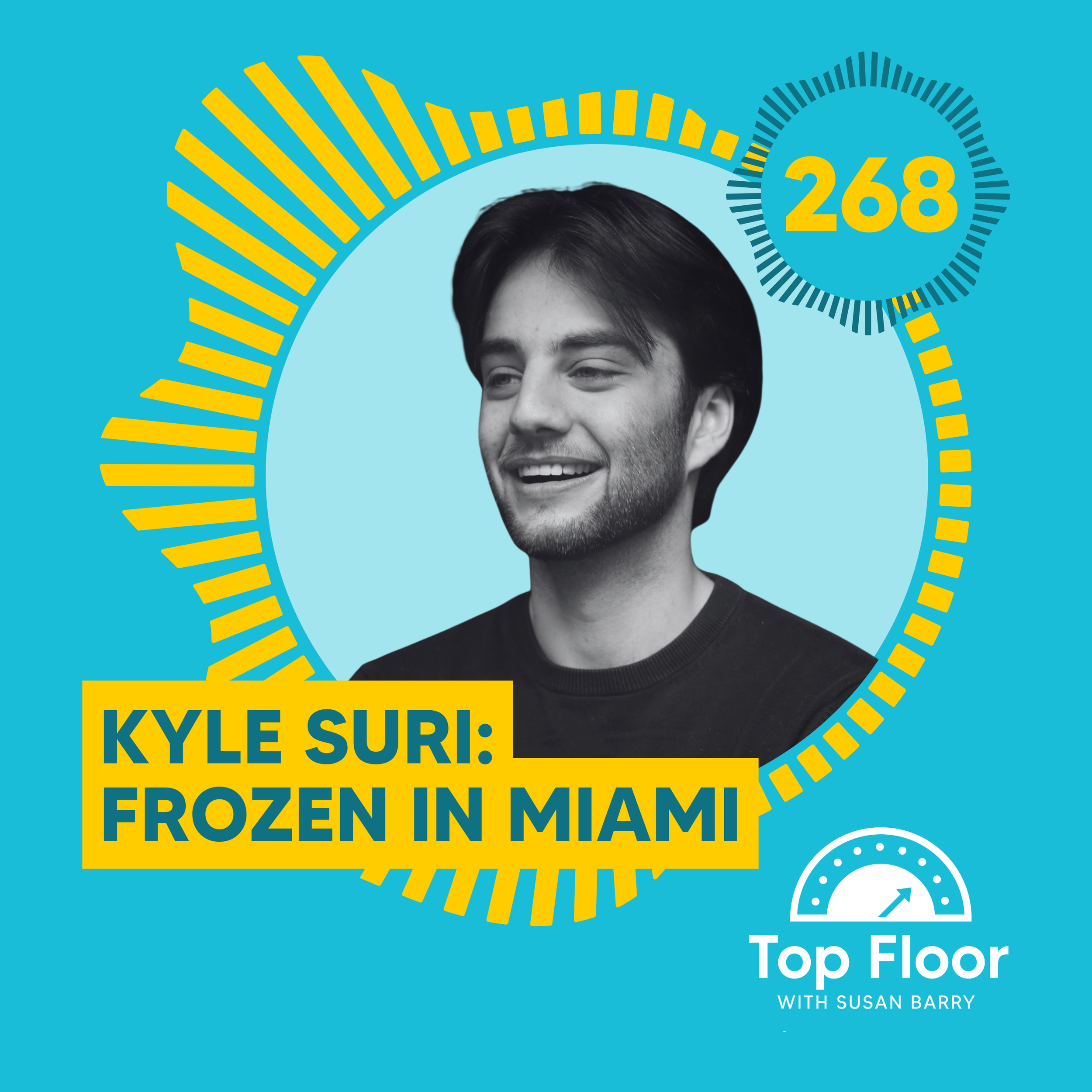
LISTEN TO THE EPISODE:
APPLE PODCASTS | SPOTIFY | TOPFLOOR.COM
[00:00:00] Susan Barry: This is Top Floor, episode 268. You can find the show notes at topfloorpodcast.com/episode/268.
[00:00:13] Narrator: Welcome to Top Floor with Susan Barry. This weekly podcast ride up to the top floor features tangible tips and excellent stories from the experts and characters who elevate hospitality. And now, your host and elevator operator, Susan Barry.
[00:00:32] Susan Barry: Welcome to the show. Kyle Suri didn't start his career anywhere near an easel. He came up in finance, worked in private equity and venture capital until a high school friend and artist posed a problem he couldn't stop thinking about. Today, Kyle is the co-founder of Acrylic, a Montreal-based company that uses robots to paint artwork, brushstroke by brushstroke, in collaboration with artists for hotels and other hospitality spaces. Today, we are going to talk about whether or not this should freak you out. But before we jump in, we need to answer the call button.
Call button rings…
The emergency call button is our hotline for hospitality professionals who have burning questions. If you have a question, you can call or text me at 850-404-9630. Today's question was submitted by Amanda. Amanda asks, you're gonna be so annoyed with this question. Who is your favorite artist and why?
[00:01:44] Kyle Suri: Oh, that's a great question. And first of all, thanks for having me on, Susan. I would say my personal favorite artist is an artist that I've had a chance to work with. His name is Peter Triantos. He's this 62-year-old eclectic, over-the-top figure. You're talking about a 62-year-old man who has a Mohawk, is who we're speaking about here. He's based in Toronto, and I had a chance to get to know him through kind of the artist community in the city, and he's been incredibly welcoming and embraced our technology with open arms. And he's just got this really cool, almost Basquiat-esque style with these crazy lines and figures. And watching his artistic process, it almost looks like he's literally scribbling on the wall as he's kinda speaking with you. You can tell that he's just a million things going on in his brain at once. But it comes together in such an amazing way. And selfishly, I actually have one of our collaboration pieces with him hanging in my apartment right now. So I'd have to go with him, partially because of my relationship with him personally, which is always what art is all about. But also as a huge admirer of his style and his work as well.
[00:03:00] Susan Barry: Man, I am so surprised. I thought that question was for sure gonna trip you up. So I'm impressed that you had somebody at the ready, and we'll link to his work in the show notes. Well, take us back to the start of your career, because it was nowhere near art. So the fact that you can sort of speak fluidly about art is pretty impressive. How on earth did you end up in the commercial art business?
[00:03:26] Kyle Suri: Yeah. So my background is in finance, so we're talking I had a cup of coffee in private equity, and then worked in a growth-stage venture capital before I ended up coming over to the artwork world. But when you're on that side of the world, what you're investing in is new companies and new exciting ideas, and I started to realize that I was more excited about creating something new in the world versus just providing money to fund those kinds of new ideas. And the timing was really good, because a friend of mine from high school was an artist, and her idea was, "If I can make an original once, why can't I produce it many times over? If there's several different people that wanna buy work from me, I think we should be able to find a way to reproduce that artwork and serve that market." And so we kind of had this perfect synergy of her being the artist and also a mechanical engineer, so the technical side combined with my business knowledge and my financial side of helping fund the company and so on, really created this sort of perfect harmony. So I came into the art world as a complete newbie, learning all about these different artists and different styles. But approached it sort of like an economics problem, which has created this kind of really cool, dynamic where we've invented this company that combines both the automation and the technological side with this, like, deep roots of art with a little bit of my business brain sprinkled on top there.
[00:04:58] Susan Barry: All right. Well, if you have a business brain, what's the most creative thing that you've ever done?
[00:05:04] Kyle Suri: Yeah. I like to joke that I'm the least creative person to ever run an art company.
[00:05:11] Susan Barry: Okay, fair enough. I mean, businesses can be creative.
[00:05:15] Kyle Suri: Absolutely. And I don't want to just give you, like, classic, "Oh, here's a business problem that I solved in a creative way." So I think the actual most creative thing that I ever did was back before I ever got interested in finance. I actually wanted to be an actor. So when I was 10, 11, 12 years old, I was convinced I was gonna be a leading man in Hollywood. And so my version of that was to create a YouTube channel where I would act in these, like, short movies, and I was really into, like, Nerf guns at the time. And so me and my friends would reenact these, or not even reenact, just enact these beautiful. Beautiful is a big word. These intricate, I will say, sets of action themes, scenes, and, like, having these gun fights with each other, and put together these stories, and I would edit them myself. I would add music to them. And they would get posted on YouTube to 10 of the viewers, to my adoring fans.
[00:06:20] Susan Barry: And is that channel still alive?
[00:06:22] Kyle Suri: It is still alive. I think you'd have to torture me to get the title of the channel out of me. But it does still exist on the internet, and we certainly had a lot of fun doing it at the same time.
[00:06:37] Susan Barry: You talked about the problem that you were trying to solve, which is that your friend wanted to recreate her work. I mean, people have been making reproductions of art for a really long time, so was the problem that she felt like, I don't know, existing reproductions weren't it? Or do you know what I mean? Like, you could do a giclée, you could do a print, you could do this, you could do that. Why wasn't that satisfying the need?
[00:07:07] Kyle Suri: Yeah. You kind of hit the nail on the head there, where, like, giclées and prints have their place in the world, and they're very affordable, which is great. But they don't kind of have the same authentic nature as a painting does. Like, if you put a painting next to a print of the same image on a wall, you can really tell the difference in quality. The painting just has more depth and more texture. The colors are brighter and more engaging, and it's just not a kind of faithful representation of what the artist was originally going after if you just do a simple print, right? And so we realized that if we were able to reproduce it as a painting, it's a much more valuable, it's a much more collectible sort of product that is something you're much more likely to wanna put on your wall, and covet, and tell the story of the artist behind it, right? So even if you look into history, like, there's plenty of examples of very famous artists having workshops of other younger artists who are their trainees. Assistants, exactly, right? Who are helping them produce their work. And so you can kind of think of our robots that way, a little bit of sort of like the modern version of the artist's assistant who's helping scale up the art. And then I think the flip side of it as well is that's on the artist's side. But on the consumer side, or on the hotelier side, there's a price gap between what an original piece of art typically goes for and what somebody might be able to afford, either in their home or on a project. And we realized that by automating some of that, we could make real paintings a lot more affordable. And that's kinda where the magic started to happen, if you're helping both the artist and the person who's buying the piece of art, it really creates a great solution.
[00:09:02] Susan Barry: Okay, so for anyone who's picturing a robot sitting around, like, with a beret and a paintbrush, walk us through it tactically. From a technical perspective, how does the painting go from the artist's idea or the artist's original to an actual canvas that can hang on a wall?
[00:09:20] Kyle Suri: Yeah. So basically, the way that it goes from an artist's design or an artist's original to a reproduction is in two ways. One, the artist might have already created the piece. Let's say they've already created the piece. Then what's gonna happen is we're going to translate it to brush strokes on a digital tablet, right? So imagine, like, Adobe Illustrator sitting in front of you. The artist will come in and do every single brush stroke exactly like they originally did, right? And so they'll choose the color that is matched to the hex code of the paint. They'll choose the brush size that they want. They'll choose the paint.
[00:09:57] Susan Barry: How do they remember?
[00:10:00] Kyle Suri: The honest answer is that it'll always be slightly different. But this artist, like, this is what they do, right? So it is absolutely a process of, like, remembering, and then the cool thing, though, is they might say, "Oh, actually, if I had my go again at this painting, I might change X or Y or Z." And then be able to make that change in this process, right? So it's kind of this cool iterative creative function there too. But yeah, the brushstroke by brushstroke creates basically these layers on this digital file, and then that gets turned into basically code that goes to the robot and instructs it how to do the painting. So the robot has no mind of its own, right? It's fully following the creativity of the artist. It's following, like, the dip order. So, like, every stroke that they do, every dip that they would do to fill up with paint on the brush, or every time they would go to wash their brush, the robot is replicating that exactly. So it's following sort of that process. And then I mentioned there are two ways. The other way is that if the artist doesn't want to actually go through and try and remember and do every single brushstroke, they can also just send us an image of the final work, and we have a machine learning model that'll automatically convert it into robot-paintable brushstrokes. And then we also have a team of artists on staff that'll kind of sanity-check that as well and make sure that there are no kind of silly mistakes. And so either way that we're working, there's always a human very involved in the process, and then it goes to the robot for the sort of the production mode from there.
[00:11:39] Susan Barry: Gotcha. So then, how do the artists get paid in that type of model? Like, do they sell you the work and then they're hands-off? Or who owns the work?
[00:11:51] Kyle Suri: Yeah, it's a really important question when we think about a lot. Like, we will never work with an artist without their consent or without putting together some type of compensation agreement, right? So, as I mentioned, we have founded from, like, an artist's perspective. We're very much an artist-first company. So, the way it works is that we will do a royalty or a revenue share agreement with every artist that we partner with. And so, sometimes that will look like a limited edition run of their pieces, so to say, "Hey, I will allow you to do 10 reproductions of my work, and then you can sell it, and we'll share the revenue that comes from it." Or other times it might be more unlimited, like, "Hey, I give you a kind of perpetual license to be able to use my artwork," right? And then oftentimes, what we'll do with hotels as well is we'll work out an agreement where a hotel will often want to have exclusive rights to that piece of art, right? They don't want it to show up at the Hilton down the road after they've spent all this time selecting this perfect artwork for their property. And so we'll work out a deal there where they do get exclusive rights to at least the painted version of it. So yeah, that's how the artists are paid. They're always in the loop and always compensated for the work that they do.
[00:13:05] Susan Barry: You said artist first, and so after I met you and learned about this concept, I talked about it to so many people. And I'm gonna tell you that the level of freak-out was very high, particularly among the artists that I spoke with, which we happen to have a bunch of in our lives. My husband's an artist. Whatever. So I'm curious about what the criticism is that you hear most often, and then how you respond to that.
[00:13:37] Kyle Suri: Yeah. Certainly something we're very familiar with.
[00:13:42] Susan Barry: I know, sorry. Like, why does everyone hate you, Kyle?
[00:13:46] Kyle Suri: I think it's because it sounds like The Terminator. It sounds like there are robots coming in to take one of the last jobs that people really love and enjoy the process of doing, right? There's kind of the old joke of like, I don't want robots to take away my creative passions. I want it to help me, like, do the dishes, right? Or do the laundry.
[00:14:08] Susan Barry: Why is it like that? Why is AI machine learning so focused on the creative arts and not on, like, folding my laundry, bro?
[00:14:17] Kyle Suri: Yeah. I mean, my one defense of the folding-the-laundry argument is I do think that technology has made these things a lot easier in terms of, like, there's a dishwasher that helps you do your dishes or a laundry machine, right? So, on the point of the artist, which is, I totally understand why at first glance it's scary, right? It feels like somebody's coming for your territory almost, right? And I think there are a couple of ways that I respond. The first is that it's what we talked about before, of how there's always a human and always an artist in that process. Like, the robot does not have a creative bone in its body. We would not be able to do the work we do without the creative humans who come up with the incredible designs and the incredible ideas that then eventually get produced by the robots, right?
[00:15:06] Susan Barry: I think one of the things that freaks people out is they think, they assume that there is some generative piece to this. That you're like combing the world for every work of art, and then generating designs. But it sounds like that's not the case.
[00:15:21] Kyle Suri: Yeah, no. And like the only time we use generative AI in our process is when we're doing, like, mood boards and iterations for custom work. But even when we do custom work like that, we might show you a couple of mocked-up examples. But then when you choose what you want, it then gets taken to one of the artists on our team, who then brings it to life, and then they are compensated via the commission, right? And so no matter the situation, there's always an artist involved. So it's about the compensation for the artist and the creativity from the artist. But the other thing I'll touch on as well is that, when you speak with artists, what artists enjoy in their creative process is making every piece unique. They don't want to sit there and do the same piece 200 times over and over and over again, right? That's moving away from the creative part of their work that they really enjoy into basically like factory-line production that an artist would never like to do, right? And so that's really where we come in. It's not to automate the first piece, it's to automate piece two, five, 10, 100, 1,000. And let artists focus on creating more new pieces, expanding their creative brain and pushing the boundaries of what's possible with art, rather than just doing what they need to do to put food on the table, from the volume standpoint. That's where we kinda help them out.
[00:16:50] Susan Barry: I think their response to that, which I do understand is probably not super realistic, is why do we need 200 of the same painting? Why can't a hotel buy 200 pieces of original art? And I think you and I both know that that's just financially not feasible. You would have to, like, do one every six months for the next 40 years to make that happen.
[00:17:19] Kyle Suri: For sure. Yeah. And if you look at what the price points of original artwork will go for, and for a hospitality project, you're talking about maybe there are 200 rooms, right? And maybe there are three pieces of art per room, and then plus lobbies and common areas and business centers and so on, right? It gets so big that the scale of it is just not possible to do without some type of automation. And not even to say, like, there's also, from a hospitality standpoint, if you're an interior designer or an owner, you do wanna have some continuity across your property as well. Like, you want the same pieces of artwork in every room so that a guest is getting the same experience no matter which room they happen to get assigned in, right? And so there's that component as well.
[00:18:03] Susan Barry: Yeah, that makes a lot of sense. Speaking of the designer, the owner, etc., who are the folks that are making these decisions? Like, who's at the table going, "All right." Let the robots loose. We'll do it. You know what I mean?
[00:18:16] Kyle Suri: Yeah. Yeah. So we find there's almost always an interior design. Either it's an interior designer or an interior design firm involved in the process. They are really kind of like the tastemakers behind which pieces of art get selected for a project, because the artwork needs to match the bed and the carpeting and the wallpaper and everything. If not, it's gonna be a mess. But the projects that we enjoy the most are when an owner, or especially on a boutique hotel project, has strong opinions and has a strong vision for what they would like the artwork to be. Because then you kind of create this really cool creative dialogue where the interior designer has opinions, the owner has opinions, our curation team and the artists on our team, or the artists that we're working with, have opinions. And that can seem scary at first because there are a lot of voices in the room, but it really tends to build on each other, right? Of like, you take the kind of vision of what the owner is looking for from their property, combined with the sort of craftsmanship of the interior design work, and then the creativity of the artist, and it kind of creates this beautiful meld. And then of course, like, if we're working with a branded hotel as well, there will be brand standards and whatnot that we're very comfortable working within. We're very used to doing that. But we like to find creative ways to meet those brand standards so that we are pushing the envelope a little bit, and allowing for some really unique artwork on these projects rather than the more plain stuff that we've maybe gotten in the past in the hospitality world.
[00:19:57] Susan Barry: We like to make sure that our listeners come away from every single episode of Top Floor with a couple of really practical tips to try either in their businesses or in their personal lives. I was looking at my notes, and one of my questions is printed in a completely illegible fashion. So perhaps I need a robot to start doing my notes printing for me because I'm like, "I have no idea what this says." But what I think it says is, how can a hotel use art to give guests a sense of place in the city or the neighborhood that they're in?
[00:20:33] Kyle Suri: Yeah. That's a big focus of the work we do. And I would argue that artwork is one of the rare areas within a hotel project where you can give guests a real sense of the city, right? So obviously, you can pull from the direct scenery of the city, right? You can have a landmark, or you can have a landscape. But that's a little bit on the nose for me. I would recommend that, hey, if you're going to incorporate something like that, be a little bit more creative with it, right? Like, for example, we have a project that we're doing in Ottawa, which is actually my hometown, where it's an abstract piece of art. But the abstraction is inspired by the kind of Gatineau Hills, which are right near Ottawa, right? And so you can be a little bit more playful with the artwork that is inspired by the region, but not directly on the nose of here is a painting of the Golden Gate Bridge let's say, right? It can be a little bit more inspired. And the other thing that I would say is pulling from local artists as well, right? And this is what we'll do on our projects a lot, is do a call for artists or pull from artists in our network who are from the city that the hotel is in, right? And say, because these are the people, these are the creatives that know the roots of the city in and out, right? They actually have artwork that is inspired by the city, or through the artwork, they can tell the narrative of the city. And then you can also have the opportunity for guests to learn about these artists, right? You can have a little plaque next to the painting that tells the story of the artist or tells their background, or has a QR code that links you to more information about how you can support this artist or how you can learn more about the work that they do. And so if you kind of combine those two together and you have the artwork that's inspired by the region that's done by a local artist, you can create a really powerful experience for guests. And it is the kind of thing that people will remember and will notice and take home with them, and that definitely kind of shines a light on the hotel property and just leaves people kind of very impressed.
[00:22:40] Susan Barry: If a hotelier's working with a particularly tight budget, where should they put their art dollars first? Like, what's the most important, in your opinion?
[00:22:49] Kyle Suri: In my opinion, yeah.
[00:22:51] Susan Barry: According to you.
[00:22:52] Kyle Suri: Yeah. I think the common answer would be to put its artwork in the lobby, as it's kind of like the main area when somebody walks in. But I don't actually agree with that because when you're staying in a hotel, you spend the vast majority of your time in the room, right? You walk through the lobby, you walk through the other common areas, but you're spending most of your time within the room. And so if budget is tight, I would rather see a hotelier maybe sacrifice the number of pieces in the room. So let's say you were originally planning to do three prints within the room, right? Maybe cut that down to two pieces of artwork or one piece of artwork, but make it a really high-quality piece. Like, make it a statement piece that someone can actually appreciate and spend some time with, enjoy, and learn more about if it's from a local artist. I think that's the kind of thing that a guest will actually remember versus just the piece that they walked by in the lobby. And at the end of the day, I would rather sacrifice the one small framed print in the bathroom that people won't necessarily notice in favor of this maybe big, beautiful headboard-style piece that's right above the bed that they really will appreciate.
[00:24:13] Susan Barry: Gosh, and I'm just thinking about the places that I've stayed that have nothing. Like, why do people do that? That's so weird to me. It's also weird to me in people's homes when they have nothing hanging on the wall. But that's another story. Well, we have reached the fortune-telling portion of our program, so now you have to predict the future, and we'll come back and see if you got it right. What is a prediction that you have about the future of art in hospitality spaces?
[00:24:42] Kyle Suri: Yeah. There's a concept called patronage that I really like, which is the art of the owner, or basically the person who's commanding the project, getting intricately involved with the artwork that's involved in the space, right? So rather than just delegating it out and saying, "Hey, you can do this. You can do this. Come back to me with something that's good enough," I think we're gonna see a trend of more hotel owners getting deeply involved in the artwork that's in the space and working to craft what they actually want on their property, right? Because the more personal it feels, the more personal the property is gonna feel, and the more personal the experience that a guest is going to feel. And so if it stops being acceptable to just have something that's good enough on your wall, I think you'll see a lot more people in the hospitality industry lean into, how can I make my property feel special through artwork? And I think the classic pushback against this has always been the budget doesn't allow. But I think with technology and with companies like ours, and we're far from the only one, there's other people who are doing great things in sculptures and different art forms, we can really bring down that cost and provide tools for creativity and creating your own artwork. Like, for example, we have a tool that allows interior designers or owners to craft their own artwork that they'd like on a project, or edit their own artwork, or kind of brainstorm with the tool to come up with what their ideal artwork for a project would be. And so I think that as people start to care more and start to have a better appreciation for what artwork can mean for a project, we're just gonna see a lot more involvement from the key people in the hotel in terms of what should actually be on the walls.
[00:26:27] Susan Barry: Okay. If you could wave a magic wand and change one thing about the way the industry, the hospitality industry, buys art, what would that be?
[00:26:37] Kyle Suri: Yeah, this is a pretty easy one for me. I think the thing we see frequently is artwork being left to the end of a project, right? It's the last thing that people think about, which I understand, right? You gotta worry about the construction, then you've gotta worry about all the FF&E, and you've gotta worry about all the operations. And then finally you get to the artwork, and at that stage, the budget has dissipated, or there's not enough time to get the proper artwork for a project. So if I could wave my magic wand, I would say start earlier, be more intentional with the artwork. Bring it in alongside, right from the beginning of the inception of the design package, to make sure the art fits, and make sure the art is intentional in the space, rather than being an afterthought. Because I really feel that when it is an afterthought, guests notice. And you end up with the situation that you were just talking about, like there's some crazy things that end up on the wall, or there's no art on the wall and you walked away remembering that.
[00:27:35] Susan Barry: Totally. Okay, folks, before we tell Kyle goodbye, we are going to head down to the loading dock, where all of the best stories get told.
Elevator voice announces, “Going down.
[00:27:49] Susan Barry: Kyle, what is a story you would only tell on the loading dock?
[00:27:52] Kyle Suri: Yeah, I have a fun one for this. So back when we were a very early-stage company, we had an opportunity to go down to Art Basel Miami, which is obviously the big art show. This is a huge opportunity for us. And so we went down, and the blame here is fully on myself not knowing very much about Miami or the area. I know this is blasphemy to hotel owners, but I booked an Airbnb in a district of Miami, pardon me, that I was not familiar with. And so we get to this Airbnb, and we get settled in, and we kinda notice that the area looks a little kind of rough around the edges, and there's kinda like bars on some of the windows nearby and so on. And we don't think too much about it. We're these young Canadians who have no sense of danger in our hearts.
[00:28:48] Susan Barry: You're just happy to probably be in Miami, right? Not freezing.
[00:28:50] Kyle Suri: We're happy to be there. It's not freezing, this is a cool opportunity to go to Art Basel. And then my co-founder shows up, and the taxi driver is literally hesitant to let her get out of the vehicle to get to the Airbnb. And so we kind of keep brushing this off, though. And so we go to bed that night, and I wake up in the middle of the night to a loud banging on the door. And then I hear, like, footsteps walking down the hallway, because my bedroom is right near the entrance to the door. And so I'm frozen solid. I'm as still as can be, terrified beyond my life, convinced that this is my last night on earth, and I just lay there silently for what feels like days, but in fact was, like, a couple of hours. And like, there's no more sound. It kind of goes away. I sort of lasted out until morning. And then I come out, and we're all talking. I look at the door. The door's locked. It's all fine. I look around the house, like, laptops are still there. TVs are still there. Everything's fine. But we start chatting amongst ourselves, and I'm like, "Oh, has, did anybody hear anything last night?" And the two people who were sleeping at the back of the house say, "No, didn't hear anything." But one of the people that we had brought along on this trip was a, like, 20-year-old, five-foot-nothing woman intern who had come along with us, and she's like, "Yeah, I heard some banging at the door last night." And so I'm like, "That's crazy. Like, I heard the same thing. It woke me up. I was terrified." And she was like, "Yeah, I went to investigate." And so while I was cowering away in my bedroom, still as a rock, scared to death, this young lady just waltzed on out there and said, "I'm gonna go confront the danger." So the footsteps that I heard walking down the hallway were from this 20-year-old intern. Now, we are still convinced that somebody genuinely made an attempt to get into this house, but we had it well locked up. So thank God we got out of there unscathed, but certainly learned a lesson about picking the locations when you're staying in a new city. And certainly I was humbled a little bit about my bravery in that moment.
[00:31:19] Susan Barry: That's so funny. I love that story so much. Kyle Surry, thank you for being here. I think that I get it, and am not anti your robots. And I really appreciate you riding with us to the Top Floor.
[00:31:37] Kyle Suri: Yeah. I'm glad we converted you, and thank you for having me.
[00:31:42] Susan Barry: Thank you so much for listening. Thank you for listening. You can find the show notes at topfloorpodcast.com/episode/268. Jonathan Albano is our editor, producer, and all-around genius. He even wrote and performed our theme song with vocals by Cameron Albano. You can subscribe to Top Floor on Apple Podcasts, Spotify, or wherever you like to listen, and your rating or review will go a long way in helping us give you more of what you like.
[00:32:18] Narrator: Thanks for listening to the Top Floor podcast at www.topfloorpodcast.com. Have a hospitality marketing question? Reach us at 850-404-9630 to be featured in a future episode.