
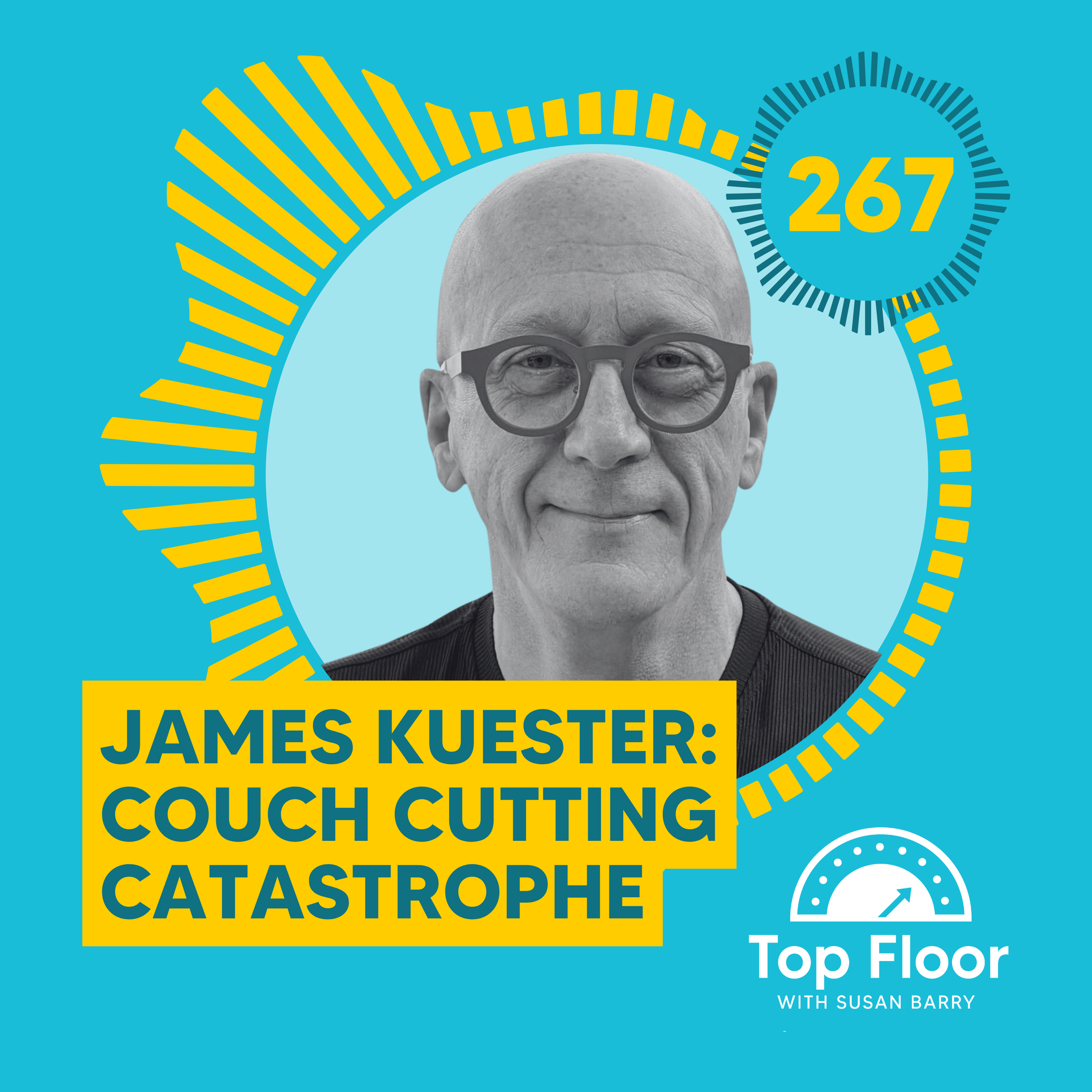
LISTEN TO THE EPISODE:
APPLE PODCASTS | SPOTIFY | TOPFLOOR.COM
[00:00:00] Susan Barry: This is Top Floor with Susan Barry, episode 267. You can find the show notes at topfloorpodcast.com/episode/267.
[00:00:14] Narrator: Welcome to Top Floor with Susan Barry. This weekly podcast ride up to the top floor features tangible tips and excellent stories from the experts and characters who elevate hospitality. And now, your host and elevator operator, Susan Barry.
[00:00:32] Susan Barry: Welcome to the show. James Kuester is a hotel designer with a background in industrial engineering and a lifelong love of hotels that started long before he ever picked up a floor plan. He is also the kind of traveler who can't check into a room without noticing exactly where the towel bar is, whether he wants to or not. These days, James works with independent and boutique hotel owners to make sure their properties live up to the promises their marketing makes. Today, we are going to talk about why hotel design is really a marketing strategy, but before we jump in, we need to answer the call button.
Call button rings…
The emergency call button is our hotline for hospitality professionals who have burning questions. If you would like to submit a question, you can call or text me at 850-404-9630. Today's question was submitted by Lionel, and Lionel asks, "The lines between hotel and residential design have blurred in recent years." Lionel states this as a fact, maybe you agree or disagree, we'll see. Which has the most influence over the other? So for example, does residential design influence hotels more, or do hotels influence homes more? I think this is a really interesting question. What do you think, James?
[00:02:08] James Kuester: I think that hotels, especially your independents, or I'll say even boutique brands within the big flags, the more boutique flags within the bigger brands, are influencing residential design because people are wanting to pull more of that spa-like getaway retreat kind of aspects that they're finding in the hotel guest rooms and baths into their own homes, especially in the primary suites.
[00:02:55] Susan Barry: Interesting. Do you think that the beige-ification of a lot of homes is the result of that, or is that something else entirely? Like, I feel like I see so many designs that are just beige, and I wanna see bright colors.
[00:03:15] James Kuester: And that's interesting because so many of the hotel properties have gone. Well, they were going beige, right? But now I'm starting to see more of them bring color back. I was just in a Hampton Inn that was undergoing renovations, and they were bringing more bright colors back. And Tru as a flag has got some really nice color pops against the more industrial background that they go for. I blame the beige-ification on RH, West Elm, and the big residential retailers that have nothing. I don't know if you've walked through any of the new RH showrooms that they've put around. There is not one drop of color anywhere.
[00:04:21] Susan Barry: Oh, that's so interesting. Restoration Hardware used to be so inspiring to me. Like, I remember maybe late '90s, early 2000s, thinking that was the coolest store that I had ever seen in my life.
[00:04:35] James Kuester: Yeah. I just think I was through their great big massive showroom in Indianapolis a few weeks ago. And I was bored out of my mind.
[00:04:45] Susan Barry: Oh, no. Well, we will bring color back. So tell me about your relationship with hotels. Where did your love of hotels begin?
[00:04:57] James Kuester: Well, that goes way back to when I was a little kid. My family traveled quite a bit, and I just fell in love with staying in hotels, especially the mid-century Holiday Inns with the courtyards and the swimming pool in the middle.
[00:05:21] Susan Barry: The Holiday Inns. I can smell it. As you're saying it, I can smell that chlorine.
[00:05:26] James Kuester: Even if we had to stay at some of the others, it was like, "Oh. Well, can't we stay at the Holiday Inn? I really wanna stay at the Holiday Inn."
[00:05:38] Susan Barry: I remember it well. What do you remember about from, I guess, like, from a sense memory or design perspective, what do you remember seeing or experiencing?
[00:05:53] James Kuester: Again, the pool was big, big, right? Yes. I think I learned to swim before I learned to walk. And my family went boating a lot. We grew up in Indianapolis, and we would go to Southern Indiana and to Kentucky to go boating, and there was one little town, and I can't remember exactly where it was, maybe near Dale Hollow or something. Anyway, there was a Holiday Inn that was nestled right there in the hills, and I can remember coming off the boat from the day, right, out boating and swimming and stuff all day long, but I insisted that Dad take me swimming in that pool before we got changed for dinner. Troy didn't want to.
[00:06:42] Susan Barry: Why do you think that is? I mean, please know I grew up in a beach town, and yet the hotel swimming pool was like the kryptonite, or I don't know. It was mesmerizing for me. Any time I was a little kid, I stayed at a hotel. I could swim in the Gulf of Mexico. Like, what was the deal?
[00:07:05] James Kuester: Well, I know for me, personally, because we also had a summer home in Michigan, and I always preferred swimming in pools over lakes and rivers 'cause there's nothing in the pool that wants to eat me, or bite my toes, and there's no icky mud.
[00:07:24] Susan Barry: Yeah, fair enough. All right. I guess it's the whole mud of it all. Well, how did you go from avoiding critters in a hotel pool to being a hotel designer? I know there was a sort of circuitous route that you took. So talk about that a little bit.
[00:07:43] James Kuester: So my bachelor's degree is in industrial engineering, and I became very intrigued or interested in, like, hotels and how they could be better designed for operational flow. And so my master's thesis focused, I used Hilton properties as my corporate, and then compared and contrasted a couple of Hilton properties that I visited with some independents to look at their guest room design, their back-of-house, like, housekeeping. How did they do the housekeeping? The ergonomics of the design of the housekeeping and F&B prep and in the guest room. Again, looking at the ergonomics and reach, and it was from a very technical standpoint that kind of launched my obsession with it, right? I can't stay in any property without immediately looking at the flow and the materials that are being used. Do they wear well? Do they create hazards?
[00:09:28] Susan Barry: Like, what's an example of something that would create a hazard, a material?
[00:09:34] James Kuester: I had a client that really, really, really wanted to put marble in the lobby right in front of the front door. And not just marble but a high-polish marble. You can't do that. Yes, it's beautiful, but you have now created a trip hazard or a slip hazard, right? And I don't think your insurance underwriter is going to appreciate the fact that everybody that walks in right off the street could slip and fall if they have wet shoes."
[00:10:14] Susan Barry: Yes. Well, and the solution for that, I mean, I've worked in plenty of hotels that have those types of lobby finishes, is that you have to roll out those, like, black rubber rugs. Do you know what I'm talking about? I can't remember, from probably Cisco or wherever, and cover up all the marble anyway, so might as well use something else, right?
[00:10:42] James Kuester: That's my point. I mean, why are you putting it down? Why are you spending the money to put it down and then have to counteract it by putting something really ugly, like one of these rugs that you mentioned with the rubber backing on it that your linen supply house comes in and changes regularly?
[00:11:02] Susan Barry: Right. Exactly. Aside from, I don't know, trip hazards or sort of material problems, what are some of the first things that you notice when you walk into a hotel room?
[00:11:15] James Kuester: The very first thing when I walk into a guest room is the smell. As soon as I open the door and it's opening, what is the smell? Good, bad, indifferent that's coming at me?
[00:11:32] Susan Barry: And would you rather it be proactively good or neutral?
[00:11:38] James Kuester: I want it to be good, but I follow that up with having asthma. I am incredibly sensitive to people's allergies and allergic reactions. So the more neutral it can be, especially since they say art is in the eye of the beholder or beauty is in the eye of the beholder. One person's scent preference could really turn somebody else off or cause an allergic reaction or an asthma attack. And I equate that with, like, cilantro, the people that think cilantro tastes like soap and those that think it smells really good.
[00:12:30] Susan Barry: Yeah. I remember when I was working for Starwood and signature scents became a big deal, probably, like, circa 2004. Maybe it was a big deal in other companies before then, but for Starwood that was, like, right around 2004. And I remember people saying, like, "Are we sure about this? Is this universal?" I don't recall there being a ton of complaints, but I bet there would be more now than there were then.
[00:13:03] James Kuester: I would think so because people become increasingly more sensitive to scents.
[00:13:08] Susan Barry: And more aware if they're having an allergic reaction, more sort of thoughtful about where it's coming from. I always like sort of food or spice-related scents inside of buildings because that feels like something that could actually happen there, like citrus versus something floral. You know what I mean?
[00:13:32] James Kuester: Or anything that comes off as chemical.
[00:13:35] Susan Barry: Not so good, right?
[00:13:38] James Kuester: I mean, especially in the guest room baths, you want it to just be clean, right? And you want it to smell clean. But I think the expression of that is for it to be totally odor-free.
[00:13:59] Susan Barry: And not smell like bleach is what you're saying? Although now we have to hearken back to our Holiday Inn days when that chlorine smell was, like, the smell of freedom and happiness on vacation. Well, let's talk a little bit about how a hotel's design and marketing are connected. Why do you think they're connected, and where do hotels tend to get that wrong?
[00:14:26] James Kuester: So many properties, especially your smaller properties, think their brand is their logo. And it isn't, right? The brand is what the guest feels when they walk through the door, as soon as they drive up to the property. That whole experience is the brand. And so from a marketing standpoint, the properties have got to make sure that their marketing is in line with that experience, and they're not marketing, say, on their websites through photos or something, an experience different than what actually occurs.
[00:15:19] Susan Barry: Interesting. Well, how do you balance that? How do you balance what works for guests with what works for staff and what works for brands? What are some of your rules of thumb for how to make that work?
[00:15:35] James Kuester: See, I don't think it's an either/or. Because I think through design, we need to be mindful, right, of both the maintenance of it and the efficiency for staff, as well as the experience the guest is having. And an example I can give of that is in, like, the plumbing fixtures we put in the guest bath. Even if you have a very traditional bathroom design, I like to put very modern plumbing fixtures in. One, it creates a very European feel and a nice juxtaposition against the traditional, but the removal of all the swooshes and crevices and stuff in more ornate faucets and stuff, those kinds of things are a nightmare for housekeeping to keep clean. And they collect dirt. So if you simplify that and you look at materials and choices that still reinforce that branding experience that the property's wanting to have, but make it simpler and more efficient to clean. Because again, you're going to diminish the guest experience if housekeeping can't keep the room clean.
[00:17:01] Susan Barry: Absolutely true. And then what happens when the pendulum swings and that ornate becomes what's on trend again? Do you just say, "Too bad, that's not part of our brand," or what happens?
[00:17:19] James Kuester: I think you have to be very intentional about still looking at what the product choices are that are being made. How hard is it to clean it? How is it going to collect lime deposits, or how much time is it gonna take to wipe that down and keep it clean? And another one is the flooring choices. Have you chosen a tile that, the first time a guest walks on it, it looks filthy dirty just because of the color and texture, or, no matter how hard housekeeping is doing at cleaning it, you know? And I really get into the weeds, right? It's when the wall meets the floor, how hard is that to mop and get all of the dirt out of the crevice where the wall meets the floor so that it's still efficient to clean, but it looks great for the guests.
[00:18:31] Susan Barry: That's so interesting. Okay, so I never maybe thought I would be having a full-on conversation about lime deposits with a designer. But I'm very curious about how do you test for that kind of stuff? Is the onus on sort of your vendor to say to you, "Hey, here's what it looks like at 60 days, six months, six years, etc., etc."? Or I don't know, is it product knowledge, like you know the materials well enough to know what will happen? How do you know about this, James?
[00:19:10] James Kuester: 40 years of doing it.
[00:19:12] Susan Barry: I mean, fair enough. That's a perfectly fair answer. I hear you.
[00:19:16] James Kuester: But I also like to independently test product. I mean, we don't have a test lab, right? To get things in, test them, go to shows and talk to the manufacturers, and then I'll get tiles and try different cleaning solutions on them to see if the color comes off. Get samples of various faucets and see how they clean. Last year at the International Kitchen and Bath Show, they were promoting these new shower handhelds that have massage brushes built in that are supposed to help detangle hair, right? So I ordered one, and I sent it to a property owner I know and asked her to put it in one of her guest rooms and test it. And I'm waiting for feedback now, and it's like, okay, did guests like this, or did guests think this was really creepy?
[00:20:39] Susan Barry: Well, I'm gonna go with creepy. Like, you're gonna have to have the bald man suit for that product. Do you know what I mean? There's no way, do I wanna put my he- oh, God, that just sounds so yuck to me. It's probably very nice, but it doesn't sound good.
[00:20:59] James Kuester: Well, and I can see it go both ways, right? As long as it is presented, we really keep this clean and sanitized, and it's fresh for every guest, right? It could be a really luxurious thing, right? To be running this hand spray through your hair and it's massaging your scalp all at the same time. Or it's like, "Oh, no." "I'm not going to touch that with a 10-foot pole."
[00:21:28] Susan Barry: Yes, exactly, and I feel like every time that, especially showers, get overly innovative, it becomes that much more difficult to figure out which levers to pull and what to do. Like, I can't think of an example of where this was, but I have stayed, and I'm sure you have, too, in millions of places where there's, like, an overhead shower head, but then maybe jets on the walls and, like, a handheld thing here, there, and everywhere, and it's so confusing to know. It's like those funny memes that people make about how to turn off the lights in the guest room. Like, no matter which button I press, some kinda light is still on. It's the same thing with the overwrought showers in my Plain Jane opinion.
[00:22:22] James Kuester: I would agree because while people idolize or idealize the luxury showers, I don't know how often they actually get used, right?
[00:22:38] Susan Barry: Same with the beautiful bathtubs, right?
[00:22:41] James Kuester: Right. Yeah. We're working on a property right now, and in the two big suites, the owner requested freestanding tubs with separate showers. It'll be very interesting to see once they open and start having guests, are those used, or is housekeeping dusting them?
[00:23:09] Susan Barry: I mean, they're gorgeous. Like, the look of it is absolutely breathtaking, but I think it's probably one of those things that, if I lived in that community, I would be on the lookout for the first renovation of that hotel, 'cause you could probably get a very underutilized beautiful tub for your own house. We like to make sure that our guests come away from every single episode of Top Floor with some very practical tips to try either in their businesses or in their day-to-day lives. I'm curious, how can an owner choose finishes and design elements that won't look dated in a few years? I'm sure that this is, like, the impossible question to answer, but do you have any tips for that?
[00:24:01] James Kuester: My recommendation is to design from where you are, right? Let your property's location, history, and community drive the design, and stay clear of what is trending. What you are seeing on Instagram is not where you should be basing your design. And make sure that the primary finishes, your flooring, your plumbing, and stuff are timeless and very high quality, and then go trendy with the things that are easy to change. Your artwork, your throw pillows, your pillow shams. Stuff that, like that. You can change the color. You can go traditional. You can go modern. Very easy if your underlying flooring and other finishes are timeless.
[00:25:05] Susan Barry: That is excellent advice. What are your guest room design pet peeves?
[00:25:11] James Kuester: First and foremost, placement of towel bars and towel hooks.
[00:25:16] Susan Barry: I had a feeling you were gonna say that. Say more. What's good and what's bad?
[00:25:22] James Kuester: They never seem to be within reach, so I'm there, and I'm washing my face, and I can't grab a towel. Or I'm finished showering, and I'm opening the door to the shower or sliding back the curtain, and there's not a towel bar within reach anyway.
[00:25:48] Susan Barry: Same with the hook. Like, if you have a used towel and you wanna hang it up, there's never a hook. Or not one that I can reach at 5'1".
[00:25:59] James Kuester: Right. So second is luggage racks. I mean, I was just in a newly renovated hotel room, right? And a brand-new luggage rack, and it had a back on it, and there was only one in the room, right? Which is bad. You should always have a minimum of two. But it had a back on it, right? So I couldn't lay my suitcase down on the luggage rack and open it.
[00:26:30] Susan Barry: Yes. Because if you have a hard-sided suitcase, like that's what I have, too, and I had to learn to not lay it sideways. You have to open it up like a book, or else it'll fall off.
[00:26:42] James Kuester: Well, and mine, the way it opens, because mine's hard-sided, the rack isn't deep, wasn't deep enough with that back on it. So I'm having it on the floor. And my third would be wastebasket placement. I don't know who decided hiding them behind the toilet was a great idea.
[00:27:07] Susan Barry: I mean, if there is one in the bathroom, it's my thing, because so often there will be only one, and it's in the bedroom part of the guest room. If you use makeup remover or dental floss or anything, you need a trash can there. It's crazy.
[00:27:29] James Kuester: Yeah, I think there should always be two trash cans. One in the bathroom and one close to wherever the coffee machine is. 'Cause when you're in the guest room, you're fixing your coffee, you've opened the little Keurig, now you gotta go walk into the bathroom to throw it away?
[00:27:53] Susan Barry: Right. There have to be two, 100% agree. For a property that's working with a limited budget, what do you think is the most impactful design choice for a guest? Where should the money go to make the biggest difference in how a guest experiences or perceives their stay?
[00:28:19] James Kuester: First, think about taking out before you put back in. So you can make a huge impact on the guest experience by subtracting, walking through and looking where there is too much clutter, something is outdated, whatever. Walk the property with the idea of what can be removed that's going to improve the guest experience, and then that costs you nothing. And second, staying overnight in the property. Living the property as a guest. You start seeing where those friction points are and where you can make changes to improve them.
[00:29:16] Susan Barry: We have reached the fortune-telling portion of our show, so now you have to predict the future, and then we will see if you got it right. What is a prediction you have about the future of hotel design and the guest experience?
[00:29:32] James Kuester: Design in hospitality is starting to be judged the same way food has been judged for years. And with Michelin launching their Key program and rating, properties and the very first point in their rating is the design of the property and how well it reflects the community in which the property resides.
[00:30:05] Susan Barry: I love it. That's very interesting, and I will tell you that we have enough boring hotels, so some more that are reflective of the local community would be welcome, in my opinion. What about if you could wave a magic wand and change one thing about the way guest rooms are designed, what would that be?
[00:30:27] James Kuester: Every room would be designed by someone who is truly committed to and understands the guest experience that brand is trying to communicate.
[00:30:42] Susan Barry: What do you think happens now?
[00:30:44] James Kuester: I think somebody gets a set of blueprints and goes through and designs things that they think look good on paper, but are not living the experience that they're designing, or they're not visualizing exactly how that guest is going to live in that space.
[00:31:10] Susan Barry: Okay, folks, before we tell James goodbye, we are going to head down to the loading dock where all of the FF&E gets delivered and all of the best stories get told.
Elevator voice announces, “Going down.
[00:31:28] Susan Barry: James, what is a story you would only tell on the loading dock?
[00:31:31] James Kuester: So years ago, we were doing this basement lounge for a client. Had custom-designed two sofas for this space, and the only way to get into the space was down these stairs. And measured everything, going down the stairs, measured all the dimensions on the sofa, blah, blah, blah. Failed to measure the height on the landing, because there was a landing in the stairs to the ceiling on the landing, right? Did the top of the stairs, bottom of the stairs, missed the landing. We had to have the sofas cut into two pieces. And have special hardware installed where they could be clamped back together and be one solid piece again after they got installed.
[00:32:33] Susan Barry: Oh, no. And okay, I'm assuming that this happened a minute ago, so did you tell the hotel, or did you just sort it out and never mention it?
[00:32:48] James Kuester: Oh, no, they were aware. The GM was right there as we were trying to bring them downstairs.
[00:32:57] Susan Barry: Holy moly. But I assume that once they were put back together, nobody could tell.
[00:33:04] James Kuester: You could not tell. We fixed the upholstery, we got the special clamps, yeah.
[00:33:10] Susan Barry: That is unbelievable, and very true to life for the hotel business. James Kuester, thank you so much for being here. I loved hearing your perspective about design, and I appreciate you riding to the top floor with us.
[00:33:28] James Kuester: Thank you.
[00:33:30] Susan Barry: Thank you so much for listening. You can find the show notes at topfloorpodcast.com/episode/267. Jonathan Albano is our editor, producer, and all-around genius. He even wrote and performed our theme song with vocals by Cameron Albano. You can subscribe to Top Floor on Apple Podcasts, Spotify, or wherever you like to listen, and your rating or review will go a long way in helping us give you more of what you like.
[00:34:05] Narrator: Thanks for listening to the Top Floor podcast at www.topfloorpodcast.com. Have a hospitality marketing question? Reach us at 850-404-9630 to be featured in a future episode.