
LISTEN TO THE EPISODE:
APPLE PODCASTS | SPOTIFY | TOPFLOOR.COM
[00:00:00] Susan Barry: This is Top Floor with Susan Barry, episode 266. You can find the show notes at topfloorpodcast.com/episode/266.
[00:00:13] Narrator: Welcome to Top Floor with Susan Barry. This weekly podcast ride up to the top floor features tangible tips and excellent stories from the experts and characters who elevate hospitality. And now, your host and elevator operator, Susan Barry.
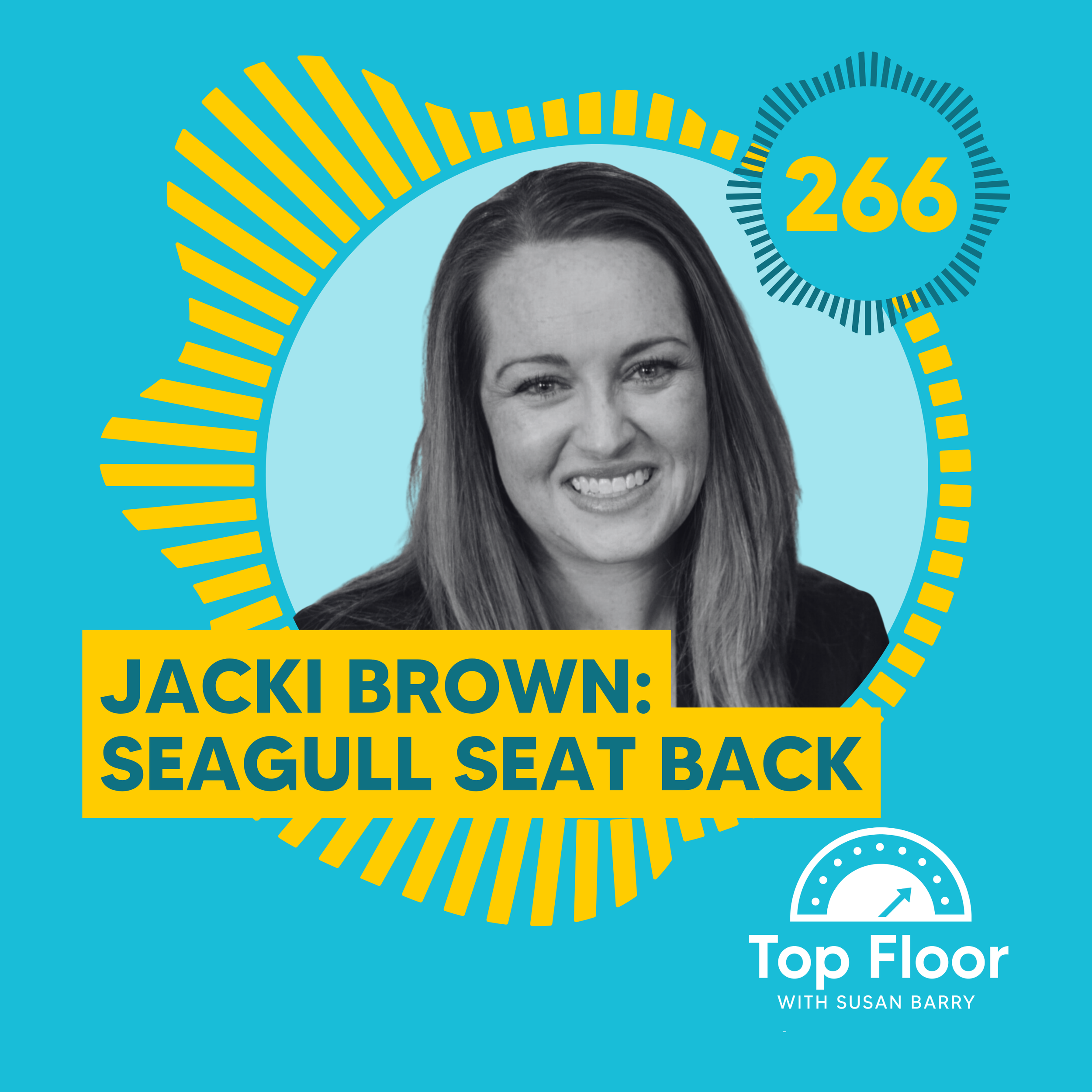
[00:00:32] Susan Barry: Welcome to the show. Before she ever touched hotel tech, Jackie Brown marketed protein bars, haircare, vacuums, and blenders. Then she landed at Amadeus Hospitality, where she ended up steering marketing for 30 products, four kinds of buyers, and for reasons no one could quite explain, rental cars. Now Jackie runs her own consultancy, helping hotel tech companies figure out what they're actually trying to say, and she accidentally founded the Women Travel Freelancer Network along the way. Today, we are going to talk about what hospitality marketing can learn from the world outside of hospitality, but before we jump in, we need to answer the call button.
Call button rings…
The emergency call button is our hotline for hospitality professionals who have burning questions. If you would like to submit a question, you can call or text me at 850-404-9630. Today's question was submitted by Leon. Leon asks, "Marketing seems to cover..." This is such a good question. "Marketing seems to cover everything from creative content to very technical data analysis. Do you have to know all of that to be a marketer these days?" I certainly have an opinion about this, but I'm curious what yours is. Take it away, Jackie.
[00:02:03] Jacki Brown: Well, thanks so much for having me, Susan. Excited to talk marketing with you and nerd out a little bit. Leon has a great question, and I had a bit of a heated conversation with a founder once, because they were looking to hire a marketer that did all of those things. And I told him that's like a unicorn. And the way I explained it, because he was a developer, is that it's just like being a developer these days. Technically, there are all different types of code, right, that you have to learn. You probably can't do all of it. Maybe you're good at back-end coding or front-end coding. Marketing's exactly the same way, and so there are generalists. There are people who are good at multiple things, but nobody is good at all of it. You just can't possibly be.
[00:02:59] Susan Barry: I think people can be good enough, but the problem is that on that entire spectrum some of the stuff is so boring for me, or so, like, impossible for somebody else. Like, I definitely fall on the more creative end of that spectrum. Can I do SEO and email marketing, data analytics, and all that stuff? Sure, I can, but I'm not going to because it's boring.
[00:03:31] Jacki Brown: And I'm not an expert in it. I'm going to outsource the expertise. Yes, and so if you only have a little bit of money to hire a marketer, then, yes, you can probably get someone who can dabble across, but you're not going to get the deep expertise.
[00:03:47] Susan Barry: Yes, 100% true. Well, what was your first marketing job like? Did you have to dabble across all of that whole spectrum, or what were you doing?
[00:03:57] Jacki Brown: It was very unglamorous. I worked for a wholesale heating, ventilation, and air conditioning company because it was 2008.
[00:04:10] Susan Barry: Ah, got it. So no jobs to be had.
[00:04:14] Jacki Brown: So no jobs to be had. I was lucky I got a job. And this is my first full-time role. I had actually had incredible internships that I could talk about, too, but I learned how to do a fax blast. Have you ever done a fax blast, Susan? I was harassed by other team members in the organization 'cause I didn't know how to use the fax machine. And I said, "That's because people email today." So as unglamorous as it was, I had one of the best managers that I have ever had to date, and she was not from that industry. She had decided to take a role closer to where she was living. She had done all far more glamorous things, and she really completely empowered me to do everything that I wanted to do. So they let me plan enormous events for all of their clients, so huge golf tournaments. It was their big anniversary, I wanna say 250th or something anniversary. It was, like, a multifamily company. And so I got to create all these amazing events. I got to redesign their website. It was a really good first job because I had a lot of leeway to try on all of those different hats.
[00:05:33] Susan Barry: That's really cool. So 2008 is when I was just barely, still last hotel job, last hotel opening, and I did a Facebook campaign and a Twitter campaign for that opening, and I think it had been, like, absolutely unheard of. Were you guys doing social at that point, or was it still too soon?
[00:06:00] Jacki Brown: I mean, we were doing fax blasts at that company. So no, they were certainly not doing social media. But then, fast-forward two years, so then you're looking at 2010, 2011, I ended up becoming the social media manager at a company called UPromise, which was cash back on college on everyday spending. And so they basically said, "Hey, is anyone interested in learning this social media stuff and helping us figure it out?" And I raised my hand. Like, absolutely. I have no idea how to create a strategy or do any of these things, but yes, I will 100% figure it out. And of course, they just gave the keys to all of it to the young people who knew what Facebook was.
[00:06:49] Susan Barry: So. That's so funny. What brought you into hospitality, then?
[00:06:54] Jacki Brown: Really a complete accident. So I moved to Portsmouth, New Hampshire, 'cause it is a lot cheaper to buy houses here than it is in the Boston area, which is where I was living. And I applied for a job and found this company, Amadeus Hospitality, that had a small marketing team and needed support, and I had no idea that they were the largest travel tech provider globally. I was very surprised going forward, and it was a wild ride. So I was there for six and a half years, and as you said, I was a whole lot of products, lots of acquisition, lots of change, but I loved that 'cause it was constant learning, doing new things, new challenges. And I led the product marketing strategy, and it was a $170 million business. Like no joke.
[00:07:50] Susan Barry: Well, besides finding out that they were the biggest, what surprised you? I think what I'm trying to ask here is what surprised you about hospitality versus that specific company? You know what I mean?
[00:08:02] Jacki Brown: The biggest surprise for me was that management companies exist. I had no idea.
[00:08:07] Susan Barry: Oh, okay. That's, yeah. That is always surprising to people.
[00:08:12] Jacki Brown: Right. And so that was, now, like, when I teach people about the industry or when I hire people, or I meet new tech companies, and I'm like, "Are you aware of management companies?" Because people just are not, and it's a huge factor in the industry. In the US in particular. Also, there's such warmth in this industry. I've worked in so many other industries, and the warmth of the people is what has kept me here, just the genuine warmth and enjoyment of being here.
[00:08:48] Susan Barry: It's funny. As an adult, I've only ever worked in hospitality, and when I see on TV shows, like, probably more about law- doctors or lawyers or whatever, and they yell at each other at work, I'm like, "That could no more happen in a hotel than someone sprout wings and fly to the 11th floor." It's just so undone. It seems fake to me, but I think it really does happen in other industries, people are hospitable in hospitality.
[00:09:20] Jacki Brown: Oh, yeah. I've had people really yell.
[00:09:23] Susan Barry: Yeah. I mean, I've had a couple of situations like that, but they're rare enough that they stand out versus, sort of being, like, par for the course. Like, "Oh, yeah, we got in a screamy match and blah, blah, blah." I cannot even imagine what that would be like. Well, what made you decide, then, to leave Amadeus, to leave the corporate world, and go out on your own?
[00:09:45] Jacki Brown: So my whole career, I've bounced back and forth between the large companies and smaller startups, and agency versus in-house. I think I get, like, too much of one thing, I need to go back to the other side. And so I get frustrated with, in corporate, how much things are slow to move and slow to make decisions, but then in startups, it is, like, all-encompassing. It's your whole life, right? And so I wanted to still help smaller companies make a real impact, and I was trying to figure out the best way to do that, have that speed and excitement and impact, but without the massive amount of hours. And so, bold move, I just said, "Let's try this and see what happens."
[00:10:31] Susan Barry: How long have you been in business?
[00:10:33] Jacki Brown: Two and a half years.
[00:10:34] Susan Barry: When you look at hospitality marketing with sort of fresh eyes from other industries, since you've had so much experience in consumer products and all that stuff, what jumps out at you first? Like, I don't know, was there something, or does there remain to be something that you're like, "Why do they do this?"
[00:10:55] Jacki Brown: The general lack of support for marketing, staffing, budgets. It's so starkly apparent. And I'll give you a couple of examples. So, two different teams I worked on. I mentioned Upromise earlier, so say that was 2010. We had a team of over 20 people, and we were fighting each other over who could send out the email that day because we were all fighting over the same audience. Like, we used to have a weekly meeting where everyone had to get in a room to fight for their day for their email. When I worked at SharkNinja, the Shark vacuums, Ninja blenders.
[00:11:34] Susan Barry: The greatest products. I love Ninja.
[00:11:37] Jacki Brown: But in 2016, they had four different teams. So they had the brand team, the creative team, the product marketing team, the digital team. So I was on the digital team. It must have been over 60 people. Just in marketing. And the number of times that I hear from hoteliers that it's one marketer for a management company of seven properties. It's so sad.
[00:12:05] Susan Barry: It's crazy. Well, and if you look at, sort of the biggest disruption in the hotel business ever was the advent of online travel agencies, Booking.com, Expedia, whatever. Their entire business model is marketing. Like, that's what they do. They are a marketing company. So the idea that hotels suffer because they don't get direct bookings and have to pay through them, and yet invest nothing in marketing literally, it's so mind-boggling to me. At the same time, that's what owners are paying the brands for. So of course they're not gonna also pay to market their individual hotel because they've bought a flag, a franchise. They pay a percentage of their revenues as a marketing fee, so they, in theory, shouldn't have to do marketing, but of course we know that they do need to do marketing.
[00:13:03] Jacki Brown: Right. Well, and that applies to the branded properties, right? So I am up in New England, and I participate in some of the associations and events and things up here, and there's a lot of unbranded properties. A lot of inns and resorts in Maine in particular, right? And they don't have it. And I looked up data, 'cause I was like, "What is the latest data point?" So my LLM search tells me that the hotel industry is spending, like, 2.5% of room revenue, while your e-commerce brands are spending 7 to 12% of revenue on marketing.
[00:13:40] Susan Barry: That's a stark difference. And I would bet you, I don't have recent numbers, so don't quote me on this, but I know that 70% of hotels in the United States are branded. The brands charge, I think, three or more percent for marketing fee. So what's going on? What's that delta between the 2.5 and the 3?
[00:14:05] Jacki Brown: But then that translates. So this lack of investment, the lack of staffing, the next thing that's super glaring to me is the entire booking process. So when I was at SharkNinja, I was running their e-commerce. So I was brought on to figure out how to create an e-commerce platform, and that was the thing I did with my manager at the time. Now, we built it all from scratch, which is wild, 'cause there are e-commerce platforms you can just buy that do all of these things. But we did it. And the idea is that a booking process opens in a different window, and you have to put in information that you've already put in, and that so many properties are still using this type of technology, where you can't even see what's going on in the booking process to be able to optimize, like, a step at a time, or you're not upselling properly. It's so frustrating to me.
[00:14:58] Susan Barry: Oh my God. We could legitimately make an entire episode of this show about upselling because I think maybe it was you and I that were talking about this on LinkedIn, the idea that if there is not a way to charge for something, they just won't do it. So there are all of these top-line revenue opportunities that I think exist. I mean, I could probably make a list of 25 right now, but they're not proven, not set up in the PMS to be charged for, etc., etc., so there's no way. Oh, Lord have mercy. That's insane. What about stuff like research?
[00:15:36] Jacki Brown: So SharkNinja, and I'm sure they still do today, does the most incredible customer research I've ever seen. But all of the companies I worked for were a lot different, both in-house and agency side. I got to see all these different CPG consumer goods companies. And for SharkNinja, for instance, all the employees were part of the testers. So you would go down. You'd sign up and go down during your day and give them feedback on specific questions for whichever products. You would bring them home, try them out for a few days, and give them feedback. And then they started, when they moved to their new office location, they have people coming in all the time who are just regular consumers that come in and try out the products and give feedback. It was incredible. I've never seen anything like it.
[00:16:25] Susan Barry: That's why they're so good, I bet.
[00:16:26] Jacki Brown: Right. 'Cause they're getting lots of real feedback. But even when I worked for Upromise, they did annual focus groups in different cities to get a lot of people together, both customers and non-customers, and say, very clearly, like, "What's going on? What are your pain points?" And I'm not seeing as much of that in this industry.
[00:16:51] Susan Barry: How would you do a focus group in hospitality tech?
[00:16:54] Jacki Brown: In hospitality tech?
[00:16:56] Susan Barry: Yeah. Who would you invite?
[00:16:57] Jacki Brown: Yeah. Oh, I could probably name people I would invite. But it's all about getting a mix too, of your different audiences, users, non-users, making sure you actually get the profile of the people that you're trying to talk to and sell to. And I think that we don't do that nearly enough across the whole industry.
[00:17:21] Susan Barry: It's interesting. I think there's also, you may feel differently about this, but it seems to me that there is a profusion of hospitality tech products being built by people who've never worked in hotels and don't know. So it's a little bit trickier of ICP or, like, a target audience to identify because you think you know and you don't know. Does that make sense?
[00:17:52] Jacki Brown: Yes. I think that's true, and I wouldn't say that it's a majority. I don't know the numbers, right? But yeah, it is a thing, and especially with the popularity of AI, I'm seeing more of it. I'll just get inbound messages on LinkedIn from founders who've created a new AI chatbot, and I'm like, "Yeah, there's like a zillion of these already." "You're not doing anything special," and they just don't even realize they haven't done the due diligence to that point. So that's why people need marketers and product marketers and commercial people to help them figure out all of that.
[00:18:33] Susan Barry: Yes, it's absolutely true. In the tech world, product marketing is its own discipline, but I don't know that in hospitality people are familiar with that phrase or at least that way of describing what it is. So talk about what that is and how it compares to maybe what hotel people would call positioning or even brand strategy.
[00:18:59] Jacki Brown: So it's funny, because it depends on who you ask. So what I learned going, becoming a consultant, going on my own, I started spending more time in the product marketing community. I didn't realize that product marketing as a concentration is only about 12 years old. So there's a lot of confusion about what it is, even amongst ourselves, because it actually is different based on the organization. The short answer, it's essentially branding. It's branding for a specific product, right? So if a company has multiple products, you need to do that for each one because you might be selling to different audiences based on the product. It's really complex, because it could include everything from product strategy and pricing to the research. It almost always does include the positioning and messaging, though. So if you were to say, does it relate to positioning, 100%. Positioning is almost always part of product marketing, and it's the part I love the most that I super geek out about. It's this puzzle, right? How do you really understand the buyer and what their challenges is, and, are, and how you can then communicate with them in a way that's going to get them excited to talk to you.
[00:20:17] Susan Barry: What are some things that hospitality does a better job of in marketing that the rest of the world, like other industries, should borrow?
[00:20:27] Jacki Brown: So going back to this niceness, this kindness, there's also the collaboration. So something that I have thought is so incredible that I've not seen anywhere else is, for instance, a destination. All of the properties in a destination will come together and work together to bring people to the destination. I have worked for companies that have literally referred to the competition as the enemy. And everything was about taking down the enemy. And I know this is not everywhere, but I've seen it, and I think that's so incredible. So if you were talking about the destination or creating a new category, at some point you need to educate people that the thing exists first before people will buy anything.
[00:21:20] Susan Barry: That's such a good point. Like, glamping is a great example of that, right? Like, glamping started to exist. All of the glamping companies, as it were, have to agree on what that means before consumers are ever gonna buy it. Is that kinda what you're getting at? Okay. Interesting. We like to make sure that our listeners come away from every single episode of Top Floor with some really practical and specific things to try either in their businesses or in their day-to-day lives. When a company comes to you saying, like, it needs a new website, what's the first thing you wanna know?
[00:22:00] Jacki Brown: Why?
[00:22:01] Susan Barry: I love that answer. Say more.
[00:22:04] Jacki Brown: What is it not doing for you today? Why do you want this? What is going on? Because I will tell you, I've done over 30 websites now, and the majority of the time it's not that the functionality is the problem. It's almost never that the functionality is the problem. It's usually a positioning problem, and that's actually how I learned branding and positioning because I was working for an agency that did mostly website redesigns and custom build-outs. And the more we talked to various companies, the more they really needed the storytelling, and I learned how to extract that. I got to work with some really, really smart people who had done a lot of branding work, and I learned by just doing it. And it is staggering how much of a difference that makes, especially on your homepage.
[00:23:01] Susan Barry: It's so interesting. I'm thinking about website projects that I've done over the years, and one of the things that people say the most often that I think is so strange, or it's not strange. I get it, but I wanna get your take. The reason they need a new website is that it's, quote, dated, but like, that's not a thing. I mean, visual branding is, if it's tied to time, it's not a visual brand. In other words, like, if your website, if it needs to look of the moment, that's not a brand. That's advertising, right?
[00:23:46] Jacki Brown: So I have a couple of thoughts on that. One, from a user experience perspective, UX evolves over time. Yes. And so there are some things that start to appear dated because the UX isn't flowing in the same way. So Webflow, for instance, now everything has this really cool kind of scrollability, and things move when you scroll down, right, on their templates. And so if you don't have that, it feels a little bit less cool and of the moment. And visually, there are visual trends. So you're seeing right now a lot of logos, even all the big companies that we're very familiar with on CPG brands, are all going to, like, very flat logos. They don't have as much drop shadow or curve or anything to them, right? The fonts are changing, and gradients are really hot right now. So it might be the same colors, but a slight, slight tweak and evolution to it. And I do think, yeah, there are some things that actually do look dated. But it should not be something you have to do on an annual basis.
[00:25:01] Susan Barry: Well, that's the thing. Okay, so, like, if you're scrolling, for example, I can tell you visual branding or design trends right now, people are using serif fonts again instead of sans serif. People are justifying text and center-justifying instead of left or to the right, even when it creates these huge and weird gaps between words. Like, that's just a stylistic choice that enough people are making that it's a trend, right? So say I'm like, "Okay, well, here are the most modern, new things. Let's do this." Next year it's gonna look ridiculous because it will be out of style. It's too quick. So your visual brand has to have some relationship to your strategy and some, like, sort of leg to stand on, as it were, because otherwise everything's dated all the time and everything's modern all the time. Those words mean nothing. You know what I mean? Sorry. Welcome to me interviewing myself.
[00:26:12] Jacki Brown: And that's the challenge when you talk about marketing. It totally makes sense though, and I think we have to be really mindful of what do we stand for as an organization, and then how does that come across, and how do we represent that visually.
[00:26:28] Susan Barry: 100%. Well, what is a habit from outside hospitality that a hotel marketing team could start using next week?
[00:26:38] Jacki Brown: Getting out on a daily basis and walking the floor and talking to your guests. I would love the idea, and I actually really wanna do it myself, is just walk around, choose a property, and ask people why they chose that property, what is their favorite part about it. Because as a hotel marketer, that's your content for the next day right there. If you hear a couple of people say they chose it because they really liked XYZ thing, or, "Wow, this was a real surprise. I loved this." That's your content. Post it.
[00:27:14] Susan Barry: Sold. Yes, totally. That is an excellent idea. All right, this is kind of a big subject change, but you and I offline have been talking about this a lot lately, so I felt like we needed to bring this conversation to the show. This is about ground rules for AI. So I'm curious, what are your ground rules for using AI in your work without, like, I don't know, embarrassing yourself or annoying your colleagues. Like, what do you do? Have you set up a set of rules of thumb yet that you're trying to follow?
[00:27:54] Jacki Brown: So the example that I found, and just on LinkedIn, Clay, so this B2B company, but they have ground rules, and I think they're amazing, and everybody should use something like this. It's kind of sad that I feel like organizations need to have etiquette rules, but I think we're at a point where we do.
[00:28:15] Susan Barry: Yeah. Well, I don't think it's sad. I mean, it's also new that people don't know what they don't know, right?
[00:28:23] Jacki Brown: Yeah, and some things I feel like should be common courtesy and sense.
[00:28:25] Susan Barry: Yeah, touché. You're like, except for the whole common sense part.
[00:28:31] Jacki Brown: So read everything. Like, stand by every word that is in there, because the number of errors that I see, right? Like, we all see the errors, so it makes them still, even when it's super smart. Longer is not better. So we talked about how we were, like, early to social media. The number of tweets that I wrote in 140 characters and the amount of time that I trained myself to write in the shortest way possible, I cannot tell you how much it pains me when someone sends me a 20-page document.
[00:29:08] Susan Barry: Oh my God. I haven't been on Twitter in fully 15 years, and I still credit it with me being a better writer for that very reason.
[00:29:21] Jacki Brown: Yeah. Yeah. It took a lot of work. I mean, I'm never gonna be able to write that novel that I always wanted to write because I can't write anything lengthy anymore. It's all concise. Exactly.
[00:29:31] Susan Barry: But it's clear. But you're probably communicating something, right?
[00:29:35] Jacki Brown: Yeah. So I feel like those are my big, big ones. But I will say that I finally just started scheduling automations in Claude, and it's pretty cool, just the reminders it's sending me and the prompts. So I'm even dabbling more than I had been in the last couple of weeks.
[00:29:54] Susan Barry: I just got Instinct a couple of days ago, so I've been like, testing Instinct and trying to figure out sort of like a personal assistant. So you text instead of having a desktop app or whatever. And, so now it's so silly, but now I have ChatGPT, Claude, and Instinct, and they are all doing different things for me. So I probably need to work on toning that down, streamlining it just a little bit. But I like the rules that you talked about. You know, something that I'm doing that maybe sounds holier-than-thou, and I don't mean it to, is when I'm prompting for a written outcome. I'm deliberately not asking for everything that I want or exactly what I want because it forces me to go through that process of reading every single word, and I'm not tempted to just cut and paste. Because you get busy, and all of a sudden you're like, "Ugh, I don't have time for this. Cut, paste, let's go." I sort of am building in a little, I guess, wabi-sabi is the way that you say that, like a little deliberate mistake so that I'm forced to get in there and fix it. We'll see how long that lasts. Well, we have reached the fortune-telling portion of our program. So now you have to tell the future, and we're gonna see if you got it right. What is a prediction, Jackie, that you have about the future of hospitality marketing?
[00:31:35] Jacki Brown: It's pretty impossible to predict, isn't it?
[00:31:38] Susan Barry: I mean, that's why it's such a broad question, 'cause you can't get it wrong. I'm certain.
[00:31:42] Jacki Brown: Yeah. None of us thought we'd be doing social media. It didn't exist when we went to college. And then we made a profession out of it.
[00:31:52] Susan Barry: Jackie, email didn't exist when I went to college.
[00:31:59] Jacki Brown: And look at this. We're so enjoying our emails. It'll keep evolving and adapting, right? And I think you can't have a career in marketing if you're not okay with that. You have to be willing to constantly change and evolve and try new things. But I will bet that knowing your audience and creating differentiated positioning will always matter.
[00:32:29] Susan Barry: Oh, that's good. That's a really good point. What if you could wave a magic wand and change one thing about how hospitality companies tell their stories? What would that be?
[00:32:42] Jacki Brown: Did you ever read Building a StoryBrand?
[00:32:45] Susan Barry: I did not, but I know a little bit about it. For the listener, explain what that is.
[00:32:52] Jacki Brown: So I finally listened to it after I had a couple of colleagues tell me for, I'm not joking, like two or three years to listen to it.
[00:32:58] Susan Barry: Oh my God, I know. People talk about it like crazy. Yeah. I mean, I know it's valuable. I think I've heard enough commentary on it that I feel like I've read it. You know what I mean?
[00:33:06] Jacki Brown: And there are short versions. I listened to the audiobook. It's not very long. But the idea is that every story has a hero and a villain. And you, your company, you are not the hero. Your guest is the hero. The customer is the hero. And everything you do should be about what they're trying to overcome. What are they trying to achieve? And you are the guide. How do you guide them to achieve that? And creating your entire narrative should then create everything else you do should ladder up to your overarching narrative. And it's not just the beautiful rooms. It's not just the pretty food, right? But, like, what do you want them to feel after it? That is what we need to lead with. And in no way is this easy.
[00:34:06] Susan Barry: But I mean, even just remembering hotels that you are not the hero of the story is a huge step because I think it's very easy to forget that. And it's easy for me. I think I'm the hero of everything.
[00:34:22] Jacki Brown: You're the hero of my story.
[00:34:26] Susan Barry: Oh, thank you. Thank you. Oh. Okay, folks, before we tell Jackie goodbye, we are going to head down to the loading dock where all of the best stories get told.
Elevator voice announces, “Going down.
[00:34:39] Susan Barry: Jackie, what is a story you would only tell me on The Loading Dock?
[00:34:44] Jacki Brown: This one goes way back to when I was something like 10 years old, and my family was taking a road trip to the Poconos. And we're on the car ride, and all of a sudden, I'm sitting behind my dad, and his seat collapses into my lap. Okay. And so, we're only, like, maybe an hour into this drive.
[00:35:08] Susan Barry: Wait, was he driving, or was he the passenger?
[00:35:10] Jacki Brown: He was driving. Oh, he was driving. And his seat just went straight back. And so we pulled over. I don't know, he, like, jerry-rigged it somehow to try and get it back together. But he was kinda holding it as he was driving, and I think it was probably, like, a three or four-hour drive. Another hour in, a seagull hits, we're on a highway, by the way. We're inland. A seagull hits the windshield, completely smashes the windshield, and of course, with that, his seat falls back again. We're in the middle of a highway in Pennsylvania or New Jersey. Very, very strange, and I just always think it's the most strange way to kick off a holiday. So we ended up with my dad driving the two hours back home with a very smashed windshield. I do not recommend it, and he’s like holding onto his seat. And we just changed cars and then continued on our trip.
[00:36:20] Susan Barry: Oh, no. Well, that's nice that they were able to take it in stride. I've never been to the Poconos. Please tell me a little bit about what that was like. All I know about the Poconos is remembering seeing the brochures for the hotels that were in Starwood that were in the Poconos that had the champagne glass bathtubs. Did you guys have that?
[00:36:46] Jacki Brown: No. We were not that fancy. No, we did a lot of, like, going and staying in more rustic lakes because I grew up really close to the ocean, so we got the beach all the time, so it was more like, what's quiet, very quiet lake life? I grew up on Long Island, and it is super packed with people, so it was just, how do we go somewhere quiet, where you need to drive a half an hour to get the groceries and have some fishing and camping-esque feel while staying actually in a lodge of some sort.
[00:37:19] Susan Barry: Very cool. Well, Jackie Brown, thank you so much for being here and for all of your great tips for marketers. I definitely learned a lot and have a lot more that I'm thinking about, and I really appreciate you riding with us to the top floor.
[00:37:37] Jacki Brown: Thank you so much for having me.
[00:37:40] Susan Barry: Thank you so much for listening. Thank you for listening. You can find the show notes at topfloorpodcast.com/episode/266. Jonathan Albano is our editor, producer, and all-around genius. He even wrote and performed our theme song with vocals by Cameron Albano. You can subscribe to Top Floor on Apple Podcasts, Spotify, or wherever you like to listen, and your rating or review will go a long way in helping us give you more of what you like.
[00:38:15] Narrator: Thanks for listening to the Top Floor podcast at www.topfloorpodcast.com. Have a hospitality marketing question? Reach us at 850-404-9630 to be featured in a future episode.