
Transcript: Episode 262: Island-Hopping Gone Wrong
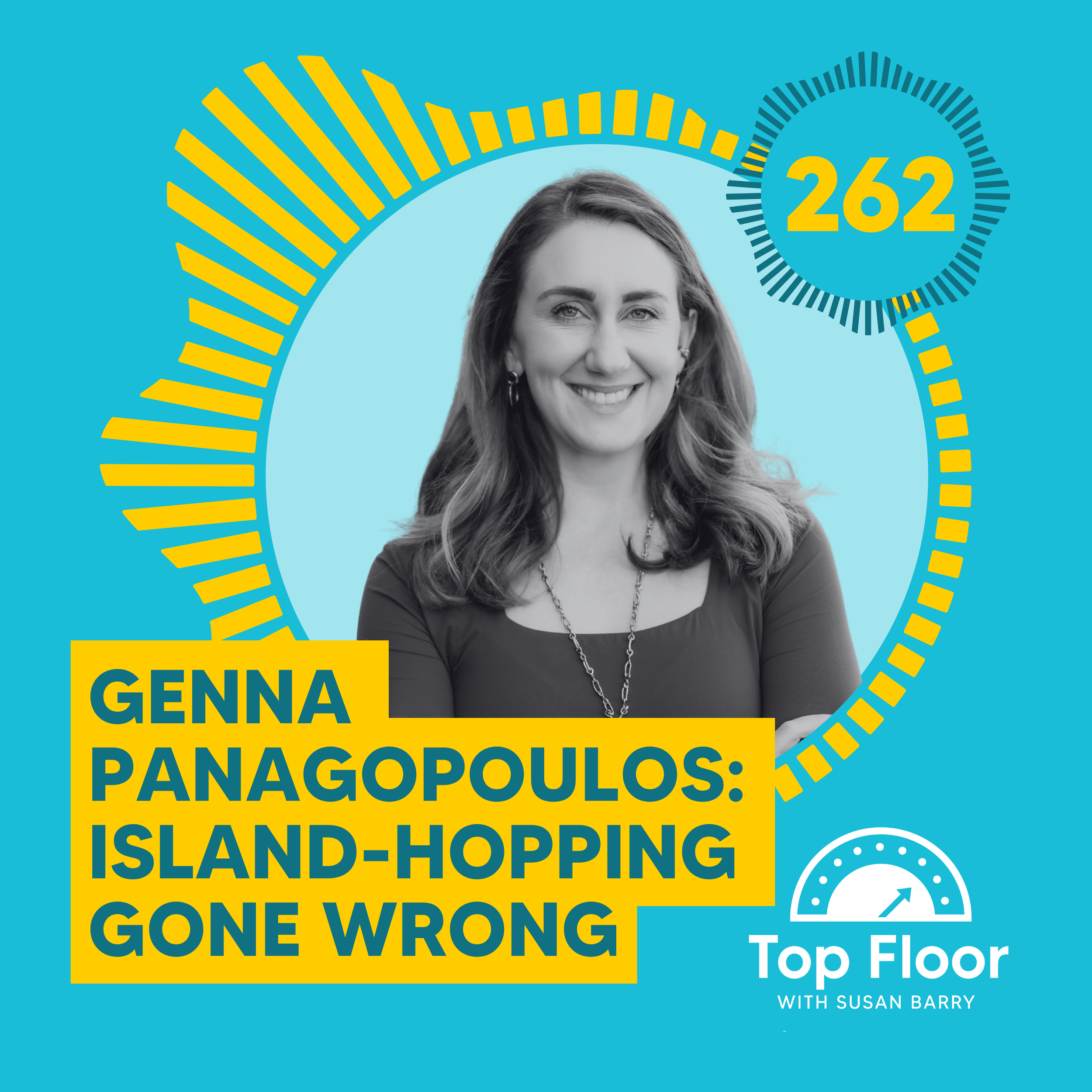
LISTEN TO THE EPISODE:
APPLE PODCASTS | SPOTIFY | TOPFLOOR.COM
[00:00:00] Susan Barry: This is Top Floor, episode 262. You can find the show notes at topfloorpodcast.com/episode/262.
[00:00:13] Narrator: Welcome to Top Floor with Susan Barry. This weekly podcast ride up to the top floor features tangible tips and excellent stories from the experts and characters who elevate hospitality. And now, your host and elevator operator, Susan Barry.
[00:00:32] Susan Barry: Welcome to the show. Jenna Panagopoulos grew up in her family's restaurant and spent one summer working for her father before deciding a restaurant career was a lifestyle, not a job for her. She studied hospitality at Michigan State with an eye toward hotel development, cutting her teeth on feasibility work at Davidson Hotels before moving into development at IHG. Along the way, she took a somewhat unusual detour onto IHG's brand team, working on luxury and lifestyle brand strategy. Jenna leads US and Canada development for Minor Hotels, the Bangkok-based owner and operator of more than 650 hotels across a dozen brands, including the ultra-luxury wellness brand Anantara and the newly launched Wolseley. As the only member of her team based in North America, she is building out Minor's presence here from scratch. Today, we are going to talk about strategic luxury hotel development. But before we jump in, we need to answer the call button.
Call button rings…
The emergency call button is our hotline for hospitality professionals who have burning questions. If you would like to submit a question, you can call or text me at 850-404-9630. Today's question was submitted by Mike. This is a perfect question for you. What do development teams get wrong about marketing? Having sort of been on both sides of this, I'm so interested in your answer. What do you think development or, like, business development folks miss about marketing in the hotel world?
[00:02:26] Genna Panagopoulos: That's such a good one for me. It's the lack of funds and the focus on it. Honestly, I don't think that it always crosses their mind. And in this role and other roles, we've always, like, thought about how much money we need to place, not just the owner, but us as a brand, if we're launching a new brand into a new market. So, it's typically not that they forgot to do it, but they just didn't put enough money towards that.
[00:02:55] Susan Barry: That's interesting. And what does that money get spent on? Are you talking about, like, sort of conference attendance or straight-up advertising? Kind of, what's the range of things that get spent?
[00:03:07] Genna Panagopoulos: It's usually a combination right of a specific hotel going to a conference and doing the whole dog-and-pony show about their hotel or the brand. But then it's also straight-up advertising, either in the market, usually not an airport, but it could be an airport, markets that are traveling to that market, okay, which sometimes could get missed as well.
[00:03:30] Susan Barry: Oh, yeah, that makes a lot of sense.
[00:03:32] Genna Panagopoulos: Yeah, I mean, case in point, we have no Anantaras in the US yet, and when I was joining Minor Hotels, I asked, "Well, we need to build out a fund for it," and they said, "We actually already spent money on Anantara marketing it here in the US," because US travelers are the number one demographic of the brand. And that blew my mind. And I was like, "Oh, you beat me to it."
[00:03:55] Susan Barry: Amazing. Well, you started your career not in marketing, but in feasibility at Davidson and then IHG before eventually leading that brand team and working on luxury and lifestyle strategy. How different were those worlds? How different was the brand strategy piece from the real estate and finance side that you sort of came up in in your career?
[00:04:22] Genna Panagopoulos: Yeah. Very, very different. I like to say they use two different parts of your brain. So feasibility was very analytical, desktop, numbers. We used to joke we eat numbers for breakfast. Excel-heavy. I was an Excel master. And then switching to development, that was more of a sales, more salesy, if you will. So it was taking all the feasibility, investment, finance, and real estate skills and being able to package it into a very attractive sales pitch. And then going into brand, it was like, okay, forget about the numbers. Let's talk about the big picture. Where do we wanna go? Very creative. Dream big. We will, through the process, pull you back down to ground. But like, how can we be really different and unique? And so it was just a totally different way of thinking. And it took a while for me to really push myself to be out of the box and think to shed the heaviness and the financial burden that I was always like, "We need to pay for that." And they would be like, "No, no, no, just dream, and we'll figure out the finances as we go." One small brand standard change could be incredibly significant. And as a development person, I'm always advocating, "We might need to soften it here. Please, let's waive this here." But thinking about it on the opposite end, if we're driving a brand and changing the direction and the train that it's on for the next five or eight years, evolving the brand standards and then rolling it out to hundreds of hotels across the world is no small feat. Just thinking through the logistics of having to do that, in addition to advocating to the owners on why we wanna do that and how much it's gonna cost, was really, really fascinating.
[00:06:14] Susan Barry: What ultimately drew you to Minor? That company hasn't really focused on the US and Canada before you. Did you go knocking on their door and say, "Hey, it's time for you to expand?"
[00:06:28] Genna Panagopoulos: No, they came knocking on my door. Everybody that I asked that was in that region, meaning Europe and Asia, had heard of them and said they are serious players and they have real ambitions. I was super attracted to the ability to be able to help start something from scratch here. I had a lot of skills that they were looking for somebody to have, which was great, but on the flip side, they basically were offering me a very entrepreneurial role that's essentially like a startup, right? Like, I have my relatives around the globe, but growing up here in the US, I'm really the only one that's here doing it. I've got my support from leadership throughout the world, but I wear a lot of different hats. And so being able to challenge myself to something new, you know, expand how I think about roles. And the wonderful thing is all these different hats that I wear all impact what I do, like they each influence each other. So previously in my career, I'd always be in a silo, like I only do this, and then somebody's telling me, "Well, you have to do it this way, and you can't do it this way." Now I get to be the decision-maker for all of that, of course with input from around the world, but it's great because I feel like I can control my own destiny a little bit. So that was super attractive.
[00:07:47] Susan Barry: You talked about your relatives and your coworkers and colleagues around the globe. You report through offices in Madrid and Bangkok. I'm curious about what has been the sort of biggest or even sort of most amusing adjustment working across all of those time zones and different corporate cultures.
[00:08:10] Genna Panagopoulos: It's definitely interesting. We've got Thai culture, we have Spanish culture, and now I've got my own US culture, and they're all very different. Everybody has different holidays, so it's definitely a little bit of an adjustment when I'm getting pinged to join team meetings on Thanksgiving. I'm bringing my turkey, for example, and I'm like, "Oh, I forgot to tell them. It's Thanksgiving." So there are funny moments like that. But then also more, in my day-to-day, just the lingo that we use is very different, right? So English thought the world kind of has its own colloquialisms. And so, for example, as I'm working through some of our brand documents, I'll look at it, and I'll be like, "Ah, what are they trying to say?" And I'll have this moment. So, for example, Tivoli. Our brand Tivoli, one of the brand pillars is society, which in US English is, okay, that like gives us one connotation. But I think where they're trying to go for is social, community, gathering, that sort of thing. But society doesn't get it.
[00:09:14] Susan Barry: Society sounds general.
[00:09:16] Genna Panagopoulos: Oh, well, yeah. Hello. We're society. Yeah. So yeah. So I've had to finesse some of our emails, brochures, to be able to be a little bit more relevant for the US. So that's one funny thing. And then, new for me is having calls almost in the middle of the night or my bedtime, at least. And, yeah, sometimes it's early in the morning so I can catch someone in Bangkok. Sometimes it's Europe, and then I have my American working hours and West Coast hours. And so the days can get very long, but I've learned to shed, wearing, like, a professional face, through all of that because at the end of the day, I'm human. And my kids are going to school, they're coming home from school, so I've taken a very kind of COVID-esque approach, where it's like, no, they're here. I'm not pretending that my kids aren't here. They're gonna walk in, and I'm gonna say, "Have a great day." So, that's actually been a great personal learning for me.
[00:10:13] Susan Barry: That's so interesting. I'm glad that you brought that up. I've been thinking about that a lot lately. Maybe this isn't for the show, I'm just curious. Do you feel like people have walked back some of that comfort level since the end of the pandemic? Like, my life changed dramatically, because I used to go to an office that I rented every day, all day, do my work, and then come home. So 650 hotels and a dozen brands is a big company, but you have sort of referred to it as a beautiful medium-sized company. Which, I guess, in the full, like, global landscape of things, it's medium-sized, but to 99% of the people listening, 650 hotels is a very big company. Can you talk about why you make that distinction, and what that in-between kind of size lets you do that maybe a giant global brand can't do?
[00:11:12] Genna Panagopoulos: Yeah. So we're always looking at our competitors, and when I think about who those are, it's the really big. Maybe that's our distinction, the really big brands right? That have thousands and thousands of hotels worldwide. We are moving to be more of a brand. I've always thought that we started as an owner, then an operator, more recently a brand, and so we are certainly on this journey. In going through all of that, now acting like a brand, we find ourselves compared against Marriott, Hilton, Hyatt, IHG, and so on. And so in comparison to them, we're medium. I coined the big, beautiful medium-sized company because it really is just that. Like, we are really entrepreneurial at our core, very opportunistic at our core. We don't have the same kind of corporate red tape because we're not big enough to have that yet, and we really don't want to be. And so we are much more flexible and easy to work with versus high-volume businesses. So that's why, but at the same time, we do have all the infrastructure that all the other brand companies have as well. All the various teams, the support teams, brand, franchise, operations, design and construction, and so on.
[00:12:31] Susan Barry: Well, speaking of being opportunistic, a lot of developers take a pretty opportunistic approach to building new hotels. Like, "Hey, wherever we can put together a cap stack and pencil out a deal, we'll do it." I think Minor is more strategic than that. You have target markets for the specific brands that you're trying to grow. Can you talk about why that is the approach and why it's important for, like, a brand like Wolseley?
[00:13:01] Genna Panagopoulos: Yeah, yeah, of course. So there's only one of me, so I have to be very choosy. Gosh. I physically can't travel to all the projects that I'm looking at most of the time, and I have a list, a lineup of trying to get to some of them. So that's one component. And so, actually, the hardest part of my job, and I would agree with it, and I was told this from the beginning, is being very diligent about how I use my time, and where to spend my time, and what will lead to the most value for us. And so I've been doing this long enough that I know, like, certain brands work in certain markets, because each brand has a different guest profile and target consumer. And it might not even be a demographic, it might be psychographics, but those travelers don't always travel to the same places. So, each brand can have its own target markets, and it might be even more, within segments. So, for example, the NH guest profile is very different from the Anantara guest profile, so we're not necessarily looking to put those hotel brands in the same markets. NH, as you come down in chain scale, you have a lot more flexibility of where your brands can fit because they could go suburban, they could go urban, they could go resort. You have so many options. When you get to the Anantara level or the Wolseley level, for example, having really thoughtful locations is really important to the brand because if you proliferate too much, you're kind of losing the cachet of the brand. Wolseley and Anantara are our most, I would say, our most precious brands. Wolseley like you said earlier, is a new brand that we've rolled out from a restaurant concept that we have in London, and it is super special. We've only identified a couple of target markets in North America where we think it can fit. I will say, even though I have our target markets, opportunities arise, and I'll say, "Huh, I didn't think about that one." And I'll find myself kind of going down to see if it's viable, and I've been surprised. There are a few that I've missed. So we stay open-minded. We're not too stuck on what we've developed. But in terms of staying on strategy and knowing where we're gonna provide the most value in what markets with what brands, we'll stick to our MO on that.
[00:15:30] Susan Barry: Speaking of Anantara, that brand has been around for 50 years. It sits in that ultra-luxury tier alongside brands like Six Senses and Rosewood. Two brands that I have personally never experienced, and I think a lot of our listeners, like, they are very exclusive, ultra-luxury hotels. What does that brand really stand for that's helped it stay distinct for five decades?
[00:15:59] Genna Panagopoulos: It stands for a very specific kind of luxury. So one that's really deeply connected to place, culture, personal experience. It was born in Thailand. We've had many years to perfect it, but we've been doing this for a very long time, these really rooted, emotionally resonant destinations. And that started off in the resort space and has moved into the urban space as well. We think today's guests are looking for brands that really have a lot of character and depth, not just surface level. I like to call it vanilla luxury. We don't wanna be vanilla, so each location is totally different. You should walk in and feel the same, but be really pleasantly surprised that each one is reflective of each unique destination, and really is a conduit for guests to that specific location.
[00:16:46] Susan Barry: So what's an example of vanilla luxury? Not a hotel, but, like, a feature of a hotel.
[00:16:53] Genna Panagopoulos: I think it's when you walk into a hotel in Tokyo, New York, and Paris, and they all look alike. That is vanilla luxury.
[00:17:01] Susan Barry: Got it. Got it. That makes a lot of sense.
[00:17:04] Genna Panagopoulos: Predictable could be another word.
[00:17:06] Susan Barry: One of the things that there has been a profusion of articles written about is the idea that luxury as a segment, luxury hotels, don't seem to be experiencing the same contraction that other types of hotels are, that basically there is no price point at which people say, "Whoa, whoa, whoa, that's too expensive." And I always wonder when that happens, developers have a tendency to sort of lag behind. So there'll be, like, hundreds of developers out there in the world going, "Hey, luxury's booming. Let's do it," without realizing that they're all doing it. So suddenly the segment gets overbuilt. Do you think the luxury segment, it's even possible to overbuild it? Or do you think because they're unique and there's a high barrier to entry, they're expensive to build, ba, ba, ba, is, does that sort of protect the situation?
[00:18:02] Genna Panagopoulos: I've thought a lot about this, actually, because it does feel like everybody, even third-party operators now, are becoming luxury experts, and it's the flavor of the year or decade, I'm not sure. But I really don't think that it's becoming over, I think what we're seeing is more a segmentation proliferation. Like, I was thinking about it the other day. I listed out all the different types of luxury I've heard of. Anything from entry luxury to upper luxury to wellness luxury to boutique luxury to lifestyle luxury. I mean, the list goes on. So looking back 10 years, we might not have had all those definitions because maybe we didn't have all of those brands or those types out, but now that we've had more growth in it, we've widened that spectrum of luxury. So it's not that it's getting oversaturated. It's getting differentiated, and I think there's growth in all of those as well because some people call a $300 ADR or even 400, $500 ADR luxury. Other people call $4,000 ADRs luxury, right? That's a huge difference.
[00:19:20] Susan Barry: And both are a huge price, FYI.
[00:19:23] Genna Panagopoulos: And both are a huge price. So, there are always people who are always gonna argue about the definition. I think it's the next, like, what is a boutique life or lifestyle hotel versus a luxury hotel. The number of millionaires and billionaires has, like, exponentially risen in the last decade. And so when you think about high-net-worth individuals that are traveling to luxury properties and want these hyper-immersive, experiential, personalized guest experiences, well, there are a lot more of them to cater to now, and they all have different things that they like. Some might like more traditional luxury. Some want really barefoot, no electronics, no Wi-Fi, completely off the grid. And then, on the other side of the luxury spectrum, you have younger travelers and demographics that are choosing to spend their flexible income on these one-of-a-kind experiences because that gives them this social currency and cachet with their social groups, or it's on their bucket list. And so you kind of have all of this feeding into this funnel that's just getting wider. So, I'm not too worried about it.
[00:20:36] Susan Barry: This episode of Top Floor with Susan Barry is brought to you by Lodgify. If you run any kind of hospitality property and you're relying entirely on third-party platforms to fill it, you're giving away a cut of every single booking, and you don't own the guest relationship. Lodgify gives you your own direct booking website so guests can find and book your property. It's not complicated to set up. It looks professional, and every booking that comes through it is yours with no commission going out the door to somebody else. They also have tools to manage your calendar, your guest messages, and your listings all in one place, which saves a ton of time. Top Floor listeners get 20% off on all one or two-year plans with the code TOPFLOOR20. Go to lodgify.com or the link in the show notes and use code TOPFLOOR20. We like to make sure that our listeners come away from every single episode of Top Floor with some specific things they can try, either in their businesses or in their travels, in their day-to-day lives. What signs do you look for that a location can actually support a one-of-a-kind hotel without real competition nearby? I always think about this when people are building these, like, remote but very luxurious and expensive properties. Like, how do you know people want to go sit in the middle of a field or whatever?
[00:22:15] Genna Panagopoulos: It's a growing segment for sure. I'll be honest, it's unique to me, and it's a segment I'm still learning about because it kind of defies all the rules of feasibility, right? Pulling a comp set to underwrite it is really challenging, let alone you have to do it, the brand has to do it, the finance team has to do it, or the, the, the lender has to do it. I've started to pick up on that are common thread is they might be very remote, but they have a private runway nearby, or they will build a private runway nearby or within a couple mile, not miles, but within an hour or two, you could take a helicopter or a private jet from a high-net-worth luxury residential area. So if I think about it, like, you have Aspen and Telluride and all these mountain cities, and lots of people live there year-round. And so within a certain radius, where can you build hotels that might only be an hour helicopter flight from there? And then, maybe, maybe you're even landing there, and you're driving 45 minutes by private transfer. So you're remote and hard to get to for the masses, but maybe for some people it's actually not so bad, and we find that those upper luxury travelers want to do that. They want the discretion, they want the immersiveness into that location. And so it's a bit of a conundrum, but it's definitely there, and we've now identified that it's not when we're looking at those projects, the competitors aren't necessarily nearby them. They're within the country or within the region. So a hotel in rural Colorado might be competing with a hotel in rural Tennessee or rural Georgia.
[00:24:11] Susan Barry: That's so interesting and proves to you that I am not a high net worth individual because it never would have occurred to me like, "Oh, yeah, a private runway. That makes all the sense in the world." Okay. When an opportunity crosses your desk that does not fit within your strategic plan, do you have a process by which you decide to, like, bend your rules or pass on the deal, or is it very case by case?
[00:24:44] Genna Panagopoulos: It's very case by case. Sometimes I'll know this is never gonna work out for us, right? Like, I say no more than I say yes, in fact, because certain deals or markets or owners just aren't fitting. We have 12 brands, we don't have 40, right? So we don't have a home for everybody. And to me, that's okay because that's holding our toes to brand integrity. And also, I've always considered myself, I'm not a real salesperson. I do my job in sales because I love making places people can go and have wonderful memories that they hold onto for a lifetime, right? Like, that's why I do what I do. And so I'm brutally honest with a lot of my clients where I say, "I don't think we're the one for you. What you want, we can't give you." So that honestly happens more often than not. But like I said earlier, there have been deals where people have brought them to me, and I was ready to pass on them and gave them a second look, and we're still talking today.
[00:25:46] Susan Barry: Speaking of deals that are coming to fruition, Anantara's Miami project is coming pretty soon, correct?
[00:25:57] Genna Panagopoulos: 2030 soon.
[00:25:59] Susan Barry: Oh, I thought it was sooner than that. Well, I guess 2030 seems like a million years from now, but it's not that many years.
[00:26:05] Genna Panagopoulos: It always happens faster.
[00:26:06] Susan Barry: Yes. I know that one leans very heavily into wellness. What do you think a hotel project needs to include or needs to be about in order to really call itself a wellness property?
[00:26:20] Genna Panagopoulos: It's about integrated wellness, right? So wellness, if you think back to what wellness meant previously, it was having a spa, right? And, like, it was having massages, it was having facials. And today it's more about, okay, well, what about IV drip therapy for vitamins and hydration? What about longevity treatments? It's so much more. And so Anantara Miami is really working to bring all of that into the residential experience because I actually think of it first and foremost as a residence and a hotel kind of secondary. And so we're weaving in that wellness aspect into the entire residential experience as well. So wellness is influencing the color of the color palettes that we're putting forward, the materials that we're using, how does that impact somebody's mood or feeling? The scents that we're using, is it boosting somebody on the wellness front? Instead of a residential experience, just living the hotel lifestyle, they're really living a wellness hotel lifestyle.
[00:27:25] Susan Barry: We have reached the fortune telling portion of our program. So Genna, you have to predict the future, and then I'm gonna tell you if you got it right. What is a prediction you have about the future of luxury hotel development in the United States? Or maybe North America since you're the head of North America
[00:27:46] Genna Panagopoulos: Yeah. This is I think about the future a lot, and I feel like we always try to predict it, and we tend to be wrong. So I'm gonna toss this out there, and we'll find out. But, with luxury hotel development, I'm gonna take more of a brand spin on it and lean back into wellness. Like I was just saying, wellness has changed, and I think that's, that's something that's here to stay in most segments of hotels today. Where I think we will start to see wellness lean harder is into neurodiversity and more mental health versus physical longevity.
[00:28:26] Susan Barry: So interesting.
[00:28:29] Genna Panagopoulos: Yeah. I just think about the neurodiversity we have and how that impacts. And I remember reading an article a while ago about groups and meeting business and how they design groups and meeting events at hotels for the neurodivergent, and I thought it was fascinating. And so I've already started to see that come into hotel guestroom design a little bit, but I think we'll lean even heavier into the experience as well.
[00:28:53] Susan Barry: What's an example of something you've seen in guestroom design that you think is particularly apropos for neurodivergence?
[00:29:02] Genna Panagopoulos: I'm just thinking, like, the more balanced color palettes because colors could be over-stimulating to some. And then the lighting, so being able to change the color of your lights depending on the time of day. I know that sounds basic and simple, but that does even for me, I may really like a dome-like overhead light or fluorescent lights, so being able to control the brightness is something for me personally that I think is really amazing.
[00:29:31] Susan Barry: We did an entire episode about lighting in hotel guest rooms for that very reason, to help people sleep better and experience greater wellness. So I think you're right on the money. If you could wave a magic wand and change one thing about hotel development, what would that be?
[00:29:49] Genna Panagopoulos: I might get my hands slapped for this either now or in the future, but adding brands. Like, it's too much. At some point, we just have to be like, "All right. That's enough." Because I wonder, like, if you were to take the top shareholder from each of these big brands that are public, could they name all of them?
[00:30:09] Susan Barry: Could the CEO name all of them?
[00:30:12] Genna Panagopoulos: I'm gonna dream about that one day and just be like, "Everybody's on a panel. Let's see who gets it right."
[00:30:19] Susan Barry: It's absolutely true, and you're absolutely correct. And funny enough, I have a little note to ask you this after we stop recording about h- are you sick of seeing brands? So I'm glad you just came out and said it because I agree wholeheartedly. And you know what? It's not even that there are too many numerically. It's that the thin slicing is such that they are indistinguishable. I would much rather have 10 brands that are firmly who they are than 20 that could go either way. Does that make sense?
[00:30:52] Genna Panagopoulos: Yes, 100%. Yep.
[00:30:54] Susan Barry: Okay, folks, before we tell Jenna goodbye, we are going to head down to the loading dock where all of the best stories get told.
Elevator voice announces, “Going down.
[00:30:54] Susan Barry: Genna, what is a story you would only tell on the loading dock?
[00:31:12] Genna Panagopoulos: Okay. So, a couple of years ago during COVID, I was overseeing Caribbean hotel development, and we had an owner with two properties on different Caribbean islands. And we had done everything we could do from the desktop, and so I said, "It's time. We have to go visit." And nobody wanted to travel at that point. COVID was still really fresh. There were travel restrictions. So we put together a little posse, and I shepherded our six colleagues across the Caribbean for one entire week. Maybe it wasn't one whole week, but five days, and it was a really interesting experience. So the first resort we went to, they had a very specific guest demographic. They were elderly British couples, specifically. Elderly, not singles. Elderly British couples. Lovely people. It was a wonderful hotel. And I looked at the owner, and I said, “How has travel flow been?” And he said, "Well, they're going down." And I said, "I imagine they're going down, and I imagine they're gonna keep going down, so how do we future-proof this hotel to be more relevant?" And it was hysterical because we were having this conversation during afternoon tea, and half the guests had already fallen asleep at tea. I was like, "We have a problem, and we have a solution." So that, that was one piece of it. We went on to the next resort a few days later, and it was amazing. We got to take this catamaran through the Caribbean. We stopped, and we swam. It was, I mean, very wonderful. But this next resort was on a private island. And we arrived around sunset. It was beautiful. We were all having a drink as we checked into our hotel, or into our rooms. And as we walked into our rooms, the power on the island went out. And it was black. And we just, I mean, we didn't even have the opportunity to get our bearings. And I thought, "Okay, well, this is where I die, and I'm now in a thriller." "And the things I do for my job." And it was hysterical. The power came back on 10 minutes later, but it was a private island with only the resort. So when it was black, there was nothing out there. So, I've had a lot of interesting experiences, but that one was a mix of funny and scary. It was extraordinary.
[00:33:34] Susan Barry: I mean, it sounds like you could write a novel just about those five days of your life alone.
[00:33:40] Genna Panagopoulos: Yeah. I guess I didn't tell you how I scaled a fence to get to the plane, but that's for next time.
[00:33:44] Susan Barry: What? That is amazing. Genna, thank you so much for being here. I loved learning all about luxury hotels and the different types, and I appreciate you riding with us to the Top Floor.
[00:33:59] Genna Panagopoulos: Thanks for having me.
[00:34:01] Susan Barry: Thanks so much for listening. Thank you for listening. You can find the show notes at topfloorpodcast.com/episode/262. Jonathan Albano is our editor, producer, and all-around genius. He even wrote and performed our theme song with vocals by Cameron Albano. You can subscribe to Top Floor on Apple Podcasts, Spotify, or wherever you like to listen, and your rating or review will go a long way in helping us give you more of what you like.
[00:34:37] Narrator: Thanks for listening to the Top Floor podcast at www.topfloorpodcast.com. Have a hospitality marketing question? Reach us at 850-404-9630 to be featured in a future episode. Reach us at 850-404-9630 to be featured in a future episode.