
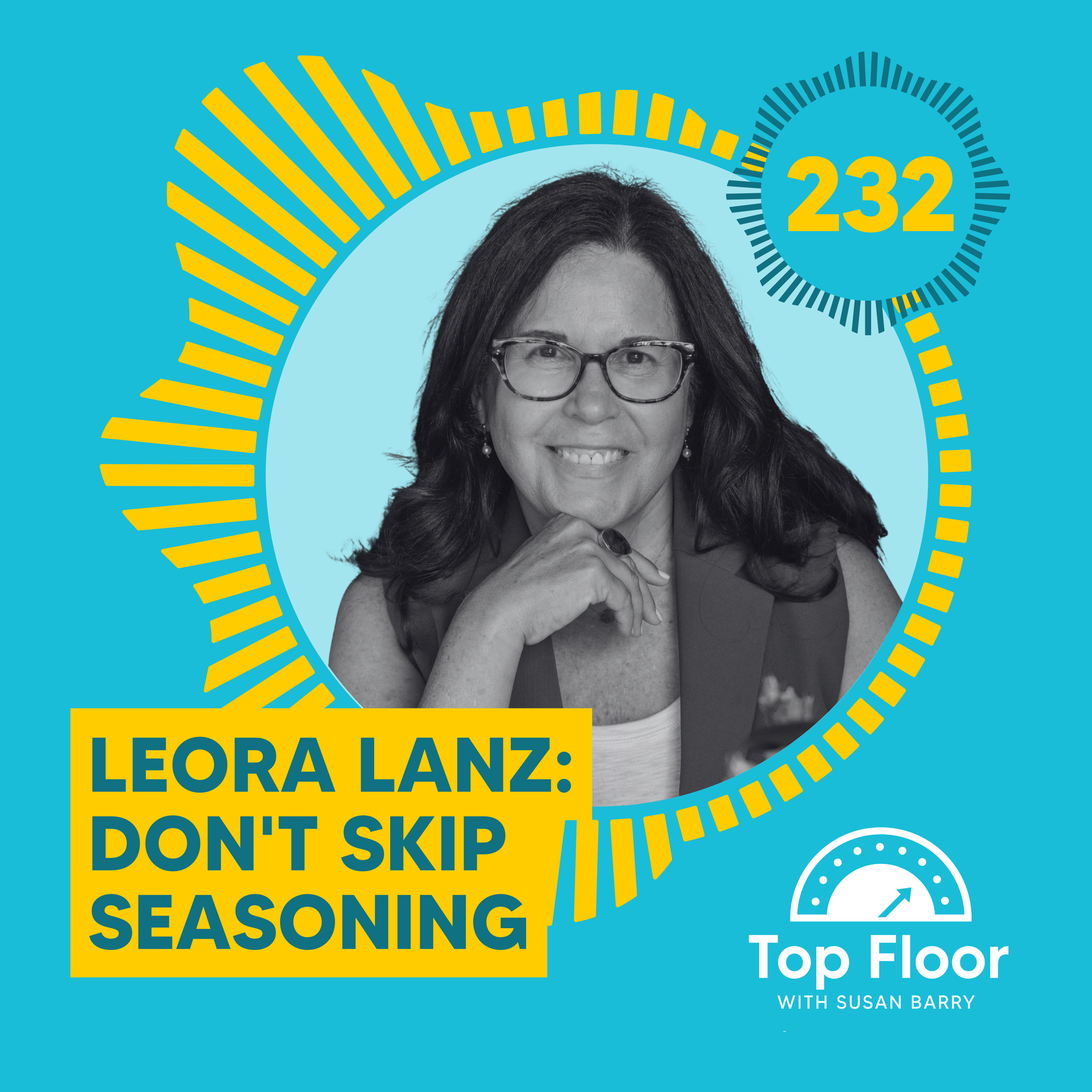
Transcript: Episode 232: Don't Skip Seasoning
LISTEN TO THE EPISODE:
APPLE PODCASTS | SPOTIFY | TOPFLOOR.COM
[00:00:00] Susan Barry: This is Top Floor with Susan Barry, episode 232. You can find the show notes at topfloorpodcast.com/episode/232.
[00:00:14] Narrator: Welcome to Top Floor with Susan Barry. This weekly podcast ride up to the top floor features tangible tips and excellent stories from the experts and characters who elevate hospitality. And now your host and elevator operator, Susan Barry.
[00:00:32] Susan Barry: Welcome to the show. Leora Lanz is an associate professor at Boston University School of Hospitality Administration, where she has also served as faculty chair of the graduate program and assistant dean. Prior to academia, Leora built a deep marketing and communications career in hospitality. She started in destination marketing in Boston and then spent 9 years with ITT Sheridan Hotels in New York for 15 years. She was the global director of marketing for HBS, helping the firm expand from 7 offices to 40 worldwide while also leading their marketing communications practice in the Americas. Leora launched her own business-to-business PR consultancy and has recently turned her teaching and real-world casework into two books, Developing Your Marketing Mindset and Marketing Mindset in Motion. Today, we are going to talk about my favorite subject, which is hospitality marketing. But before we jump in, we need to answer the call button.
Call button rings…
The emergency call button is our hotline for hospitality professionals who have burning questions. If you would like to submit a question, you can call or text me at (850) 404-9630. The emergency call button is brought to you by Cayuga Hospitality Consultants. Cayuga is a highly concentrated organization of the industry's best-connected consultants across multiple disciplines. Members are former senior executives who now work independently on projects worldwide. Learn more at cayugahospitality.com. That is c-a-y-u-g-a hospitality.com. Today's question was submitted by Claudia. Claudia asks, how do I know if my digital marketing agency is actually performing? Oh, what an excellent question. Leo, what do you think?
[00:02:49] Leora Lanz: That is an excellent question. I would say we need to do two things off the top of my head. I would recommend, number one is we need to speak the language of digital to be able to have conversations with our agency.
[00:03:02] Susan Barry: Excellent.
[00:03:02] Leora Lanz: So, even we need to be, it's generalists. As I share in my syllabi when I teach digital marketing, you need to know enough to be dangerous. You need to be able to ask the right questions. So I would say brush up on the digital vocabulary and the digital plan from the start so that we can ask the right questions along the way, because with digital, we've gotta assess it along the way anyway. So that's number one. And number two is, know what those KPIs are from the start. So, as I say in one of the books, start with the end goals. When we work with the digital agency to determine what is it that we need to accomplish, we need to know what we want to strive for, and then we determine how to get there. So if we know the KPIs and what the goals are, speak the language, and then periodically check in to ask for those KPIs and review.
[00:04:02] Susan Barry: Got it. Well, early in your career, you learned destination marketing and crisis communications quote way too quickly, so I have to know about this. What's a crisis moment that permanently shaped how you think about communication?
[00:04:20] Leora Lanz: Well. Being on property at a hotel for nine and a half years, hotels are very sexy places for very crazy things to happen.
[00:04:31] Susan Barry: It’s my entire reason for being, yes.
[00:04:34] Leora Lanz: Yeah. Anyone in hospitality marketing, if you've been on property, you know this and being in New York, where I had two properties across the street from each other that were 2,400 rooms total. There's a carjacking in New York City that happens in front of the hotel. There was a robbery during the jewelry show that happened. There's a man who wants to jump because he lost his life insurance because of his job. So this is a long time ago, by the way. This was in the 90s. But when those kinds of incidents happen, frankly, they get referred to the police. That's not something a PR person on the property is going to deal with. Let that get handled by the police. But it woke me up to how important that communication is, how thoughtful it needs to be and how compassionate it needs to be. I do think it's harder today. You probably know this better than I do, Susan, but it's better today. It's harder today 'cause there are so many more outlets. And there's so much that we have to make sure that we connect with and get the facts straight.
[00:05:42] Susan Barry: Every guest is an outlet. They have their camera crew and many channels to broadcast from.
[00:05:49] Leora Lanz: That's what I call civilian journalism. When that sort of started to arise, as, hey, we can do our own reporting, we can cover our own, we can post it however way. Yes. And I also call that the pinball machine framework of communication. The traditional marketing funnel of awareness and interest, desire, and take action. I think today it's really hard because it is a pinball machine, but getting our messages from everywhere. So, to your point, it is harder to control, but so important to try to do your best to do so.
[00:06:24] Susan Barry: At HVS. Actually, before I ask this question, can you explain quickly what HVS is for folks who may not know?
[00:06:33] Leora Lanz: Yeah. Folks in ops may not understand HVS, but folks who are on the development side of hotels and the ownership side of hotels are familiar. Folks are familiar with HVS. HVS is probably the largest global hospitality consultancy. So if someone is looking to buy, build, or sell a hospitality asset, a hotel, or a mixed-use piece of real estate, HVS would work with the owner, the operator, or the developer to get the valuation, the feasibility, the documents from the bank, and the market studies to make that happen. What I did was help market HVS globally as a consultancy, as the go-to if we're looking to be in the hospitality ownership or operations business. And then ultimately, as you indicated earlier, I had a second hat. I actually did conduct sales and marketing projects for independent owners or for hotel owners in the Americas as well. So I marketed the firm while I also helped owners in the Americas.
[00:07:42] Susan Barry: In terms of marketing the firm itself, are there maybe a couple of the most important moves or campaigns or things that you did that impacted that growth from 7 offices to 40 offices?
[00:07:58] Leora Lanz: Yes. When I think back at that, first of all, to market a services firm is very different from marketing a product. How do you sort of market this knowledge? How do you market thought leadership and knowledge? As we grew and we became more global, and we had to handle many different aspects. So what did marketing entail? It entailed getting out a weekly newsletter. It entailed growing our conferences globally and conference branding and conference marketing. It entailed graphic standards for the firm as we grew and in different countries. So we created what's called global business teams, and they were volunteer teams. I think I oversaw seven of them. One that handled internal communications, one that handled graphic standards, and one that handled our conferences. And each global business team was comprised of associates, the analysts from around the world who wanted to contribute to getting our name out there in some way and contribute to the effort. So that, to me, it was called buy-in. When you think about it, it's getting the company to engage and participate. In our own internal communications to get the external communications out there. And that to me is something I'm still really proud of, as long ago as that was, very effective because the firm globally felt connected. That's a hard thing to do.
[00:09:29] Susan Barry: So then what prompted the move to BU?
[00:09:33] Leora Lanz: You know, it's funny when I get asked about that. The real answer is opportunity. The opportunity arose. It was time. I had been with Sheraton in New York for nine and a half years. I'd been with HVS for 15 years. There were good runs. The opportunity came to teach for one semester in Boston, and I live in New York, so that's a whole other story. But the opportunity came and I thought, I didn't even think of it as a shift or a pivot, to be honest with you, Susan. It was sort of seemed like the next chapter of my hospitality contribution. That's really how I thought about it. I never thought about it as a shift or a pivot. The opportunity came, it was supposed to be for one semester, and now it's 23 semesters later. So clearly it worked and I love it. I absolutely love it. And being in front of the classroom is a big responsibility. I learn as much from my students as I hope they learn from me. But it was timing that worked out well and it was opportunity that worked out well. And I always tell folks, you know when to say yes, and you know when to say no, and I was glad I said yes to this.
[00:10:48] Susan Barry: Well, your book is all about developing a marketing mindset. What is a marketing mindset in plain English?
[00:10:55] Leora Lanz: Okay, so marketing is about connecting and building relationships. I actually equate marketing to hospitality. Hospitality is about connecting and building relationships. So in some regard, you can almost equate the two. Having a mindset is putting this way of thinking into our DNA, so it becomes an automatic or organic approach to how we handle our business. So I would say marketing mindset means we're thoughtful. We're always thinking critically and strategically. That's really important for developing the mindset, and I talk about this in the first few chapters to the book. Critical thinking means assessing a situation holistically, a 360-degree view. Where strategically means looking forward, how do I plan ahead? It's not these sorts of one-hit wonders and gimmicks that a lot of brands tend to do and take advantage of. It's good to be trendy, but it's also good to be strategic and what is that value proposition? And so critical thinking, strategic thinking and then I would say always adding in the hospitality as part of a marketing mindset.
[00:12:14] Susan Barry: That makes a lot of sense. Well, your first book is built around casework from your class and from your students, with contributions from all kinds of people. What is one of the case studies that consistently changes how people think? Is it even possible to narrow it to one?
[00:12:35] Leora Lanz: It's hard to narrow it to one, in fairness, thanks for asking that. Let me just say that I wrote one manuscript, Susan. It turned into two books. But I wrote one manuscript that the publisher very smartly guided me and said, if you restructure, we've got two books here, let's do that 'cause it'll make more sense. And I wrote this manuscript as a celebration of 10 years of teaching. That's not something I ever imagined was gonna happen. And I thought this was a perfect opportunity to celebrate it. And I wanted a souvenir. I really actually wanted this to be sort of a personal project just for me as a memory of 10 years of teaching. And as I said, not just what I taught, but what I learned from these students. I reached out to over a hundred of my former students as I wrote this manuscript. And I asked them not about me. I asked them, what do you remember that we learned in class that sticks with you? What's sticky? And that you might actually apply any work today, whether you're in hospitality or not. One case that comes to mind during the pandemic, I actually reached out to the director of the CVB, the Convention of Visitors Bureau. Today, it's called Meet Boston. And I called Martha and I said, I want our class to help the city. How can we help? Quite honestly, my classes were always designed to help the hospitality landscape of Boston. That was always really important for me to us, have us immerse in the hospitality community. And so we took on the city of Boston as our client. It was wonderful. It was hard. For me, it was meaningful 'cause I started my career at the CVB, so I felt very just an affinity for it. But it was hard when you're having a mandate every other day change that says you can travel here, but you can't travel there, you can't travel there, and you can't travel there. Well, if we can't get you to Boston, how on earth can we get Boston to you? And so I was teaching the students the concept of digital visibility and physical visibility. If we can't physically get you, how can we digitally get to you? And Airbnb did a great job of that. When you think about it, remember those are Airbnb experiences. Those online experiences. So Meet Boston did that as well. So that's just one very simple example of a philosophy in marketing, and that's in the second book, the Mindset In Motion book, like how do we put our marketing to work? We've gotta remember physical presence and digital presence, for example.
[00:15:22] Susan Barry: One of the things that's shown through for me when I was reading is, so many of your students said that they learned we versus I or you from you, which I thought was interesting. Can you say a little bit about the concept? What do you mean by that?
[00:15:39] Leora Lanz: We live in a we world. I have to think creatively like a marketer, but ultimately, it's the owner's money that's gonna actually make this decision come to be. So we have to think like the owners. I tell the students when we're involved in a project, I don't wanna hear us saying, well, we recommend that you do this, or, based on our research, you ought to do blah, blah, blah. Who are you? Oh, 20-year-old students, right? Think about it. But if we say, here's what we recommend for our hotel, and when we happen to do this and update our website, we need to get people to our website. So now all of a sudden they have a vested interest and they are living and breathing the brand with the client, with the owner. We are part of their business. We're an extension of their businesses, and I have to say, many of the GMs or owners who participated in my classes, that's one of the things they immediately note and appreciate. These students have become a part of their team. They genuinely care about the success of their team and the success of their recommendations. It's gotta be a we world and not an I and you world. That means we're disparate, we're not connected. That's not gonna work.
[00:16:58] Susan Barry: Quick side note, we are giving away a real sponsor ad read on Top Floor. Not just a shout-out, not a mention in passing, but an actual host red spot in a real episode where your brand can become part of the conversation instead of just an interruption. I keep thinking about how much noise we all swim in every day with ads, pitches, promos, and popups. And how rare it is to hear something that actually feels human. So we are opening the mic to one brand that deserves to be heard. The giveaway opens on Tuesday, February 17th and closes on March 6th, and we will announce the winner on March 10th. If you have a business with a story worth telling, visit topfloorpodcast.com/win to enter by March 6th, 2026. Okay, back to the show.
We like to make sure that our listeners come away from every episode of Top Floor with practical, tangible tips to try either in their hotels or their businesses or in their personal lives. So, for a general manager or department head who doesn't think like a marketer, maybe, who can't think like a marketer, naturally, what habits should they practice to build that mindset?
[00:18:28] Leora Lanz: We need to know what questions to ask. We need to know enough to be dangerous. And the truth is, we all need to have a marketing mindset, whether marketing's in our title or not. So we're gonna hire the right people to do the marketing work and they'll have the titles. But if we can't have the conversations with them and think like a marketer, we need to shift gears. Critical thinking, strategic thinking, and thinking with hospitality.
[00:18:55] Susan Barry: I have a sort of flipside question to that. I'm not exactly sure how I wanna ask this, but one of the things that I have noticed in my very lengthy career is that people sometimes believe, because they experience marketing as a consumer, that they have greater depth of expertise or that sort of every opinion is valid kind of decision by committee type thing. What do you think of that? Do you think that's a better place to be? Or is there a way that marketers should think about sort of tamping that down too?
[00:19:39] Leora Lanz: I would wanna remind everyone that we're not always the target market. When I have assignments shared with students, and they'll come up with the ideas, I keep reminding them, you guys aren't actually the market for this product, right? You are just helping with the marketing, but you don't have the mindset of the actual customer. We have to conduct the research to determine what's the customer thinking. You may not be the customer, and that's what I would remind people when we're always quick to sort of make suggestions, but we may not be the right customer for that particular product or asset. We have to remember that.
[00:20:16] Susan Barry: That's a very good point. Well, we have reached the fortune telling portion of our show, so now you have to predict the future and then we will see if you got it right. What is a prediction you have about the future of hospitality education? This is such a hot topic on this show, Leora. We talk about this with a lot of different guests. I'm very interested to hear what you have to say.
[00:20:39] Leora Lanz: I'm concerned about the future of hospitality education. Yes, there’s less enrollment for hospitality education. And I think what needs to happen is we need to get to parents. We need to get to families to understand it's not just a summer job, there is a career here and there is money to be made. And there are so many young people that have the same passions we had. When we were just emerging into the industry, they loved the travel aspect and the service aspect and the hospitality aspect. I wish business schools would mandate hospitality courses because I think every business should have hospitality, and I think that's what's missing from business schools, quite honestly. I think hospitality is a business differentiator.
[00:21:32] Susan Barry: I agree with you. One of the things that comes up all the time when we're talking about hospitality education on this show is the notion that the industry is an apprenticeship industry, meaning you can have a PhD in hotel management, but no one is gonna hire you until you've worked frontline jobs and done your rotation through a hotel. I think that there are some beautiful things about the idea that it's an apprenticeship business. I think that's where we get really cool, glamorous, romantic traditions. It is also, of course, the reason why the industry is so technologically behind, because I didn't have that when I was coming up, so why do we need to put money into it now? I'm curious your thoughts on that. You know, I think about these students who are taking out $60,000 worth of loans to get a hospitality degree, and then being asked to take a housekeeping supervisor job because they need to pay their dues.
[00:22:38] Leora Lanz: I don't know if there's a right or wrong answer, but let me share some thoughts, Susan. I personally believe everybody, whether you're going into a traditional hospitality career or not, should work in a hotel or a restaurant in your life. What I've noticed in the 11 years that I've been connected with academia is that it's not necessarily the first job out of school or grad school that gets you the return on the investment with your salary. It's usually the second. That's been my observation. There are ways. What I do like about our industry is that you could be an introvert and there's a role for you in hospitality. You could be an extrovert, which is what everybody expects. You could be a math and a numbers person and there's a role for you. You could be the people person that a lot of us are and not really math-savvy, and there's a role for us. So there's something to be said about that. And there are other industries today, like senior living, retail, where they're hiring from hospitality because they need that mindset in their business sectors to be able to be successful and they don't get it anywhere else.
[00:23:51] Susan Barry: That's absolutely true. I have another theory. I have had so many guests on this show who talk about watching the television show hotel as part of the inspiration for them to get in the industry or go to Cornell or whatever the case may be. And when you look around, first of all, we don't have a monoculture anymore, right? Like everybody's not watching the same television.
[00:24:13] Leora Lanz: It's not broadcast anymore. It's personal streaming.
[00:24:16] Susan Barry: Exactly. But even though hot shows that are in our industry are the bear, which makes you feel like you need to down a bottle of Xanax when you watch it, or the white lotus, where you're afraid you're gonna get murdered. So we need some sort of like cultural touchstone that reminds people how funny, crazy, glamorous, and amazing this business can be.
[00:24:43] Leora Lanz: Well, I think podcasts, like what you are doing is exactly a way to do that because it's voices of people who have the same passions for this industry that others can listen to. Because the media today is so personalized. I actually studied communications and I wanted to be a broadcast journalist. Broadcast today is actually really difficult because people are not watching Mass unless it's the Super Bowl, and even that doesn't necessarily get the ratings that it used to in years past. Media is very customized and personalized today, and it's streaming services, so I think programs like what you have, Susan, with podcasting, is a way to communicate all that. I will say shows like White Lotus, The Bear, but more like some of these other Emily in Paris, they've created a whole new trend. They've created what's called set jetting. People are actually traveling to destinations because they see them on these shows. So it's actually been good for tourism and travel. Listen, I'm a hospitality geek. Will Guidara, executive produced season three, you saw the whole scene right out of the book, Unreasonable Hospitality. I'm teaching that to my students and they're probably not nearly as excited as I am when I talk about it. So there are elements in there that those of us who know pay attention to, the set shedding of some of these other cultural programs is even Bridgeton. I'm a big fan. That's my guilty pleasure. You know what that's done for Bridgeton Tours in the UK, etc. So that's created a whole different sort of cultural nuance. It did exist in the past. It's just more emphasized now through social media. But keep doing these podcasts and maybe we can figure out, maybe we can produce some kind of streaming show together on Netflix or something to put it out there.
[00:26:33] Susan Barry: There you go. Well, if you could wave a magic wand and change one thing about how the industry approaches marketing, aside from co-producing a TV show with me, what would it be?
[00:26:47] Leora Lanz: If I could wave a magic wand, I would want all businesses to onboard with a philosophy of hospitality, number one. If I could wave a magic wand, I would like more people to understand a philosophy that I call in the book, meaningful marketing or conscious marketing. Where we connect more meaningfully with our guests or our diners or our residents or our patrons through wellness, sustainability, or community. It's marketing with meaning, it's marketing with purpose. I truly believe if hospitality is about making people feel good, then we have a responsibility as an industry to do good with wellness, with sustainability, which is wellness of the people and the planet and with community. So I would like to wave a magic wand to say, let our marketing be purposeful, but authentic. Let our hospitality be responsible.
[00:27:51] Susan Barry: I love it. Well, thank you. Before we tell you goodbye, we need to head down to the loading dock where all of the best stories get told.
Elevator voice announces, “Going down.”
[00:28:06] Susan Barry: The loading dock is brought to you by Hive Marketing. At Hive, we specialize in business-to-business marketing and communications for the hospitality industry. Working with hospitality brands, operators, owners, and vendors to create content and campaigns that keep you top of mind outside the sales cycle. Visit hive-marketing.com for more information. That's hive, like a bee hive-marketing.com.
Leora, what is a story you would only tell on the loading dock?
[00:28:39] Leora Lanz: Ah, that's a tough one because crazy things happen in hotels. Actually, could I share one quick, serious story? Two years ago, I realized that it was the 10-year anniversary of my leaving that 15-year global job. And when I left that 15-year global job, I left with a lot of uncertainty about what's next looked like. I knew it was time to move on to what's next. I just didn't know what it was. And anything I wanted said I was overqualified. Anything that anyone who wanted me, I didn't want that level of stress at the time. And it caused me anxiety to a point where I ended up in the hospital, to be honest with you. And it was not good 'cause it affected me physically and I got through it. Obviously, I got through it, but it took a while and I vowed to myself, don't ever let that happen again. Don't get physically sick from something like this again. And so I realized two years ago, that was the 10-year anniversary of when I left that job, got myself together and I actually went off on my own and created my own consultancy. Talk about another scary move. So I wrote a post on LinkedIn on March 31st, 2024, how it was a 10-year anniversary of my starting the next chapter with uncertainty, but yet with work to do, and nobody should ever go through what I did. And if I can help you in any way, you can get through this. Well, Susan, I got 17 dms in a 24-hour period. People did not know. And most were women and most were women over 55. And so my little narrative there is, I think there's an ageism thing happening and a sexism thing happening. Most were some related to some area of hospitality. I didn't know them. I met a few in New York City just because I felt compelled to have to like create these relationships, put these women together, help one get a freelance contract job with another friend of mine at an agency. We're still in touch today, and so now while I'm in a classroom with young folks emerging into hospitality. Can I curse on the show? I really, I really give a * about what's going on with people who are seasoned. Seasoned voices are really important and I'm worried that companies are not respecting it as much. And shame on these companies that won't pay for the quality and the experience that people still wanna contribute and bring to an organization.
[00:31:26] Susan Barry: Leora Lanz, thank you so much for being here. I know our listeners are gonna pick up both books, and I appreciate you riding with us to the top floor.
[00:31:36] Leora Lanz: Thank you so much, Susan.
[00:31:39] Susan Barry: Thank you for listening. You can find the show notes at topfloorpodcast.com/episode/232. Jonathan Albano is our editor, producer, and all-around genius. He even wrote and performed our theme song with vocals by Cameron Albano. You can subscribe to Top Floor on Apple Podcasts, Spotify, or wherever you like to listen, and your rating or review will go a long way in helping us give you more of what you like.
[00:32:15] Narrator: Thanks for listening to the Top Floor podcast at www.topfloorpodcast.com. Have a hospitality marketing question? Reach us at 850-404-9630 to be featured in a future episode.