
Transcript: Episode 229: Pig Coming Through
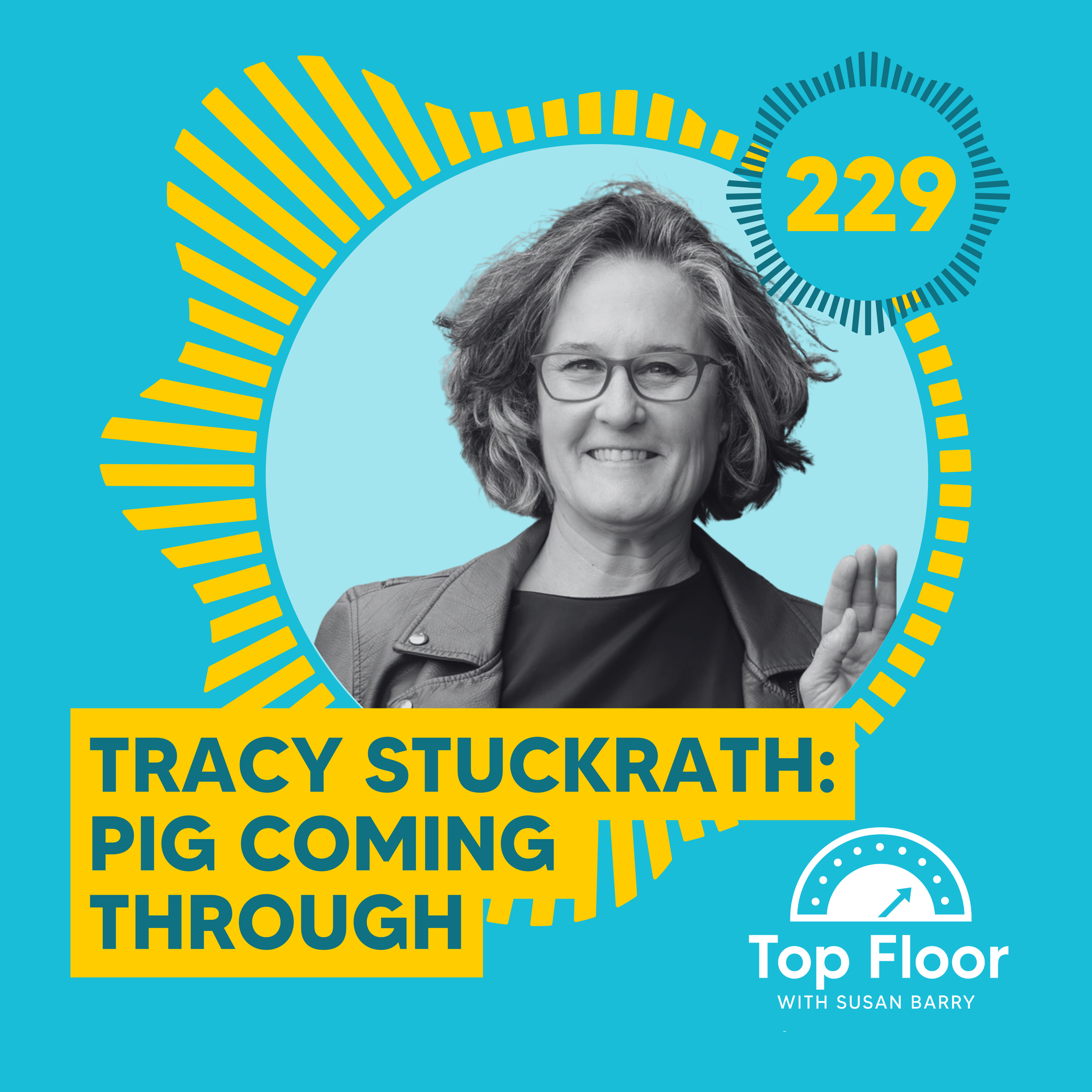
LISTEN TO THE EPISODE:
APPLE PODCASTS | SPOTIFY | TOPFLOOR.COM
[00:00:00] Susan Barry: This is Top Floor with Susan Barry, episode 229. You can find the show notes at topfloorpodcast.com/episode/229.
[00:00:13] Narrator: Welcome to Top Floor with Susan Barry. This weekly podcast ride up to the top floor features tangible tips and excellent stories from the experts and characters who elevate hospitality. And now your host and elevator operator, Susan Barry.
[00:00:32] Susan Barry: Welcome to the show. Tracy Stuckrath is the founder of Thrive! Meetings and Events, and a longtime advocate for food safety, inclusion, and thoughtful hospitality. She began her career as an event planner, worked across DMCs, media companies, and corporate planning, and even supported the Vancouver Olympics. In 2010, Tracy launched Thrive to educate the events and hospitality industry on how to safely and inclusively feed people with food allergies and dietary restrictions. She's also the host of Eating at a Meeting, which is a podcast name that I love. She launched it during COVID and has grown to hundreds of episodes featuring candid conversations about food, health and events. Today, we are going to talk about how inclusive food practices can actually drive business. But before we jump in, we need to answer the call button.
Call button rings…
The emergency call button is our hotline for hospitality professionals who have burning questions. If you would like to submit a question, you can call or text me at (850) 404-9630. The emergency call button is brought to you by Cayuga Hospitality Consultants. Cayuga is a highly concentrated organization of the industry's best-connected consultants across multiple disciplines. Members are former senior executives who now work independently on projects worldwide. Learn more at cayugahospitality.com. That is c-a-y-u-g-a hospitality.com. Okay, Tracy, today's question was submitted by Lisa, and here's what Lisa says. One of my New Year's resolutions is to work smarter, not harder. What apps or software should I use to make planning events easier? So before we got on, Tracy and I were talking about podcasting equipment and I felt like I was gonna give a spoiler for her surprise question. So do you have apps and software that you use for event planning or are you more analog, old school?
[00:02:56] Tracy Stuckrath: I am probably still analog old school. A lot of stuff is Excel because you also have to share that with your partners, and I love Google Drive, but a lot of hotel properties and caterers can't access Google Drive.
[00:03:11] Susan Barry: I know. Isn't that funny? That comes up so often with business founders who are like using the free tools that are out there. And then people who are on that Microsoft Suite cannot touch Google Drive. It's very frustrating.
[00:03:24] Tracy Stuckrath: It's very frustrating 'cause you've got all of your documents for your own team on your side in that Google Drive, and you want that team to be able to access it, and they can't. So it's a catch 22 is that I'm doing the 67 thing here, which I've never done in my life. So I'm kind of old school in that, but I carry my laptop everywhere. I almost bought an iPad, but I like my laptop, and I'm a Mac girl. So everything is connected, and if you didn't know this, but you're working on your computer and there's something on your phone, or vice versa, I can hit copy from one and paste it into the other.
[00:04:15] Susan Barry: Oh, that's so awesome. That is definitely something that's missing on the PC world side. You have worn a lot of hats in this industry, planner, media, corporate Olympics, entrepreneur. Were the pivots in your career part of a big master plan, or I think I already know the answer, or did you adjust based on external conditions or just sort of go where the wind blew? Like, tell me about that.
[00:04:43] Tracy Stuckrath: I guess kind of where the wind blew. I started event planning in college as a social chairman for my sorority and planning condom awareness week for the health center at the NT State. But I went up to DC, and I got a job doing events, meetings for an association, and then I worked on campus at Catholic University for like six months, planning events for that. But then I got the call to move to Atlanta and work the Olympics there. So it kind of just ebbed and flowed. And I did DMC work and then I went in-house corporate. And then when I went out on my own in 2015, I just took that jump and the podcast, part of it, I think you're gonna ask me something about that too, but that just came about 'cause of COVID.
[00:05:38] Susan Barry: Was it came about because of COVID, because you weren't able to meet with people face to face, or you were bored or you were like, Hey, I've got extra time here. Let me make this podcast.
[00:05:50] Tracy Stuckrath: I think it was kind of all of that. And the name actually came from a videographer, in January, who was listening to me and do videos for my website and he's like, Tracy, you're everything eating at a meeting. And my friends like, you need to start a Facebook group. So it actually started as a Facebook group and then in March, I was doing interviews for Women's History Month. And when I started the Facebook group, I needed to keep in touch with them and I started doing Facebook lives and it really took off in May of when COVID hit of 2020. And I was doing webinars on what COVID has to do with food and beverage. I had eight webinars in one month talking about food safety. And that I came about from that and I told one webinar and I had 300 new members within an hour of my Facebook group. So that's where that was born and it's just grown.
[00:06:54] Susan Barry: So speaking of food safety, Thrive started with a very specific mission around food allergies and education. Was there a particular moment that you were like, the industry is not getting this, that's a problem, or was it more, I don't know, a culmination of various things that happen?
[00:07:17] Tracy Stuckrath: Well, I got diagnosed with my food allergy in 2003. And I was a corporate planner and I couldn't eat at my own events so it was really hard. And I remember going to do an event at Disney and I remember this very vividly, walking through the hotel with the chef and all my allergies were on all 90 pages of my BEO. And I'm like, you don't have to tell the world. She's like, but if I don't come to work. My team needs to know because that BEO is what they live and die by. Right? And I'm like, oh, okay. And then go a couple of years later and I ended up taking a course in New York City, and I'm sitting in Lincoln Center and listening to the 1500 other people and the speakers talking about different dietary restrictions, and I'm like, you know what? I need to start a company that educates the industry on how to feed me and all of these people in this room who have a variety of different dietary restrictions and that's where it started.
[00:08:15] Susan Barry: I know that you work with planners, venues, chefs, executives. Is there a particular group that tends to get it fastest when it comes to food allergy safety? Is there somebody that's more resistant or is it all over the board?
[00:08:33] Tracy Stuckrath: I think the people who get it the most are the people who say, I have an allergy or have a dietary. As far as the planning side, I think it depends on the client. It's all over the place. I recently had a client tell me I'm so passionate about it that they didn't want me to handle food and beverage anymore, which is kind of crazy. And so that was a little, like disconcerting in a way, but I'm like, okay, you're not my type of client then, right? I've had chefs yell at me, saying, I cook the food, but I don't have to label it. And then I have front of house teams tell me, well, I'm not a chef, and I'm not a cook. How would I know that this is in this food? And so, to me, there's this misstep, there's not a collaboration. That's what I see a lot is there’s no collaboration with the properties.
[00:09:26] Susan Barry: I know that there's sometimes a perception in hospitality, and I feel like hotels more than restaurants, but you can correct me if I've got this wrong, that labeling food or accommodating allergies, like saying that you are accommodating a food allergy, increases rather than decreases your risk of liability. That cannot be accurate. Is that accurate?
[00:09:52] Tracy Stuckrath: No, I'm gonna say labeling's gonna reduce your liability.
[00:09:57] Susan Barry: Well, it seems like common sense, right?
[00:10:00] Tracy Stuckrath: Right. Yeah. But there are planners that have been told, we're not gonna do that 'cause we're gonna reduce our liability. We don't wanna risk our liability of putting it out there. But that just means to me that you don't have the systems in place to know. And actually, I wanna share a story that just happened a couple of days ago. I was actually in a hospital. Not for me, but I was in a hospital cafeteria and I wanted to eat some lunch. And the menu board said, chicken quesadilla contains wheat and dairy. And then at the nachos, it didn't have any kind of labeling on it. And I'm like, okay, and it said meat spelled MEET instead of MEAT, but it said meat, chicken, cheese. But there was no allergen labeling. So I'm like, okay, hey, I want to eat this beef for chicken. Is it gluten-free? And he's like, I don't really think it is because of the spices. And I'm like, oh, that's weird. And he went and brought me the Lowry spices and right there in the middle was wheat flour. And so the inconsistency of that labeling, hey, you've got your quesadillas labeled, but you don't have the nachos labeled. Thankfully, that Cook went back and got that for me and showed me to confirm it, but I think that's increasing your liability by not having your systems in place that everything is labeled.
[00:10:01] Susan Barry: But why do they think that? I think when people hear food allergies, they only think about either being somebody who's gluten-free or maybe like a shellfish allergy that causes anaphylaxis. What are the most common things that event professionals need to really be thinking about? Is it just those two or are there more?
[00:11:52] Tracy Stuckrath: No, there are actually nine foods that cause 90% of all allergic reactions. And that is wheat, soy, peanuts, tree nuts, fish, shellfish, egg, sesame, and milk. Did I say milk already?
[00:12:12] Susan Barry: Close enough. We'll put the list in the show notes, if not.
[00:12:15] Tracy Stuckrath: Yes. Those are the top nine that cause 90% of allergic reactions worldwide and are required on packaged food to be labeled. And some states are starting to implement it that it has to be labeled on unpackaged food. Like, California just passed a law that unpack or restaurants or food service establishments must be labeling for the top nine allergens.
[00:12:39] Susan Barry: Gotcha. I think there's a backlash of people dismissing those kinds of dietary needs as preferences versus allergies. And sometimes they are right? Like some people would prefer or being difficult. Here's an example: I cannot eat bivalves. I will not go into anaphylaxis. I'm not gonna die if I eat one, but I cannot have them. It causes a major situation. So it's not an allergy. I guess it's a preference, but it is a real thing. Like, I can't mess around with that.
[00:13:20] Tracy Stuckrath: But it makes you sick.
[00:13:21] Susan Barry: Yes. Very sick.
[00:13:22] Tracy Stuckrath: So that is some sort of an allergy.
[00:13:27] Susan Barry: Is there a separation between preferences? Like, I don't know if it's still trendy, but there was a trend for a while of people going gluten-free because they thought it was gonna help 'em lose weight or whatever. So how do you separate those things, or should you even separate those things?
[00:13:47] Tracy Stuckrath: From a health department, some woman from a health department, in one of my presentations years ago, said, you should consider them the same. But when an event planner is designing their registration form, I like to delineate them because celiac disease are actually considered a disability under the Americans with Disabilities Act. So any individual. So we have to provide a reasonable accommodation for those individuals.
[00:14:17] Susan Barry: That is good to know. I will bet you anything that 9 outta 10 people listening to this right now had no idea that that was true.
[00:14:24] Tracy Stuckrath: Well, it's like they didn't go put a billboard up there and announce it, but yeah. So I like to delineate in the registration form. Do you have any disabilities that we need to consider, including food and beverage? And then asking the other question, do you have any other dietary needs or restrictions that we need to take into consideration? And I'm always now at telling planners to add alcohol to that list, making sure you have religious-based practices on there. Kosher, halal, that dairy free, that gluten free. Vegetarian, vegan, and saying, these are non-life-threatening. These over here are life-threatening. So, again, the kitchen should treat them the same. But at the same time, it's a good idea to me, it's a good thing to have them separated, so you know the severity.
[00:15:16] Susan Barry: Do you ask for preferences and stuff like that? I'm sure you ask for restrictions when you're hosting people, like having a dinner party or something like that. But what about preferences? Do you ask people, like, there's a reason I'm asking this question, by the way, like, are there foods that you like or don't like?
[00:15:35] Tracy Stuckrath: I think that would be a fun registration question to ask your attendees. And pull it in, because food and beverage should be more than just, Hey, here's a slab of meat and some broccoli and some pasta that we're serving you for our event. Let's have some fun with it, but you can put other in that category. I don't like using just the open-ended box to say, Hey, what are your dietary restrictions? 'cause then you're gonna get that slew of, hey, like preferences. I have a former coworker who hated mayonnaise, right? And I'm like, oh, are you allergic to it? And he's like, no, I just don't like it. And so, how do you handle that? That's a hard one to do, but I think if you delineate it between restrictions and allergies and medical needs to restrictions, preferences, and kind preferences, with that mayonnaise dislike under the other. We'll see if they actually provide it.
[00:16:37] Susan Barry: That's a tough one for me. And I'll tell you, I don't know if I can articulate this super well, but I grew up in the south in a family and in a culture that really placed a lot of value on manners and etiquette and being polite. And so, like we're going over for dinner, anything that you like or don't like, any preferences, any dietary restrictions. And the only thing I will ever say is the thing that I cannot eat or I will get sick because I feel guilty, like I feel like I'm being rude if I say, well, I don't really like chicken salad, or do you know what I mean? I don't know. What do you think about that?
[00:17:23] Tracy Stuckrath: Well, I mean, I'm not a mushroom fan and like I'll some hotels or properties will give you that vegetarian meal because you're gluten-free, and I'm like, I don't eat a portobello mushroom. I'm gonna go completely hungry in that instance, right? Because I'm not going to eat it. But I totally get where you're coming from and it's a fine line to play. And like, if you're having Turkey sandwiches, I'm not gonna tell my friend I'm giving you a sandwich with mustard, or maybe you put these condiments on the side. And let everybody make their sandwich the way they want with the spreads.
[00:18:05] Susan Barry: We like to make sure that our listeners come away from every single episode of Top Floor with some really specific, practical, tactical tips and ideas to try either in their businesses or in their personal lives. What do you think that hotel brands and management companies should be paying attention to right now when it comes to food allergies, like baseline, first thing.
[00:18:29] Tracy Stuckrath: I think it's communication. And going back to that story of the chef in the front of the house and they're not communicating, it's really important to get that messaging across between your own staff. Because they don't know, and your front-of-the-house staff is the ones that are talking to your attendees and your guests, and if they don't know, then the chef is only as good as that person at the front of the house communicating what that chef has made. So I think the communication is key because most allergy failures happen because information breaks down between the sales and the operations, the kitchen service menu and signage, kind of like the one I talked about in the hospital cafeteria, right? And I've been to numerous events where food has been left off or you don't think about how something is prepared. Actually, a really good example is a catering menu. I picked a catering, a Peppadew Peppers with cheese in it. They're so yummy. And that was listed on the list of appetizers. Well, when it got served, it was on a crostini. But nowhere on that printed menu, which I'm required to order off of they didn't mention cini, so I thought I was ordering a very safe, gluten-free option. And so that communication got lost between the kitchen and the sales team or the marketing who wrote that menu or put that menu, published that menu.
[00:19:58] Susan Barry: It's interesting too, I don't think you know this about me, but early, early, early days, I was an off-premise caterer, and I remember so many occasions where we had utter disasters happen. All kinds of stuff like having to heat demi gloss and a coffee pot at an office park because we got locked outta the staging kitchen, like all this crazy stuff. And I can see that being like a on-the-fly, oh, these peppadews have a hole in the bottom. Let's just slap 'em on a crostini without thinking that there's some sort of downstream impact. I wonder from the planner's perspective, what's a step you could take to prevent that? Like, maybe you just include on BOS? We need to make sure that we have at least one gluten-free option for every meal or something.
[00:20:50] Tracy Stuckrath: Yeah. Well, and that's what I do when I work with my planning clients. And I'm analyzing the menu, saying, okay, I actually sort the whole menu by dietary needs. And say, okay, this is what the gluten-free people can have. It's guacamole or it's sour cream, right? And this is what the vegans can have. And then it really shows up in saying, Hey, there are no options here or I ask the question, how is this served? Because that service thing changes sometimes as well. And it comes down to that consistency and standard operating procedures and like, how are you communicating this? Because the chef's making it, but the expeditors and operations are putting it out. And which reminds me of a story from my friend Christina. She posted this in the eating at a meeting Facebook group years ago. They had ordered salad and I think it was in cones, so it came out in cones. Well, the cones were ice cream cones and they had labeled the salad to be gluten-free on the banquet event order. And she's like, these are not gluten-free. And they're like, well, they can just dump the salad out and on a plate. And it also had those dried onions on it. So the salad was clearly never gluten-free in the first place. But really thinking through how that plays out. And it's really important with that consistency because you want it to play through the same way at every property all the time and standardized language is so important.
[00:22:27] Susan Barry: It's so interesting as we're talking about this, because I can think back to my operations days and think through exactly how something like that happens. It's because the chef creates the item and the catering manager writes the menu. And never the twain shall meet, because if you wait for the chef to write the menu, you're never getting a menu. So the catering manager is just writing a menu and hoping for the best. There is a business there, in a hundred percent, your whole job is menu dietary restriction menu review. Like what? That would be fun. You should offer that.
[00:23:05] Tracy Stuckrath: Well, that is what I offer, yes. And even like in properties, like the sales team is writing the menu, right? And putting that and publishing it and not double-checking. And I don't know who's coding those menus. A majority of them are not coded with any kind of allergens. But, as we're going through, the other challenge with that, too, Susan, is the fact that I, as the planner, am ordering the food for the attendee who has food allergies. So how do I make that person comfortable? And make sure that you are feel safe in that environment as well, 'cause there are a lot of people between that chef and that person eating the food.
[00:23:51] Susan Barry: The flip side of that, too, is to not make the attendee feel so singled out that they're embarrassed. That's a piece that happens to me sometimes with this bivalve thing because people don't understand that it's not the same thing as shellfish. So then they're like, the shrimp. Can you have that? And you're like, shut up, bro. Come on. Just chill out. You know what I mean?
[00:24:17] Tracy Stuckrath: Yeah. Oh yeah. And there was a story during COVID, I think it happened before COVID. The waiter comes out and like, who's the vegan? And like calls attention to you and you don't wanna do that. It's because then the conversation comes up about, let's talk about my bowels. I'm like, I don't really wanna talk about my bowels.
[00:24:37] Susan Barry: Gross. No kidding. Well, and it gets back to that thing we were saying about sort of manners, like I don't get embarrassed very easily, but I get embarrassed when it looks like I'm being difficult. Like that is the thing that is the most humiliating to me, to look like I am causing a problem. Maybe not every problem, but in that arena, you know what I mean?
[00:24:59] Tracy Stuckrath: And that's the one thing that people with dietary restrictions, they don't wanna be a burden. So, as properties, as servers, as planners, how can we make sure that they don't feel like they're a burden, that they are part of the actual community, that they’re there and have an equal meal?
[00:25:15] Susan Barry: Do you think that it is possible to create an event menu that accommodates all diets or most dietary restrictions and allergies without having to make an individual plate for every single person there? Because I can just hear a chef on the other end of these headphones, like, well, if we go too far, then why don't we just have a meet at a restaurant? You know what I mean?
[00:25:43] Tracy Stuckrath: Yeah. I know there are products out there that are free of the top 14 allergens, which include the ones from that Europe requires to be labeled. But I think that's gonna be really hard to do, right? And I don't wanna put that burden on the kitchen, right? But I think there's a way that when you're looking at a list of 150 people who have dietary restrictions, and you sort it by those needs, you can eliminate things easily from that menu to streamline it. And to make the kitchen work easier. Like, hey, we're gonna eliminate all nuts from this event. And so we're not serving any nuts. Well, we're not a nut-free kitchen. Well, you can be at my event. And then I did that in a hotel two years ago. Unfortunately, it got missed with the pastry chef and nuts came out. And I'm like you and even in an event, years ago, a woman was allergic to apples. And she couldn't be in the room with apples. And we made a joke that it was like just your app iPad and your laptop and stuff, but she was so appreciative. But I was with the chef for two days beforehand. We're going through all the sauces, looking for apple cider vinegar and any other things that we need to remove. But she was so grateful for us taking that next step. But I did have another attendee wine about it. And yell at me about it because we were at a Great Wolf Lodge. She's like, there's applesauce all over this hotel, and how is she gonna expect it? And I'm like, we're only managing what we're doing in our space. She can manage when she leaves our space. That's her responsibility, right? So I think the responsibility comes on all of us across the board.
[00:27:34] Susan Barry: It's funny to me how Ben outta shape people get about other people's allergy like settle down. Well, Tracy, we have reached the fortune telling portion of the program, so now you have to predict the future and then we will come back and see if you got it right. What is a prediction that you have about the future of event menus?
[00:27:56] Tracy Stuckrath: I actually think they're going from moving from abundance, like overproduction to really intentional and kind of looking at our menus, what we've got, who our guests are, smaller menus, clearer labels, fewer surprises, and more storytelling. Like, how can we tell the story of where we are? And I love this years ago when the Vancouver Convention Center opened and NPIs were having their convention there and they had beverage napkins that were telling the story of the sea below the convention center. How they protected the ocean. It was really cool and I unfortunately don't have photos back from 2010 to show that off, but it stuck with me. That's 16 years later. That story has really stuck with me. Think about how many people you know who don't want 10 options that they can't trust. They want a few options that are thoughtful and that meet their needs, and connect them to the place of where they're gonna be. So I think safety, sustainability aren't trends anymore. They're just the baseline expectations of what we're doing with our food and beverage.
[00:29:09] Susan Barry: It’s interesting because I think that ties into maybe a more universal trend that I see, which is this paradox of choice idea that there are too many things to choose from. Think about when you're trying to figure out what to watch on TV and you have 10 different streamers and an infinite number of options. So you spend your whole time flipping around trying to figure it out and never watch anything. It's that same idea. Like I want somebody to curate that for me, make a recommendation, and then I'll just do it.
[00:29:44] Tracy Stuckrath: Oh, a hundred percent. I could lean back going to Law and Order or Hallmark movies when I can't find something to watch. I remember there's a restaurant in Maryland where we used to live. It is 38 page menu for dinner. Like, how do you choose? And that's what meeting planners get as well from hotels and catering companies. I think catering companies are a little bit more in that curation thing than hotels are. But it's like, okay, I have 5,000 people coming. I have 200 people with dietary restrictions, and I have a 50-page menu that I need to choose from for five different food functions for five days. How do I do that?
[00:30:29] Susan Barry: That's like a 40-hour project at least, right?
[00:30:33] Tracy Stuckrath: At least. Yeah. Yeah.
[00:30:35] Susan Barry: Well, if you could wave your magic wand and change one thing about how the hospitality industry handles food allergies, what would it be? I can guess.
[00:30:45] Tracy Stuckrath: Stop saying, I'll try or we won't even do this. One convention center total planner, like, Hey, we don't feed celiac, so you have to go find them food somewhere else. So I'm tired of that and I wish that conversation would go away and say, Hey, this is what we do. We want you to be in this building. We want you to spend 10 thousand dollars with us, and this is how you're gonna do it because we treat allergies and dietary restrictions with the utmost respect. And that's what I wish. My Tabitha knows, or my wet magic wand, we do.
[00:31:26] Susan Barry: Okay, folks, before we tell Tracy goodbye, we are going to head down to the loading dock where all of the best stories get told.
Elevator voice announces, “Going down.”
[00:31:38] Susan Barry: Tracy, what is a story you would only tell on the loading dock?
[00:31:42] Tracy Stuckrath: Okay, so I worked at Atlanta Food and Wine Festival, years ago, 13 years ago. And that last year I worked, the main kitchen was in the Lowe's Hotel in Atlanta, in midtown. The tents were up on the hill by the Federal Reserve Bank and an open lawn. And we had a guy, one of the chefs had deboned a full pig. And we had to take that full pig on a met on a wooden board on a golf cart from the hotel. Up two blocks. And I think the gates had already opened for the tasting tents and this chef and I were going through people going. Pig coming through, pig coming through, walking it to his spot in the tasting tents. It's a heavy pig.
[00:32:42] Susan Barry: Yes. A pig is not light. One time, this is so random. So I told you I worked at off-premise catering, and it was a restaurant group. This is in the 90s, so before composting was a thing, they composted and they gave their compost to a pig farm. And then in return, the pig farm would give the restaurant group a pig or two every year that they could do whatever they wanted with it. So we did a whole pig roast for. Friday night football game. This was in Tallahassee, Florida, so FSU's big football team, blah, blah, blah. And I had to sit there with a whole pig on a giant grill and cut it. I was maybe 22, 23. I'm 5’0” tall. Like, I could barely even reach this pig. So the thought of carrying a pig through Midtown Atlanta is the wildest visual that I have ever thought of.
[00:33:41] Tracy Stuckrath: Yeah, it was crazy and trying to hold it so it's balanced and you don't hit anybody. It was literally a pig coming through. Pig coming through.
[00:33:48] Susan Barry: Were people freaking out when they saw it? Like, ah.
[00:33:51] Tracy Stuckrath: Like, ah. And then I think it was Randy, it was the shout and then he just sat there, and he pulled it. It was pulled pork all day long.
[00:33:58] Susan Barry: Wow. Yeah. Well, that is making me hungry. Tracy Stuckrath, thank you so much for being here. I learned a lot about food allergies and I know our listeners did too, and I really appreciate you riding with us to the top floor.
[00:34:12] Tracy Stuckrath: Thank you, Susan. I really appreciate it.
[00:34:15] Susan Barry: Thank you for listening. You can find the show notes at topfloorpodcast.com/episode/229. Jonathan Albano is our editor, producer, and all-around genius. He even wrote and performed our theme song with vocals by Cameron Albano. You can subscribe to Top Floor on Apple Podcasts, Spotify, or wherever you like to listen, and your rating or review will go a long way in helping us give you more of what you like.
[00:34:51]Narrator: Thanks for listening to the Top Floor podcast at www.topfloorpodcast.com. Have a hospitality marketing question? Reach us at 850-404-9630 to be featured in a future episode.