
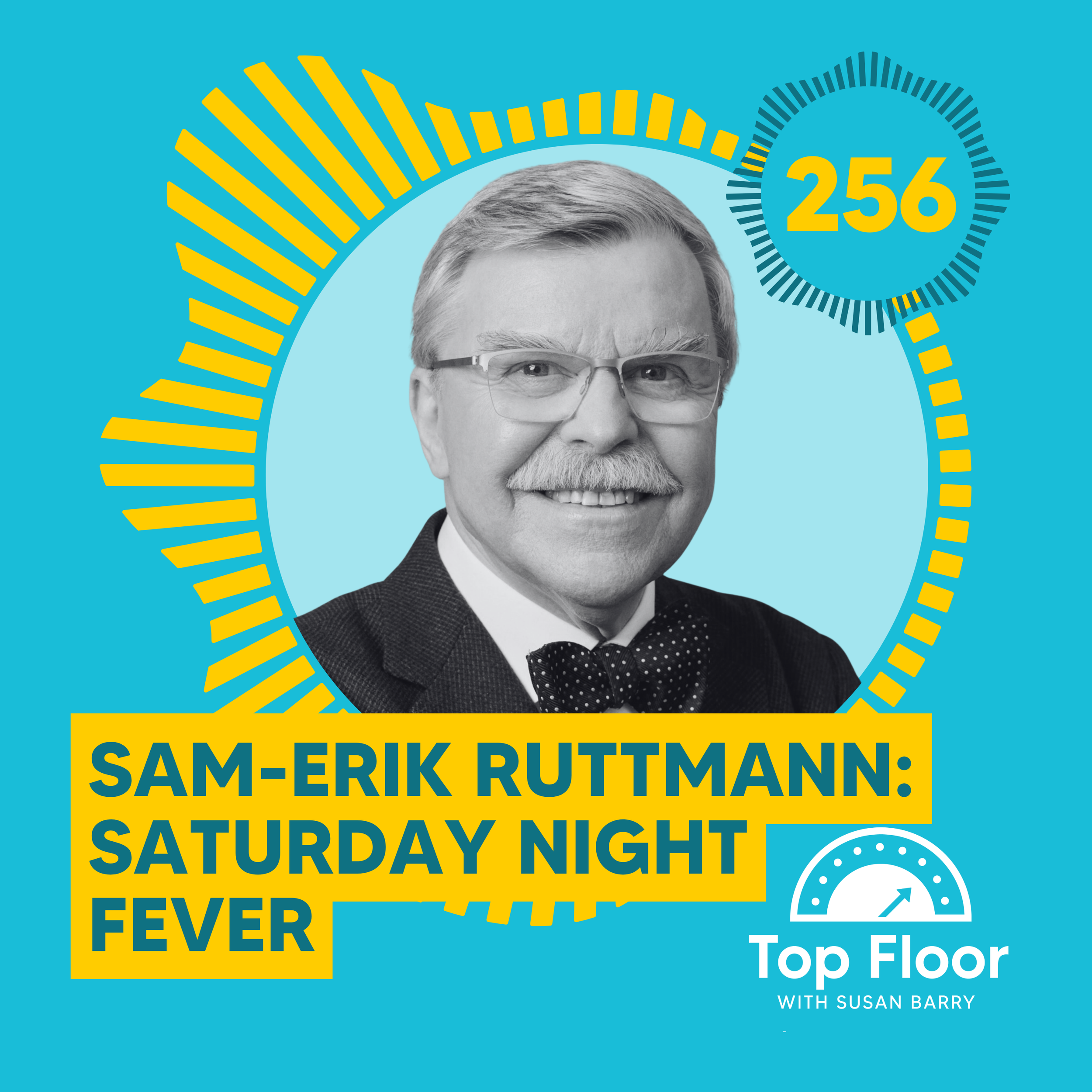
Transcript: Episode 256: Saturday Night Fever
LISTEN TO THE EPISODE:
APPLE PODCASTS | SPOTIFY | TOPFLOOR.COM
[00:00:00] Susan Barry: This is Top Floor with Susan Barry, episode 256. You can find the show notes at topfloorpodcast.com/episode/256.
[00:00:15] Narrator: Welcome to Top Floor with Susan Barry. This weekly podcast ride up to the top floor features tangible tips and excellent stories from the experts and characters who elevate hospitality. And now, your host and elevator operator, Susan Barry.
[00:00:32] Susan Barry: Welcome to the show. Sam Erick Rutman has spent decades in hospitality, working his way from a 24-hour shift hotel receptionist in a small Finnish town to regional leadership roles with Hyatt, Dusit International, and Langham Hospitality Group. Along the way, he has opened hotels on three continents, managed a resort through a tsunami, and built a career-long fascination with how differently hospitality looks depending on where in the world you are. These days, Sam channels that global perspective into hotel design, working with a Helsinki-based architecture studio built around a nature-first philosophy that plans a hotel around the land instead of clearing it first. He is also host of The Social Hotelier, a hospitality podcast that has reached listeners in more than 100 countries for six years. Today, we are going to talk about how hospitality has changed across countries and decades for better and for worse. But before we jump in, we need to answer the call button.
Call button rings…
The emergency call button is our hotline for hospitality professionals who have burning questions. If you would like to submit a question, you can call or text me at 850-404-9630. Today's question was submitted by Frankie. Frankie says, "I'm from the United States, and I want to work internationally. What is the best way to make myself attractive to international opportunities? Is one hotel department more desirable than others?" Oh, I love this question for you, Sam. What do you think?
[00:02:32] Sam-Erik Ruttmann: I love that question also because it's something I had to think about when I tried to look for jobs outside Finland. I think things have developed from the time I had to get started. But number one is that you have to be on LinkedIn. I mean, that's the number one platform. And also, number two, on any other social media platforms, you have to be very careful how you are presenting yourself. You have to present yourself very professionally, so they don't see two kinds of personalities, the goofy one and then the professional one. If you want to have a job, you have to stay very professional and focused, and then reach out to the kind of hotel companies that you would love to work for. You study them, you understand exactly what they are about, and then you try to set up an interview. Usually, it's online, and then if you really have a fortune, then you have a chance to meet them in person.
[00:03:34] Susan Barry: In your experience, have there ever been shortages of a certain type of hotelier? Like, for example, we're really having a hard time finding, I don't know, front office folks or salespeople. Do you know what I mean? Or is it more just you need to get in with the right company, and it doesn't really matter what, what kind of a hotelier you are?
[00:03:59] Sam-Erik Ruttmann: Over the years, it has changed. Initially, when I started, food and beverage was very important because it was seen as a very niche profession that has to balance a lot of aspects to make a department profitable. But then it went more into people who are marketing-oriented. Now, I see the shift to all-around managers, but also have to be comfortable in front of a camera, and also be able to articulate a unique story in front of a camera for a larger audience. So you have to be able to perform, and also that can be very uncomfortable for some hoteliers.
[00:04:40] Susan Barry: Yes, and even people who seem like they're comfortable might be a little bit uncomfortable. I know what you mean. That's really interesting to think about. I just cannot believe that this is true, but you started out working 24-hour shifts as a young receptionist in a hotel. How did you do that? 24 hours is crazy, Sam. How did you stay awake? How did that impact you over the years? Are you just, like, grateful that you don't have to do it anymore?
[00:05:17] Sam-Erik Ruttmann: Number one, grateful that I don't have to do it anymore, but it was a hotel I dreamed of working for, and it was a boutique hotel. It's called a boutique hotel these days. It was an old manor house outside Helsinki, so I had to take a bus to go to work. It was a one-hour ride. And they hired only four people at the reception, so we worked every four days, and naturally it was a 24-hour shift, so it was take it or leave it. But I thought that, when you’re young and you have lots of energy, I said, "Yeah, I'd like to do that. I want to work for the best hotel." And so that's what I did. But the thing is, what I learned a lot was about actually the hotel operation because in the reception I ended up taking reservations, checking in, parking the car for the guest, checking them out, or also providing them tips of what to do during their stay, so it was kind of a great learning experience. What kept me awake, number one, I was that during the night audit, I was not very good with numbers, and if I didn't balance and was off by a few cents, I had to stay at the hotel to make sure I balanced the books. And then it was a lot of coffee, believe me.
[00:06:37] Susan Barry: I bet it took a lot of coffee. So if you were doing the audit and you were off, did you start over again? Did you try to find your mistake? Like, if that wasn't your sort of natural forte, how did you find your way out of it?
[00:06:54] Sam-Erik Ruttmann: No, I started all over again, and I started to go through in detail. And then, because it was very quiet at night, I went outside the hotel for a walk to get some fresh air and to kind of wake up. And, yeah, that's the experience I remember, but I had a great time. It was the best learning experience for somebody like me at the start of my career.
[00:07:21] Susan Barry: Oh my gosh. The staying awake for 24 hours. I can barely stay awake for 12 hours, much less 24. Your career has taken you through so many wonderful places, so many countries: Finland, the United States, Kuwait, Russia, Thailand. That's just a handful of the many, many, many places that you've worked. Is there any one assignment or job in particular that changed how you thought about hospitality?
[00:07:53] Sam-Erik Ruttmann: Definitely. I mean, all of those places that you mentioned, they had a very strong impact on me personally and also career-wise. And one thing I'd like to mention is that early on in my career, after the US, I went to Indonesia. No, before that I went to Kuwait, and during that time I got married. So I have been blessed with a wife with me for 41 years, and we traveled the world together. And that makes a huge of a difference, because I felt that the job was very lonely at times when I was by myself, but now that I was married, I was with my wife. I also had something I could share with her. But actually, the place I really enjoyed was Thailand, and I spent 13 years in Thailand, initially in Bangkok. But what gave me the strongest impact was Dusit Laguna on Phuket Island. And it was an amazing hotel that, well, general managers changed every four years because we were on contract, but the staff stayed 15 years. Some of them had stayed 20 years. We had a hotel that had a 70% return guest ratio, so the staff relationship with guests was amazing. They were friendships. So the staff knew pretty much, and they knew how to anticipate what the guests needed because they'd been coming for years. And they knew what fruits to put in the welcome basket and what kind of food they liked to eat and so on. So the two staff were really in tune with the guests. And of course, it's the Thai hospitality that is famous for, and also one of the things that they haven't written down anything. So I thought, "Well, let's create a sort of a document of the culture of that place." So we called it the five senses. So one was relating to hearing. So, we had the gentle Thai music in the lobby, live music, vision, the interior, the staff in Thai silk uniforms, and then the smell. Every guest who arrived got a jasmine flower garland on arrival. So it gave sort of an anticipation of the place, and of course, the taste, the Thai food and fresh fruits. And then the magic of Thai massage. So all those things explain pretty much why people were coming back year after year. But I found out that the guests were very interested in what we were doing behind the scenes, and one of the things which I took a lot of interest in was how we could help the people in the community. And based on my staff's suggestion, we did some charitable work. And we adopted a school on the island of Khao Lak. People who know Khao Lak know it was the area that was deeply affected by the tsunami. But we were raising funds for this school, books, and computers. Every year went to do some annual maintenance work, painting. So that created sort of the team spirit for that hotel, and that was based on an initiative of our staff. And maybe the final comment I want to make was that I had the opportunity to develop a foundation there. And many of the guests liked to do elephant trekking on the island, which is very hilly. So an elephant is the most practical way to get around.
[00:11:19] Susan Barry: That's a sentence I've never heard anyone say before. "An elephant is the most practical way to get around." Anyway, sorry to interrupt you.
[00:11:27] Sam-Erik Ruttmann: And then, the elephants were from northern Thailand because they have stopped their teak wood development over there. So a lot of unemployed elephants. So there were people renting or leasing elephants to bring them to Phuket, and then they rented a piece of land. Sometimes the land was not in a very good location, might be on the hill, and these camps were actually not in a very good condition. So sometimes the waste from the elephants ended up in the villages. So it created a lot of problems. So I was contacted by the guest asking me, "You have to go and take a look at this. It is a disaster. How can they treat elephants like this?" And the villages are in trouble. So I went to look at a few camps, and as a result, eventually it developed into an idea that we want to recruit a full-time veterinarian who understood the elephants. One of those things that you don't know, probably I know, and I didn't know, was that one of the biggest things is that elephants have ingrown toenails. Now you can imagine having to walk around with those ingrown toenails. So we collected money to buy a Jeep, hired a veterinarian, and he was actually going on different camps to look after the elephants who were in need, whether they had infections and so on. And as a result, there was a travel journalist who heard about us, and she came to visit, and she then wrote a piece about this Elephant Health Foundation that I was part of forming with someone. And it became a very interesting piece for the Travel Writers Association in London, and they voted this foundation as the best overseas project award in the year 2000. So I was thrilled, on behalf of the foundation and the staff who were involved in this, to collect the project award.
[00:13:29] Susan Barry: That is unbelievable. I could talk to you from now until Christmas because of all of the stories that you have. I'm curious, though, jumping ahead after decades in hotel operations roles, what drew you to what you're doing now, hotel design and sort of conceptualization?
[00:13:53] Sam-Erik Ruttmann: Well, after 30 years of working internationally, we returned to Finland, and I needed to reestablish myself. All my contacts were international. All my work had been in an international arena. I knew very little about the Finnish situation. And usually, when I contacted the developers and contractors and so on, they asked me, "Well, what have you done in Finland?" I said, "I worked in this little hotel a long time ago. 24 hours a day.” Well, not interesting. Okay. Well, how about Phuket or Bali? No, we cannot relate to that. So to cut a long story short, I wrote a blog once about how I saw the future of hospitality in Finland, and the largest daily newspaper picked up on this story, and it was read by a developer who hired me to develop a project with him. And I met a couple who are from the architectural firm. We kind of understood each other very well and had a similar mindset. And as a result, they asked me to join them, and that was seven years ago. So I'm part of the team now of that architectural firm, providing that hospitality angle to development and brand search.
[00:15:15] Susan Barry: And is part of your job to sort of pressure test design to make sure that it's operationally feasible, or is it more highfalutin than that?
[00:15:28] Sam-Erik Ruttmann: No, initially what we do when there is a developer or owner who wants to develop a hotel, we have a workshop. So we go to the site, and the architects will walk the site. The architects want to see what can be done over there. The question is, we always ask, "Should we build something here or should we not?" Because in the days I started, we always cleared the site of all the trees and then started from scratch. And then when you open the hotel eventually, it takes 15 years for it to grow back. So our philosophy was that we don't cut any trees. We will try to build around things. And what I did, I was look at it from the conceptual point of view and provide input on ideas on how to make this place a very interesting destination for travelers to come. We are partly creating a destination. Most of the destinations were isolated, so we were just working with the ideas of how to do something. And my role was in conceptual level was to look at what kind of hotel, and should we make a hotel building or individual units. The check-in experience would be so that you're actually arriving into a story and to a destination, not to a sanitized hotel lobby, which you end up in many places. You don't really know where you arrived, even in a resort. So yeah, those were things. And then, eventually doing operator search. But when we did build a prototype hotel room or unit, that's where I sat in the bathtub looking at how things look and just get the feeling of things.
[00:17:12] Susan Barry: I think that sounds like a fun job. I think I would be good at that. Yeah. I have to bring the short person's perspective because they always put the hooks too high for me or, like, the shower heads, the mirrors, all of that stuff. Working across so many countries and cultures, what do you think is a change in the hospitality industry over the years that you would genuinely call an improvement? And it can't be the lack of 24-hour shifts. That is not allowed.
[00:17:45] Sam-Erik Ruttmann: My answer is I see more women in leadership positions, which I think is a huge positive because my first boss, the owner of the hotel, was a woman, and I had a lot of time for her because she had a very high emotional intelligence. She recognized the guests, employees, and everyone. And when I worked internationally, I saw that the majority were male, the GMs were male, and you had secretaries who were women. Maybe the sales manager, a woman. But that's it. But now I see a shift, which is a very positive shift, that women are rising now to leadership positions, not only on the unit level but also on the corporate level, which I think is a wonderful development. And I think maybe the best leadership teams are both women and men 'cause they can combine diverse perspectives and complementary strengths. So yeah, success depends on people, culture, and service. You need to have someone who has that emotional intelligence to deal with all that. So yeah, that's the reason for my more women in leadership positions.
[00:18:59] Susan Barry: I love it. I couldn't agree more. What about the flip side? What is a change you've seen that you think has made hospitality a little worse or maybe less special?
[00:19:11] Sam-Erik Ruttmann: Well, I'm not gonna use the AI's answer to this, but I would say that the flip side is hotels that are calling themselves sustainable and environmentally friendly, and they're reducing the turndown service, fewer towels in the bathroom as an excuse to save costs. Sustainability is for most hotels a goal. And once accomplished, their goal is to be regenerative. I really haven't seen until today a hotel that is truly sustainable. I mean, for all the listeners and viewers, if you say that you're sustainable, call me. I want to find out, 'cause I really want to see what it's all about. Because sustainability asks, "How do we reduce our negative impact?" And regeneration asks, "How do we create a net positive impact?" And we are still far away from regeneration.
[00:19:56] Susan Barry: Well, speaking of that, I know at least in your firm, design is shifting toward more environmental consciousness, nature-first thinking. How do you think that will reshape guest expectations or what they think is going to happen on a stay?
[00:20:18] Sam-Erik Ruttmann: Well, one of the ideas is that when you arrive at a destination, being able to embrace and learn from local culture, and you're taking long walks with a guide and learning about the nature. There are some great resorts, for instance, in Malaysia. They have nature walks, and they are next to a rainforest. So that's a reason why people actually are going there, and they are attracted to that opportunity. And so that's one of the things that I see that when we are designing resorts that are nature-driven, you actually are creating a destination. It's like an operatic experience. The opera starts with the overture, and then it gets to a very crescendo, and there may be some drama there, and then there's a happy ending. And I see a great experience in a wilderness resort or whatnot is a perfect example of how environmental consciousness is a way to get us moving forward.
[00:21:18] Susan Barry: We like to make sure that our listeners come away from every episode of Top Floor with some practical and tangible tips to try either in their businesses, their hotels, or in their lives. For hoteliers moving into an international market for the first time, what is a piece of advice you'd give about adapting to local business culture?
[00:21:44] Sam-Erik Ruttmann: Number one, what I did was I always make sure I develop a local contact, a person who can develop a relationship and then test if that relationship is trustworthy. And then, over time, with that relationship, it helped me to avoid any typical mistakes that a new person can end up. And also being very curious and understanding the culture. Whenever I was traveling to a new place, I read up on books about business culture and business ethics. For example, if you go to the Middle East, you are meeting your decision-makers over a cup of coffee in the hotel lobby. You don't meet them in their office many times. And there are a lot of coffees that you have before you even get the deal out of that. And there is, then in other parts of the world, it's that if you're in Northern Europe, it's cutthroat. It's just, "Well, what's the price or what's the deal?" And you move on very quickly. So it's being sensitive to finding out and understanding where you're going and getting to know somebody locally who can be your guide and trust them, at least in the beginning.
[00:23:05] Susan Barry: Has there ever been a business culture that was particularly difficult for you to acclimate to? I mean, this is gonna sound like a strange thing to say, but I feel like people from the Southeast United States and people from New England in the United States have very different approaches to sort of personal interaction and stuff like that. So there's, to me, always a lot of friction in those types of business relationships. I'm wondering if there's something like that that you encountered.
[00:23:39] Sam-Erik Ruttmann: No, I didn't, because I wanted to make sure that I get to know somebody first, and also, I took time to study as much as possible where I was going. And of course, when I joined the hotel, or I was setting up the regional office in Dubai, I had to make sure that I got to know people who were not expatriates, but the nationals, meaning the locals. And developing that relationship was crucial. Of course, there were challenges because you have cultural misunderstandings, but you have to be humble, listen very carefully, and try to learn your lessons because, without a doubt, you will make some mistakes along the way. But as long as you can apologize and hopefully move on, then things will be all right. And plus, I mentioned earlier that my wife has been with me since I traveled, so I've been very blessed with that.
[00:24:39] Susan Barry: She's your extra help, an extra set of hands in terms of not getting in trouble in the local business community. When you are conceptualizing a new hotel with the architecture team, is there a first question that you're asking to make sure that the design is about the guest versus, like, looking good in photos? Do you know what I mean? Is there a place to start, or is it just hope for the best?
[00:25:12] Sam-Erik Ruttmann: No. When we are conceptualizing a new hotel, in that first meeting, they need to clearly articulate the vision for their project and who they are, who they aim to serve. There are cases where we had developers who have been to an ultra-luxury hotel in Paris and say, "Well, this is a six-star hotel, and I want to have my hotel." I say, "Well, okay, that's a very interesting idea, but we have to now see how it fits into this destination." So we are trying to be not diplomatic, but kind of realistic with them about what the location can do. So we talk about those things. And also I advise those owners to simply underwrite every decision through the eyes of a guest. It creates a better guest experience eventually, and it usually creates better business. So if you want to have that particular style of hotel at that category, you have to build the service so that it actually fits what people are expecting to have.
[00:26:17] Susan Barry: Yes. What is a small, easy-to-miss detail that you think makes an outsized difference in how a guest feels about their stay?
[00:26:28] Sam-Erik Ruttmann: Well, two things. When I arrive at a new place, I look at the lobby. And if the hotel lobby has no sense of what I call, maybe it's a cliché, a sense of place, but actually not part of the story or the destination. I think that is a thing that needs to really be reconsidered because there are more hotel lobbies that don't give you the impression that you have arrived. Also, the arrival experience starts before you arrive at the hotel. The best example was when I went to visit an Aman Hotel in Phuket. You're driving up a kind of small dirt road, almost, and you have bamboo forest on both sides. And once you get over the hill, then you see the Aman resort and the sea in the background. I mean, I still remember that after all these years. Why it makes a difference. So, the arrival experience in the hotel lobby. But then in the room, you mentioned them already, the mirrors, the hooks, and lighting. I'm very sensitive about. The lighting has to be really perfect for a hotel room so in the middle of the night, when you need to get up, you don't get the nightlight directly in your eyes. And one thing I noticed over the years is that, in projects, when you have budget issues, the first thing that goes is the lighting designer's job is canceled. And that explains the reason why it has not been thought of, because the lighting design makes a world of difference to illuminate, obviously, the place with a nice contrast. And also to make sure that those small details in a hotel room actually work, because nothing is worse when you're in a room, but you have some strong lights in your eyes because it's not the environment. The hotel room should be calm and so on.
[00:28:23] Susan Barry: Yes. You should be able to sleep better in a hotel than you can sleep at home. That's my opinion. Because it's completely dark and freezing cold. That's the perfect way to get a wonderful night's sleep.
[00:28:37] Sam-Erik Ruttmann: So you probably ask me, where is the best hotel that had the best light switches? Dating back to years in the '90s, I went to the Peninsula in New York. Okay, shout out to the Peninsula because they had their act together. The best lights in the room, in the sense of dimmers and so on. You could hardly see them in the nighttime, but they were easy to recognize, and what they were for, so you don't have to guess what the purpose of them is. Nothing is nicer than or worse than you are in the middle of the night, you accidentally turn on the head, all the lights, then you wake up your wife or partner, and so on. So yeah, I think they did a terrific job already at that time.
[00:29:22] Susan Barry: I think that the funniest memes about hotels are about people not able to figure out how to turn the lights on and off. Like it is such a problem, so I'm glad to hear you say that. We have reached the fortune-telling portion of our show, so now you have to predict the future, and we will see if you got it right. Easy question. What's a prediction you have about the future of global hospitality? No big deal.
[00:29:55] Sam-Erik Ruttmann: The future of global hospitality is still growing, and people enjoy traveling, but I think they will see countries like Africa growing as a continent. There are so many young new workforces that are eager to learn and advance in hospitality careers, and many hotel companies have been shy to go there because they think it's too risky. But I think it's a beautiful part of the world that will be growing tremendously. But also the climate situation, the climate warming. We noticed the most pleasant temperatures here in Finland this summer, where Central Europe and Southern Europe and you're having over 115 degrees Fahrenheit, and we are in the 60s or 70s. It makes a world of difference in the summer, and we notice that people are coming on their, what we call the summer holiday, to Northern Europe, to Norway, Sweden, and Finland now. So, I think that might be something to think about because we're not gonna have these cool summers in Central Europe again. It's gonna be more of what we have seen. So, but I think that the future is bright. I mean, people enjoy traveling. They will enjoy traveling for various reasons, and they will enjoy taking long trips and maybe staying for 30 days in the same place and learning about the place rather than hopping city for two weeks in a different city every two days. And they don't really learn anything except they took a picture of a place.
[00:31:34] Susan Barry: Is there anywhere that you haven't visited that you wanna visit?
[00:31:38] Sam-Erik Ruttmann: I think Central and South America I haven't been to before. I love to visit those.
[00:31:43] Susan Barry: Excellent. All right. If you could wave a magic wand and change one thing about how hotels are designed today, what would that be?
[00:31:54] Sam-Erik Ruttmann: That was a question I was thinking. I was staying up most of the night because I was thinking, "How can I answer this question?" And too many hotels feel, like, disconnected from landscape or culture and ecology. And I think the hotels, the hospitality, should be deep in the guest connection to place rather than isolate them from it. So I would like to see more destination design around the natural environment, local materials, and authentic experience so that the guest leaves feeling closer to nature and the community they are visiting. Ultimately, I think the future of hospitality is not about building bigger and bigger resorts, but creating more meaningful experiences with a lighter footprint and stronger sense of place.
[00:32:37] Susan Barry: I certainly hope so. Well, Sam, before we tell you goodbye, we are going to head down to the loading dock where all of the best stories get told.
Elevator voice announces, “Going down.
[00:32:52] Susan Barry: Sam, what is a story you would only tell on the loading dock?
[00:32:57] Sam-Erik Ruttmann: Well, it's only between you and me this story. I was working in Finland before for a while, and I was returning from a business trip from Germany, and on the plane in front of me, I saw a personality there. He looked kind of familiar. I think I've seen him before. I knew who he was. And then, when we landed, I just introduced myself, and let's call him John for the sake of argument here. And so, I asked John, "So, are you visiting here for the first time?" "Yeah, I'm here just a few days." And so I said, "Well, I'm living in Helsinki, so I'm happy to give you a ride to the hotel. Where are you staying?" So he mentioned the hotel where I was working at the Intercontinental. So I took him to the hotel, helped him to check in, and I realized that they didn't have his name and that he was not the person I thought he was, so it was quite interesting. But, in any case, we kept in touch for a few days, and I helped him to organize a helicopter sightseeing tour of the city, and we had a few lunches together. And then, he went to a concert. At that time, it was Chick Corea, who was performing, a jazz artist. And then, he asked me whether I'd like to join. I said, "Well, I'm afraid I cannot." But I said, "Well, what are you doing Saturday night?" "Well, I have no plans." "Well, how about coming over for dinner to our place?" So, we arranged with my wife to have some food. And in fact, I called a few friends, and they were all busy. They had no time to join, so there were only three of us having dinner together. We had a great time. And then, after dinner, we went back. I took him back to the hotel, and I showed him the Helsinki tabloid that was asking the big question: What did John Travolta do on Saturday? What was the Saturday night fever John Travolta was involved with? And he was having dinner with my wife and me.
[00:34:58] Susan Barry: Oh, my gosh, that is who it was. You thought this was someone like you knew from business, and instead it was John Travolta that you were just whisking around the city and having over for dinner. That is insane.
[00:35:15] Sam-Erik Ruttmann: Yes. So that's my story for you.
[00:35:17] Susan Barry: Oh, my gosh. Sam Ruttmann, thank you so much for being here. I know that our listeners are basking in the glamour of your history, and I really appreciate you riding with us to the Top Floor.
[00:35:32] Sam-Erik Ruttmann: Thank you. It was my pleasure.
[00:35:35] Susan Barry: Thanks so much for listening. Thank you for listening. You can find the show notes at topfloorpodcast.com/episode/256. Jonathan Albano is our editor, producer, and all-around genius. He even wrote and performed our theme song with vocals by Cameron Albano. You can subscribe to Top Floor on Apple Podcasts, Spotify, or wherever you like to listen, and your rating or review will go a long way in helping us give you more of what you like.
[00:36:10] Narrator: Thanks for listening to the Top Floor podcast at www.topfloorpodcast.com. Have a hospitality marketing question? Reach us at 850-404-9630 to be featured in a future episode.